
For years, artificial intelligence was something trapped behind a glass screen. You talked to a chatbot, generated an image, or asked a virtual assistant to set a timer. But as we move through 2026 the Top Physical AI Gadgets , paradigm has shifted. We are now living in the era of “Ambient AI,” where intelligence follows you through the physical world.
The market is currently flooded with hardware designed to make AI tangible. However, not every device is a winner. If you are looking to upgrade your tech stack, you need to know which Top Physical AI Gadgets are actually delivering on their promises and which are just expensive paperweights.
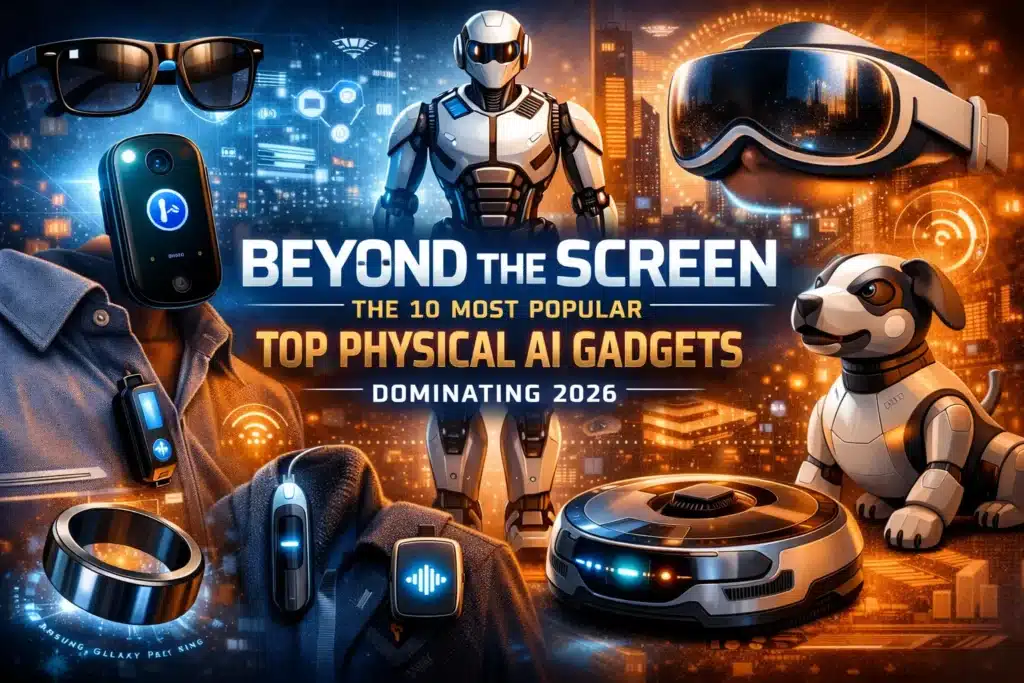
In this guide, we will break down the elite performers in the hardware space, from AI wearables and smart rings to humanoid robots and next-generation assistants.
Table of Contents
The Evolution of AI Hardware
The transition from software-only AI to Top Physical AI Gadgets happened faster than most analysts predicted. It started with simple smart speakers, but today’s devices use advanced edge computing and multimodal LLMs to see, hear, and interact with the environment in real time.
When we talk about the most popular Top Physical AI Gadgets, we are not just talking about phones with AI features. We are talking about dedicated silicon built to run neural networks natively, reducing latency and making interactions feel more natural.
Another reason for the rise of AI hardware is that users are becoming tired of opening endless apps. Consumers increasingly want AI that is proactive instead of reactive. Rather than typing into a search bar, people now expect their devices to understand voice, vision, location, and context instantly.
The biggest winners in this category are devices that blend naturally into daily life. If a gadget feels awkward, bulky, or socially uncomfortable, adoption slows down. That is why lightweight wearables, pendants, smart rings, and discreet assistants are dominating the market.
Also Read : 10 Revolutionary AI Games 2026: Experience Next-Gen Intelligent Gaming That Will Blow Your Mind
1. Meta Ray-Ban Supernova Edition
The collaboration between Meta and Ray-Ban remains the gold standard for wearable AI. Unlike the clunky headsets of the past, these look like classic Wayfarers but pack a serious punch. As one of the top physical AI gadgets on the market, the Supernova edition features “Look and Tell” capabilities that allow the AI to identify landmarks, translate menus in real time, and even give fashion advice based on what you are wearing.
Why it is popular: It is socially acceptable. You do not look like a cyborg; you look like a person wearing stylish sunglasses.
Key feature: Multimodal AI that uses the built-in camera to provide audio feedback through open-ear speakers.
Meta has continued to push the category forward with new prescription-friendly models and more comfortable frame designs. Recent updates added interchangeable nose pads, better hinge durability, and improved AI-powered navigation. Meta already controls most of the smart glasses market, making it the dominant player in consumer AI eyewear.
If you want a wearable that feels futuristic without looking strange, the Ray-Ban line remains unmatched. You can explore the latest models on Meta Ray-Ban Smart Glasses.
2. Rabbit R2: The Pocket Companion
Following the viral but polarizing launch of the R1, the Rabbit R2 fixed the battery issues and connectivity lag of its predecessor. It stands out among Top Physical AI Gadgets because of its “Large Action Model” (LAM). Instead of just giving you information, the R2 actually performs tasks like booking flights, ordering groceries, and managing emails without opening a single app.
Rabbit’s biggest improvement is that the new version feels more reliable. The updated processor reduces lag dramatically, while the larger battery makes it practical for all-day use. The device now integrates natively with more than 100 popular apps, making it far more useful than the original version.
The Rabbit R2 also adds a physical privacy switch for the microphone and camera, which addresses one of the biggest complaints users had with the first generation. Early adopters especially like how the device acts as a dedicated assistant instead of trying to replace a smartphone entirely.
If you want to see the latest Rabbit updates and availability, visit Rabbit Official Website.
3. Figure 02 Humanoid Home Assistant
2026 is officially the year the humanoid robot entered the home. Figure, in partnership with OpenAI in its earlier development phase, released the Figure 02, which has quickly become one of the most discussed Top Physical AI Gadgets.
While expensive, its ability to fold laundry, organize kitchens, sort packages, and engage in natural spoken conversation makes it a breakthrough in domestic robotics.
Figure 02 combines natural language, vision, and physical movement in a way that very few robots can match. The robot can understand spoken commands, identify objects around it, and carry out tasks without constant supervision. Recent demonstrations showed it loading dishwashers, folding laundry, and cleaning living rooms autonomously.
The humanoid robotics space is also heating up quickly, with China, Tesla, and other startups pushing similar products into the market. Experts still believe the category is in its early stages, but Figure is currently one of the leaders in practical home robotics.
You can read more about the robot on Figure AI Official Website.
https://youtube.com/watch?v=42Uemd92b3E%3Frel%3D0%26playsinline%3D1%26origin%3Dhttps%253A%252F%252Fchatgpt.com%26enablejsapi%3D1%26widgetid%3D1%26forigin%3Dhttps%253A%252F%252Fchatgpt.com%252Fc%252F69e360ec-0a2c-83e8-92cb-a8d093c1956a%26aoriginsup%3D1%26vf%3D1
4. Limitless Pendant
For professionals, the Limitless Pendant is the MVP of Top Physical AI Gadgets. This small clip-on device records your day, summarizes meetings, reminds you about promises you made, and drafts follow-up emails.
It is essentially a second brain that ensures you never forget important details. For busy founders, managers, salespeople, and students, this kind of AI memory assistant can save hours every week.
The rise of wearable productivity tools shows that people increasingly want AI that works quietly in the background. Instead of replacing human memory entirely, these gadgets help reduce mental overload by surfacing useful information when you need it most.
The biggest selling point of the Limitless Pendant is that it turns scattered conversations into searchable knowledge. If you forgot what someone said in a meeting two days ago, the device can quickly surface it for you.
You can learn more through Limitless AI Official Website.
5. Apple Vision Pro 2
While technically a spatial computer, the Vision Pro 2 is heavily marketed as one of the flagship Top Physical AI Gadgets. Apple has integrated Apple Intelligence deeply into the operating system, allowing the headset to understand your physical surroundings and overlay helpful information in real time.
Imagine looking at a broken sink and instantly seeing repair instructions floating in front of you. Or imagine architects working with full-scale 3D building models in mixed reality. That is the future Apple is building.
The Vision Pro 2 is also one of the strongest examples of “AI as interface.” Instead of clicking buttons, you interact with your eyes, voice, and hands. This makes computing feel more immersive and less dependent on traditional screens.
Although battery life remains a weak point, the overall experience is still among the most advanced in consumer hardware. The Vision Pro 2 is expensive, but for professionals and enthusiasts, it delivers one of the most futuristic experiences available today.
Visit Apple Vision Pro Official Page for more details.
Comparison of the Year’s Top Physical AI Gadgets
| Product Name | Category | Primary AI Use Case | Battery Life | Price Point |
|---|---|---|---|---|
| Meta Ray-Ban | Wearable | Visual Search & Translation | 6–8 Hours | $299–$499 |
| Rabbit R2 | Handheld | Task Automation | 24 Hours | $249 |
| Figure 02 | Robotics | Home Chores & Companionship | 5 Hours | $15,000+ |
| Limitless Pendant | Wearable | Productivity & Memory | 48 Hours | $99 + Subscription |
| Vision Pro 2 | Spatial Computing | Immersive Work & AI Overlay | 2.5 Hours | $2,999 |
Why “AI-First” Hardware is Winning
Many skeptics ask, “Why do I need Top Physical AI Gadgets when I already have a smartphone?” The answer lies in the interface.
Smartphones are app-centric. You unlock the device, search for an app, tap through menus, and eventually get what you want. AI-first gadgets remove all of that friction by focusing on intent rather than navigation.
For example, asking your AI device to “book tickets for the 5 PM movie” is far quicker than opening a cinema app, searching manually, and checking out. That small convenience becomes powerful when repeated dozens of times per day.
Consumers are also becoming more comfortable with voice-based interaction. As speech recognition improves and AI gets better at understanding context, the need for screens becomes smaller in many situations.
This is why the physical AI market is growing so quickly. Devices that save even a few seconds per task can become deeply valuable over time.
The Role of Privacy in AI Gadgets
One of the biggest hurdles for Top Physical AI Gadgets is the always-on nature of their microphones and cameras. Consumers are naturally cautious about devices that can see, hear, and record their surroundings.
That is why privacy features are becoming a major selling point. Companies are increasingly relying on on-device processing so sensitive information does not need to be sent to the cloud.
Physical kill switches, recording lights, and permission-based recording systems are also becoming more common. Devices like Rabbit R2 specifically added hardware privacy controls after feedback from early users.
When shopping for physical AI gadgets, always check how your data is stored, whether the device processes information locally, and whether you can control what gets recorded.
Check Out : Jaibir Nihal Singh Net Worth 2026: TraqCheck Founder’s Wealth & Success Story
6. Samsung Galaxy Ring (Gen 3)
Samsung has turned the humble smart ring into one of the Top Physical AI Gadgets for health enthusiasts. The Gen 3 model uses AI to predict illness before you feel symptoms by analyzing micro-fluctuations in heart rate, skin temperature, and sleep quality.
Rather than simply tracking your data, the ring provides AI coaching to tell you exactly how to recover better, sleep more effectively, and improve your overall routine.
Smart rings are becoming popular because they are discreet and easy to wear all day. Unlike smartwatches, they do not feel bulky or distracting, making them ideal for users who want passive health tracking.
The Samsung Galaxy Ring also benefits from integration with the broader Samsung ecosystem. Your ring can sync with your phone, earbuds, smartwatch, and home devices, creating a connected AI health experience.
Visit Samsung Galaxy Ring Official Page for more information.
7. Sony Aibo Evolution (2026)
Sony has refreshed its robotic dog line, making it one of the most beloved Top Physical AI Gadgets for families. The new Aibo uses a specialized LLM that allows it to learn individual family members’ personalities and react uniquely to them.
It is no longer just a toy. It feels more like an emotionally intelligent companion that remembers routines, recognizes faces, and responds differently depending on the user.
One of the most interesting parts of Aibo is that it becomes more personalized over time. The robot develops unique habits and behaviors based on how people interact with it.
For families that want companionship without the responsibilities of a real pet, Sony Aibo offers a surprisingly advanced and emotionally engaging experience.
You can check it out at Sony Aibo Official Website.
8. Plaud NotePin
Successor to the popular Plaud Note, the NotePin is one of the more affordable Top Physical AI Gadgets. It is a wearable recorder that uses advanced AI to transcribe and summarize lectures, interviews, and meetings with impressive accuracy.
For students, journalists, and professionals, it removes the need to take endless handwritten notes. Instead, you can focus on the conversation and let the AI organize everything afterward.
The device is especially useful in fast-paced environments like classrooms, press events, and brainstorming sessions. Rather than scrambling to remember every detail, users can rely on searchable summaries and transcripts.
Because of its low price compared to more advanced wearables, the Plaud NotePin has become one of the easiest entry points into the world of AI hardware.
Visit Plaud Official Website to learn more.
9. Humane Ai Pin 2
After a rocky start in 2024, Humane returned with the Ai Pin 2. By shrinking the hardware and improving the laser display, they secured a place among the Top Physical AI Gadgets.
It is designed for minimalists who want to leave their phone at home but still stay connected to a powerful AI assistant through a small wearable pin.
The newer version improves battery life, voice recognition, and overall responsiveness. Humane has also focused heavily on making the device more fashionable and less awkward to wear in public.
While it still is not a true smartphone replacement, it comes much closer than the original version. For people who hate carrying large devices in their pocket, the Ai Pin 2 offers an appealing alternative.
You can visit Humane Official Website for updates.
10. Dyson CleanBot AI
Dyson’s entry into the Top Physical AI Gadgets market is not just another robot vacuum. The CleanBot uses computer vision to identify different types of floor debris, distinguishing between spilled cereal, pet hair, and even valuable objects like jewelry.
This means it can automatically adjust suction, cleaning patterns, and movement depending on what it sees.
One of the most impressive features is that the robot can send alerts to your phone if it finds something unusual on the floor. If it notices an earring, coin, or lost item, it can notify you instead of vacuuming it up.
As AI becomes more advanced, even basic household gadgets are becoming smarter and more personalized. Dyson’s CleanBot is a strong example of how AI can improve everyday chores without requiring constant supervision.
Visit Dyson Official Website for product information.
How to Choose the Right Top Physical AI Gadgets for You
Before spending hundreds or thousands of dollars, think about your main goal.
If you care most about productivity, the Limitless Pendant and Plaud NotePin are strong options. If you travel often, Meta Ray-Bans and Rabbit R2 are more practical. If your focus is home automation, Figure 02 and Dyson CleanBot stand out.
It is also important to think about long-term costs. Many AI gadgets require subscriptions for cloud processing, premium features, or expanded storage. A cheap device can quickly become expensive if it requires a monthly fee.
You should also consider how well the device fits into your current ecosystem. Apple users may prefer Vision Pro 2, while Samsung users may get more value from the Galaxy Ring.
Conclusion
The era of Top Physical AI Gadgets is just beginning. While smartphones are not dead yet, these specialized devices are carving out a major niche by offering more natural, hands-free ways to interact with intelligence.
Whether you want to boost your productivity with a wearable, improve your health with a smart ring, or transform your home with a humanoid robot, the Top Physical AI Gadgets of 2026 are already changing how people live and work.
Expect even deeper integration in the coming years. Your glasses may talk to your ring, your ring may talk to your robot, and your robot may start the coffee maker because it knows you slept poorly.
The future of AI is no longer trapped inside a screen. It is now wearable, portable, and living right beside you.
Read : Jeff Bezos Project Promentheus and our AI Products Page for more stuff!