
If you’ve been sitting on the fence about upgrading from the free tier, you’re not alone. The debate around ChatGPT vs ChatGPT Plus has been going on since OpenAI introduced its paid subscription — but in 2026, the gap between the two tiers has grown significantly. Features that were once experimental are now mature, reliable, and deeply integrated into how millions of people work, study, and create.
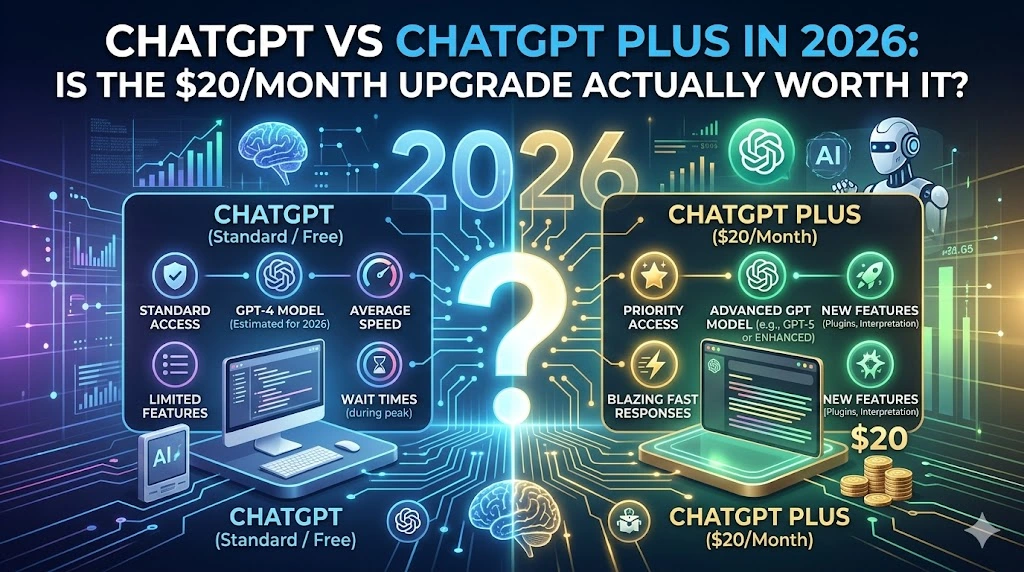
This guide breaks down everything you need to know about ChatGPT vs ChatGPT Plus — what you get, what you miss, who should upgrade, and whether twenty dollars a month actually delivers twenty dollars of value.
Table of Contents
What Is ChatGPT Free? A Quick Refresher
The free version of ChatGPT still gets you access to one of the most capable AI assistants on the internet — at no cost. In 2026, free users can access GPT-4o mini for standard conversations, use limited features like basic browsing and simple file uploads, and interact with the model in over 50 languages.
That’s genuinely impressive for a free product. However, the free tier has always come with a ceiling. Usage limits kick in during high-traffic periods, access to the latest model is throttled, and some of the most useful tools — like advanced data analysis, longer context windows, and custom GPTs — are either locked or heavily restricted.
For casual users who need help drafting an occasional email or brainstorming ideas, free ChatGPT may be enough. But anyone relying on it professionally quickly bumps into those walls.
What Does ChatGPT Plus Give You?
ChatGPT Plus is OpenAI’s $20/month subscription tier. In 2026, it comes loaded with features that have matured considerably from their early days. Here’s what Plus subscribers get that free users don’t:
- Priority access to GPT-4o — the full model, not the mini version, with higher message limits
- Advanced data analysis — upload spreadsheets, PDFs, and complex documents for deep analysis
- Image generation via DALL·E — integrated directly into the chat interface
- Voice mode — real-time, natural voice conversations with emotional tone recognition
- Custom GPTs — build and use specialized AI assistants tailored to your workflow
- Canvas mode — a collaborative writing and coding workspace inside the chat
- Longer context windows — handle much larger documents and longer conversation threads
- Faster response times — particularly noticeable during peak usage hours
- Early access to new features — Plus users are typically first in line for beta capabilities
The ChatGPT vs ChatGPT Plus comparison isn’t really about “AI vs better AI” — it’s about capability limits and workflow depth.
Also Read : How to Use ChatGPT in 2026 the Right Way (Most People Are Doing It Wrong)
ChatGPT vs ChatGPT Plus: Full Feature Comparison Table
| Feature | ChatGPT Free | ChatGPT Plus ($20/month) |
|---|---|---|
| Model Access | GPT-4o mini (limited) | GPT-4o full (priority) |
| Message Limits | Capped, throttled at peak | Much higher limits |
| Image Generation | Not available | ✅ DALL·E integrated |
| Voice Mode | Basic | Advanced, real-time |
| Data Analysis | Limited | ✅ Full advanced analysis |
| File Uploads | Very limited | ✅ PDFs, Excel, images |
| Custom GPTs | View only | ✅ Build and use |
| Canvas Mode | ❌ | ✅ Full access |
| Context Window | Shorter | Longer (128k+) |
| Browsing | Limited | ✅ Reliable web search |
| Response Speed | Slower at peak hours | Priority queue |
| Early Feature Access | ❌ | ✅ Beta features |
| Memory Feature | Basic | ✅ Persistent memory |
| Price | Free | $20/month |
This table alone tells a lot of the ChatGPT vs ChatGPT Plus story. The gap in usable features is real and significant.
Who Should Stick With the Free Plan?
Let’s be fair here. Not everyone needs ChatGPT Plus. The free plan in 2026 is genuinely functional for:
Students with light usage needs — if you’re using ChatGPT to understand a concept, summarize a chapter, or get feedback on a paragraph a few times a week, the free tier handles this without issue.
Casual experimenters — curious about AI but not integrating it into daily work? Free is fine. You’ll get a real sense of what the model can do.
Infrequent writers — the occasional blog post draft or email rewrite doesn’t require a subscription.
People on a tight budget — twenty dollars a month isn’t life-changing for everyone, but if you’re not using it enough to justify the cost, there’s no shame in staying free.
The honest take on ChatGPT vs ChatGPT Plus for casual users: the free version is good, but “good” has its limits.
Who Should Upgrade to ChatGPT Plus?
This is where the ChatGPT vs ChatGPT Plus conversation gets interesting — because the upgrade pays for itself faster than most people expect, once you’re using it regularly.
Freelancers and content creators — If you’re writing articles, scripts, social captions, or product descriptions daily, the speed, quality, and file-handling capabilities of Plus directly impact your output and income. The Canvas feature alone can cut editing time significantly.
Developers and coders — Advanced code interpretation, longer context windows for reviewing entire codebases, and better debugging conversations make Plus substantially more valuable for anyone writing software professionally. You can also explore GitHub Copilot’s comparison page to see how AI coding tools stack up broadly.
Analysts and researchers — Uploading large datasets, PDFs, and research documents for deep analysis is a genuine time-saver. What would take hours manually can be extracted, summarized, and cross-referenced in minutes.
Business owners and marketers — Custom GPTs that are trained on your brand voice, product catalog, or FAQ documents can act as on-demand assistants. This is one of the most underrated features in the ChatGPT vs ChatGPT Plus comparison.
Power users who hit limits often — If you’ve ever seen the “you’ve reached your limit” message on free ChatGPT during a crunch, that frustration alone may justify the upgrade.
For a broader view of AI productivity tools in professional workflows, resources like MIT Technology Review’s AI section offer useful context on how these tools are reshaping knowledge work.
The Real-World Value of ChatGPT Plus
Let’s run a simple value calculation. At $20/month, ChatGPT Plus costs roughly $0.67 per day. Consider:
- One hour of saved research time per week, at even a modest freelance rate of $25/hour = $100/month in recovered time
- Faster content drafting — even saving 20 minutes per article, at 8 articles a month = 160 minutes saved
- Reduced need for other subscriptions (grammar tools, image generators, basic analytics tools) that Plus partially replaces
The ChatGPT vs ChatGPT Plus debate isn’t just about features — it’s about the actual return on a twenty-dollar spend. For professionals, the ROI case is strong.
For students and academic users, Khan Academy’s AI tutor Khanmigo is worth knowing about as a free alternative for learning-specific AI assistance — but it doesn’t come close to what ChatGPT Plus offers for general productivity.
ChatGPT Plus in 2026: What’s New vs Previous Years
The subscription has evolved significantly. When ChatGPT vs ChatGPT Plus was first being debated in 2023, the differences were simpler: GPT-4 access vs GPT-3.5. In 2026, the layered feature set makes the comparison much more nuanced.
The biggest additions that have made the Plus plan more compelling in recent years include:
Memory across sessions — ChatGPT Plus now remembers your preferences, working style, and recurring contexts. This makes it feel less like a search engine and more like an actual assistant who knows you.
Canvas mode — a genuine workspace upgrade that turns the chat interface into something closer to a collaborative document editor. Extremely useful for writers and coders.
Improved voice mode — real conversations with near-human response timing, including the ability to interrupt the model mid-sentence — something that felt gimmicky in earlier versions but is now genuinely useful for hands-free workflows.
Deeper file analysis — the document upload and analysis features have matured considerably. In the current version, Plus can handle multi-document comparisons, extract structured data from scanned PDFs, and summarize lengthy legal or financial documents with much higher accuracy.
These improvements shift the ChatGPT vs ChatGPT Plus evaluation firmly toward Plus for anyone doing serious work.
Check Out : Meta-Black-Box Optimization: The Only usefull Guide You’ll Ever Need (2026 Edition)
Limitations That Still Apply to ChatGPT Plus
Fair is fair. ChatGPT Plus isn’t perfect, and being honest about that matters in any solid ChatGPT vs ChatGPT Plus analysis.
Still has message limits — Plus gives you significantly more messages than free, but you can still hit a ceiling if you’re a very heavy user. OpenAI does offer a higher tier (ChatGPT Pro at $200/month) for those who need unlimited access.
Not a real-time database — While browsing is available, ChatGPT Plus isn’t a live search engine. It can look things up, but it’s not a replacement for dedicated research tools like Perplexity AI for real-time, source-cited searches.
Image generation quality varies — DALL·E integration is convenient but not the gold standard for image generation. If visual output quality is your primary need, dedicated tools still have an edge.
No phone/SMS integration natively — Accessing ChatGPT Plus requires the app or web interface. There’s no native SMS layer or calendar integration out of the box.
These gaps don’t undermine the ChatGPT vs ChatGPT Plus case for upgrading — they just help set realistic expectations.
ChatGPT Plus vs Competitors: Brief Landscape Note
When evaluating ChatGPT vs ChatGPT Plus, it’s also worth knowing where the subscription sits relative to other paid AI tools. Google’s Gemini Advanced, Microsoft Copilot Pro, and Anthropic’s Claude Pro all occupy similar price points with different strengths.
ChatGPT Plus holds a strong position because of its ecosystem maturity — the custom GPT library, Canvas, voice mode, and DALL·E integration create a bundled suite that competitors haven’t fully matched in one package. For a general-purpose AI assistant, the Plus subscription remains one of the most complete offerings at the $20 price point.
You can explore OpenAI’s official plan comparison at openai.com/chatgpt/pricing to see the latest breakdown directly from the source.
Final Verdict: Is ChatGPT Plus Worth $20 in 2026?
Here’s the straight answer: yes, for most people who use AI tools regularly.
The ChatGPT vs ChatGPT Plus comparison in 2026 is less about whether the Plus tier has more features — it obviously does — and more about whether those features translate to real value in your specific situation.
If you’re using AI for work, content creation, research, coding, or business operations, the upgrade more than pays for itself. The combination of better model access, persistent memory, file analysis, voice mode, and custom GPTs creates a meaningfully different experience from the free tier.
If you’re a casual user checking in a few times a month, the free plan is still genuinely useful and doesn’t need to be upgraded.
The ChatGPT vs ChatGPT Plus question ultimately comes down to one thing: how central is AI to what you do every day? The more central it is, the clearer the answer becomes.
Frequently Asked Questions: ChatGPT vs ChatGPT Plus
1. What is the main difference between ChatGPT and ChatGPT Plus? The main difference in the ChatGPT vs ChatGPT Plus comparison is access to the full GPT-4o model, higher message limits, image generation, advanced data analysis, voice mode, and custom GPTs. The free plan offers a more restricted version of the same underlying technology.
2. Is ChatGPT Plus worth it for students? It depends on usage. Students who regularly use AI for research, essay drafting, coding assignments, or language learning will likely find the upgrade worthwhile. Light users can manage fine with the free tier.
3. Can I cancel ChatGPT Plus anytime? Yes. ChatGPT Plus is a month-to-month subscription and can be cancelled at any time through your OpenAI account settings with no penalty.
4. Does ChatGPT Plus use GPT-4o? Yes. In the ChatGPT vs ChatGPT Plus comparison, Plus users get priority access to the full GPT-4o model, while free users get GPT-4o mini with usage limits.
5. What happens when I hit the message limit on ChatGPT Plus? Once you hit your Plus message cap, the system typically downgrades you to GPT-4o mini for the remainder of that window. It doesn’t cut you off entirely — it just reduces the model quality temporarily.
6. Is there a free trial for ChatGPT Plus? OpenAI has run promotional trials in the past, but there is no standard ongoing free trial for ChatGPT Plus. The best way to evaluate it is through the free tier first to understand what you’d be upgrading from.
7. Does ChatGPT Plus work better for coding? Significantly better. The full GPT-4o model, longer context windows, and advanced code interpreter make ChatGPT Plus considerably more capable for debugging, code review, and multi-file projects compared to the free tier.
8. Can ChatGPT Plus generate images? Yes. ChatGPT Plus includes access to DALL·E image generation directly within the chat interface, which is not available on the free plan.
9. Is ChatGPT Plus the same as ChatGPT Pro? No. In the ChatGPT vs ChatGPT Plus ecosystem, Plus is the $20/month mid-tier plan. ChatGPT Pro is a higher-tier plan at $200/month designed for power users who need maximum usage limits and access to the most advanced models including o1 Pro.
10. Which is better for business use: ChatGPT free or ChatGPT Plus? For business use, ChatGPT Plus is the clear choice. Custom GPTs, persistent memory, file analysis, and the Canvas feature are all directly relevant to business workflows and can create measurable time savings and productivity gains.
This post reflects publicly available information about OpenAI’s ChatGPT plans as of 2026. For the most current pricing and feature availability, always verify at openai.com.
1 thought on “ChatGPT vs ChatGPT Plus in 2026: The Brutally Honest Truth About Whether $20/Month Is Worth It”