
The promise sounds identical across all three platforms: describe what you want to build, wait a few seconds, and receive a working application. In 2026, building a web application no longer requires months of work and a team of developers. Pasquale Pillitteri That part is genuinely true. What the marketing pages don’t tell you is that “working application” means something very different depending on which AI app builder you’re using — and choosing the wrong one can cost you weeks of backtracking, or hundreds of dollars in credit overages, before you realise the mismatch.
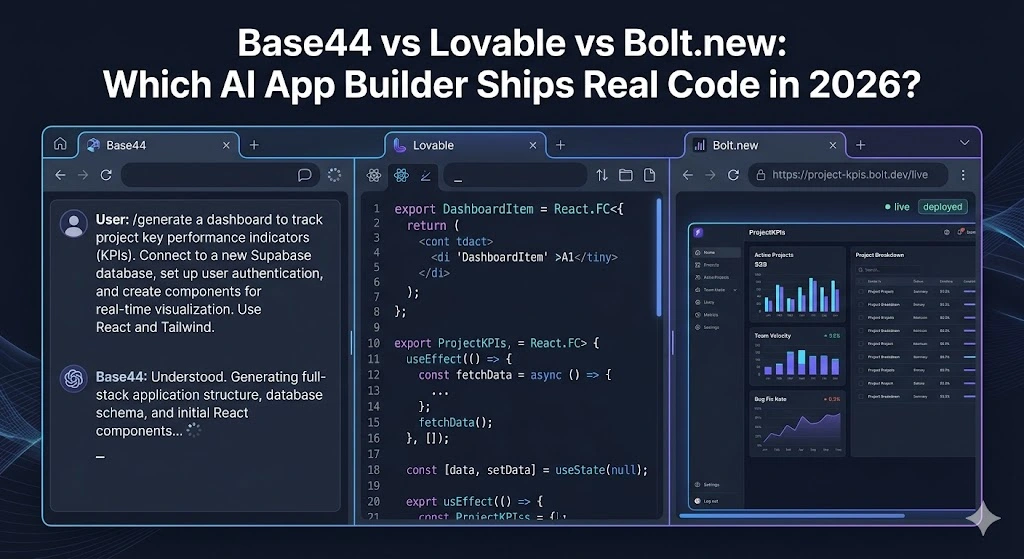
I’ve spent time with all three. They’re good. They’re also deeply different. This comparison exists to make those differences impossible to ignore.
Table of Contents
The Three Contenders: What Each AI App Builder Actually Is
Before getting into performance, it’s worth understanding what each of these tools is philosophically — because that shapes every decision they make about features, pricing, and the code they generate.
Lovable: The Product Partner
Lovable emerged from the open-source project GPT-Engineer, which had gained over 50,000 GitHub stars before the team relaunched it in November 2024 with a GUI as Lovable, an AI-powered full-stack app builder. Sacra The growth since then has been almost absurd to describe without the numbers sounding fabricated. Lovable crossed $400 million in annual recurring revenue in February 2026, adding $100 million in a single month with a lean team of just 146 employees. TechCrunch In December 2025, the company raised $330 million in a Series B led by CapitalG and Menlo Ventures at a $6.6 billion valuation, with participation from NVIDIA’s venture arm, Salesforce Ventures, Databricks Ventures, Atlassian Ventures, and HubSpot Ventures. Lovable
Those numbers matter because they signal product-market fit, not just hype. More than half of Fortune 500 companies are using Lovable, including clients like Klarna and HubSpot. TechCrunch
The platform’s philosophy is explicit. Lovable’s design ideal is that building software should feel like having a conversation with a product partner — you describe what you want, Lovable asks clarifying questions, and it builds the application step by step. Nxcode The code exists if you want it, but it is not the primary interface.
Bolt.new: The Developer’s Cloud IDE
Bolt.new launched in October 2024 from StackBlitz, the company behind WebContainers — the technology that runs a full Node.js environment inside the browser. AI Wiki StackBlitz raised $105.5 million in a Series B in January 2025 at a roughly $700 million valuation, with Claude AI as the default model powering code generation. Taskade The platform hit $40 million ARR within six months of launch — remarkable velocity, even if it pales against Lovable’s trajectory.
What makes Bolt structurally different from every other AI app builder in this comparison is WebContainers. Unlike most AI code editors that stop at suggestions, Bolt spins up a full Node.js environment in your browser tab. You can npm install, start a dev server, hit API routes, and see changes instantly — all client-side. Milestone That is not a marketing claim. It is a genuine technical distinction. You are running a real runtime, not a simulation.
Base44: The Acquisition That Rewrote a Founding Story
Base44 has the most remarkable origin story of the three. It was built by Israeli programmer Maor Shlomo, who launched it as a bootstrapped side project and grew it to 250,000 users within six months — then sold it to Wix for $80 million. TechCrunch Wix acquired Base44 for an initial consideration of approximately $80 million plus additional earn-out payments through 2029 tied to performance metrics. Wix
Base44’s approach offers a fully automated, chat-based interface that manages technical details behind the scenes — databases, authentication, deployment — without requiring third-party integrations or manual setup. Wix No Supabase configuration. No GitHub wiring. No framework selection screen. Everything is baked in, and that is both its superpower and its limitation.
Post-acquisition, the platform was projected to generate $40–50 million in ARR by the end of 2025, adding roughly $12 million in new ARR every month. Calcali Tech
Also Read : Canva vs Tome vs Gamma: Best AI Presentation Tool in 2026?
How Each AI App Builder Handles the Build Phase
The first prompt experience tells you everything about a tool’s priorities.
Lovable: From Prompt to Full-Stack in One Conversation
Feed Lovable a prompt — say, “build a SaaS dashboard for a subscription business with user auth, billing history, and a settings page” — and it does not give you a wireframe. It generates a complete application structure using React, TypeScript, Tailwind CSS, and Supabase. With Lovable Cloud, launched in late 2025, every workspace gets a Supabase backend provisioned automatically, with no separate setup, no API keys to configure, and no manual wiring. Nxcode
The editing workflow is conversational. You stay in the same chat window, refine features, add screens, and request logic changes as if you were briefing a developer. At any point, you can switch to full code editing or push directly to GitHub. Every app Lovable creates can be exported as React and TypeScript code, making it easy for developers to extend, debug, or deploy the project later. Softr
[internal link: how to use Lovable for MVP development]
Bolt.new: Real Code, Real Runtime, Real Control
Bolt’s build flow looks similar on the surface — type a prompt, get an app — but the execution layer is fundamentally different. The AI handles file structure, component architecture, routing, and styling decisions. You can steer with follow-up prompts, and the agents iterate on the existing codebase rather than starting from scratch each time. Vibe Coding
Unlike Lovable, Bolt does not lock you into a specific stack: you can use React, Vue, Next.js, Svelte, Astro, and other frameworks. Pasquale Pillitteri That multi-framework flexibility is genuinely rare among AI app builder tools. For teams with existing stack preferences or for projects that need something other than the Lovable default (React + Supabase), this matters enormously.
Bolt V2 added autonomous debugging that reduces error loops by 98%, and 2026 updates introduced Figma import, Team Templates, and MCP server integration. Banani The trajectory is clearly toward becoming a full professional development environment, not just a rapid prototyping tool.
Base44: One Prompt, One App, No Configuration
Base44’s build experience is the fastest path from idea to shareable link. There is no framework selection. There is no “connect your Supabase account” step. Base44 stands out for having everything built in with no external services: database, authentication, hosting, email sending, SMS, image generation, and AI queries are all native to the platform. Pasquale Pillitteri
That simplicity is genuine. A non-technical founder can describe a customer portal, hit enter, and have a live app URL in minutes. The friction of modern AI app builder tools — API keys, deployment configs, cloud provider accounts — simply does not exist here.
The trade-off becomes apparent when you try to do something the platform didn’t anticipate. Advanced editing remains limited. Frontend code export to GitHub is available, but only on their higher-tier paid plan. The backend logic remains hosted within Base44, which keeps things simple but limits full ownership of the codebase. Softr
Side-by-Side: The Comparison That Actually Matters
| Feature | Lovable | Bolt.new | Base44 |
|---|---|---|---|
| Tech Stack | React, TypeScript, Tailwind, Supabase | React, Vue, Next.js, Svelte, Astro + more | Proprietary managed stack |
| Backend Setup | Auto-provisioned Supabase (Lovable Cloud) | Bolt Cloud (databases, auth, hosting) | Fully native — no config needed |
| Code Export | Full GitHub export (all plans) | Full download, no vendor lock-in | Frontend only, higher-tier paid plans |
| Pricing (Pro) | $25/month (message credits) | $25/month (token-based, rollover) | ~$25–$49/month (tiered post-acquisition) |
| Testing Tools | Frontend, backend, and penetration testing | No built-in testing framework | Manual testing only (“acting as user” toggle) |
| Best For | Non-technical founders, product teams, enterprise | Developers, hackathons, multi-framework projects | Absolute beginners, internal tools, zero-config MVPs |
| Open Source | No | Yes (bolt.diy) | No |
Pricing: What You’re Actually Paying For
All three platforms advertise free tiers, and all three will push you past them faster than you expect on any real project.
Both Lovable and Bolt.new Pro plans cost $25/month, but the usage models differ significantly: Lovable charges per message credit (100/month plus 5 daily), while Bolt.new charges per token (10 million or more per month, with rollover). Nxcode The token model on Bolt can feel more generous for simple projects, but complex builds burn through tokens at a pace that surprises users. Developers have reported burning through 1.3 million tokens in a single day on a standard web application, and spending over $1,000 on tokens just to fix auth issues on a growing project. Nxcode
Lovable monetizes via a tiered SaaS model, with additional usage-based fees for AI code generation tasks — building a basic game might cost $1 in credits, while more complex applications can cost $50 or more. Sacra
Base44 pricing after the Wix acquisition runs approximately $25/month for a starter plan and $49 or more per month for business features, with a free tier limited to preview builds that cannot be published on a custom domain. YouWare Some users report that pricing felt steeper post-acquisition, with the product roadmap becoming less transparent. Whether that matters depends on whether you were already embedded in the Wix ecosystem.
Check Out : How to Use ChatGPT to Write a Business Plan in 9 Proven Steps (With Exact Prompts)
The honest summary: for a lightweight MVP or prototype, all three tools are affordable. For a complex app requiring frequent iteration and debugging, Bolt’s token model and Lovable’s credit system can both become expensive quickly. Base44 is more predictable but also more limited in what you can build.
The Code Quality Question: Who Actually Ships Production-Ready Apps?
This is the question no AI app builder marketing page will answer directly, so let me be blunt: none of them reliably produce production-ready code out of the box for complex applications. What they differ on is how close they get, and what tools they give you to close the gap.
Lovable’s Testing Advantage Is Real
Lovable’s testing suite overcomes the biggest hurdle in AI-assisted development: poorly coded apps that get shipped by people who don’t realise the apps are poorly coded. Beyond browser testing, Lovable offers frontend tests for locking down specific UI behaviour over time, and backend verification tools that let you call edge functions and write automated edge tests. All About Cookies
The penetration testing offering deserves specific mention. Lovable now offers penetration testing that attacks your app to identify what breaks under real-world conditions, a type of analysis that normally costs thousands of dollars to run — Lovable makes it accessible for $100 per test. All About Cookies That is a meaningful differentiator for anyone building anything customer-facing. No other AI app builder in this comparison comes close.
Bolt’s Token Burn Problem
Bolt generates excellent code for straightforward applications. The WebContainer runtime means you can see immediately whether the code actually executes, not just whether it looks right. That feedback loop is faster than any other tool here. But once projects exceed 15 to 20 components or require custom API integrations, context retention degrades noticeably. Nxcode The AI starts losing track of what it built earlier, leading to repetitive fixes that compound token costs.
For a hackathon build or a fast prototype you plan to hand off to a developer anyway, this is not a real problem. For a production application you intend to maintain and scale yourself, it becomes a serious constraint.
Base44’s Lock-In Trade-Off
Base44 makes a deliberate bet: by keeping everything proprietary and managed, it removes all the configuration friction that trips up non-technical users. The cost of that bet is portability. The back-end logic remains hosted within Base44, which keeps things simple but limits full ownership of the codebase. Softr If Base44’s pricing changes post-acquisition, or if Wix’s integration decisions alter the product roadmap, your options for migrating are limited.
This is not a hypothetical concern. Builders who used Base44 before the Wix acquisition often report the pricing feels steeper and the product roadmap less transparent than before. YouWare With VC-backed tools like Lovable and Bolt, the open-source components and GitHub export options give you at least a theoretical exit. With Base44, you are more fully committed to the platform.
[internal link: AI app builder vendor lock-in — how to protect your project]
Who Should Use Which AI App Builder?
The answer depends less on the tools and more on who you are and what you’re building.
If you have no technical background and you need to go from idea to shareable product as fast as possible, Base44 is the most frictionless path. The zero-setup backend, native auth, and instant deployment are unmatched for absolute beginners building internal tools, customer portals, or simple SaaS utilities. Just know you are trading portability for simplicity.
If you are a non-technical or semi-technical founder building a customer-facing product you intend to scale — something that needs to handle real users, real transactions, and real security — Lovable is the strongest choice. The mature Supabase integration, GitHub export, and testing suite make it the most production-aware AI app builder of the three. The $6.6 billion valuation and Fortune 500 adoption suggest the product is serious, not just well-marketed.
If you are a developer who wants AI acceleration without being told which framework to use, or a technical builder who needs the option to drop into code at any moment, Bolt.new is your best option. The WebContainer runtime, multi-framework support, open-source bolt.diy version, and MCP server integration as of March 2026 position it as a genuine power-user tool, not just a prototyping shortcut.
[internal link: how to choose between no-code and low-code tools for your startup]
The Scalability Question Nobody Talks About
Every comparison of AI app builder tools covers the initial build experience. Far fewer cover what happens three months later when your prototype has become a real product with real users and real edge cases.
A rigorous study published in July 2025 found that experienced developers using AI tools actually took 19% longer to complete tasks, despite believing they were 20% faster. Vibe Coding That disconnect between perceived and actual productivity gains is important context. These tools genuinely compress the early build phase. They do not eliminate the need for technical judgment on complex, long-running projects.
Lovable’s answer to this is the handoff to developers via GitHub export and TypeScript code. Bolt’s answer is giving developers the full codebase and a real runtime they can dig into. Base44’s answer is to keep managing everything on your behalf — which works until it doesn’t.
The global low-code platform market is projected to grow from around $6.78 billion in 2022 to nearly $94.75 billion by 2028, according to market research published by Mordor Intelligence. The AI app builder category is driving a significant portion of that growth, and the tools are improving fast enough that today’s limitations may be largely resolved by the time you hit them. What won’t change is the philosophical difference between these platforms — Lovable as product partner, Bolt as developer tool, Base44 as zero-configuration hosted environment.
According to Anthropic’s published research on Claude, the underlying model powering Bolt and partly powering Lovable and Base44, improvements in reasoning capability directly translate to better-generated code. That rising tide lifts all three boats — but platforms that give you code access and testing tools will always have an advantage when the AI gets something wrong.
The StackBlitz WebContainers documentation explains why Bolt’s in-browser runtime remains technically distinctive even as competitor features converge: running a real Node.js environment client-side eliminates an entire class of deployment bugs that cloud-based tools cannot reproduce until production.
For a broader look at where the vibe coding ecosystem is heading, TechCrunch’s ongoing coverage of Lovable provides useful context on enterprise adoption trends that will shape all three platforms over the next 12 to 18 months.
The Honest Verdict
Lovable wins on code quality, testing, and production-readiness. If I were building something I expected real customers to rely on, it is where I would start. Bolt wins on developer flexibility, framework choice, and the unique runtime experience that no other AI app builder can match. If I were a developer who wanted AI speed without giving up control, Bolt is the clear answer. Base44 wins on raw simplicity — if the goal is getting something built and shared today, with zero technical background and zero tolerance for configuration, nothing else comes close.
The mistake is treating these as interchangeable. They are not. Pick based on who you are, not which logo looks most impressive.
Read : How to Use AI to Write Better: The Only Practical Guide You Need (2026)
FAQ’s
Q: What is the best AI app builder for non-technical founders in 2026? A: Lovable and Base44 are the strongest options for non-technical users. Base44 requires the least setup and delivers a working app fastest. Lovable adds more production capability and testing tools, making it better for apps intended for real customers rather than internal use.
Q: Is Bolt.new better than Lovable for developers? A: For developers, Bolt.new has clear advantages: multi-framework support (React, Vue, Next.js, Svelte, Astro), an in-browser Node.js runtime via WebContainers, and open-source flexibility via bolt.diy. Lovable locks you into a React/TypeScript/Supabase stack, which is excellent but not always the right fit.
Q: How much does Lovable cost in 2026? A: Lovable’s Pro plan is $25 per month, which includes 100 message credits monthly plus 5 daily. Enterprise pricing is custom. Additional credits are charged on a usage basis, with complex apps potentially costing significantly more per project than the base subscription fee.
Q: Was Base44 acquired by Wix? A: Yes. Wix acquired Base44 in June 2025 for approximately $80 million upfront, with additional earn-out payments through 2029 tied to performance metrics. Base44 continues to operate as a distinct product under the Wix portfolio.
Q: Can I export my code from an AI app builder like Bolt or Lovable? A: Yes for both. Lovable provides full React/TypeScript GitHub export on all paid plans. Bolt.new generates standard framework code you can download or push to your own repository at any time. Base44 offers frontend code export only on higher-tier plans, and the backend remains locked to their platform.
Q: Which AI app builder is best for shipping a production-ready SaaS? A: Lovable is the strongest option here. Its built-in testing suite — including frontend tests, backend verification, and penetration testing — addresses the code quality issues that plague most AI-generated applications before they reach real users.
Q: Does Bolt.new support mobile app development? A: Yes. Bolt supports mobile development through Expo integration, enabling iOS and Android builds from a single prompt alongside responsive web frameworks like React Native.
Q: What tech stack does each AI app builder use? A: Lovable generates React, TypeScript, Tailwind CSS, and Supabase. Bolt.new supports React, Vue, Next.js, Svelte, Astro, and other JavaScript frameworks. Base44 uses a proprietary managed stack with no external services — users do not choose or configure the underlying technology.
Q: Is Base44 suitable for complex, long-term applications? A: Base44 is best suited for MVPs, internal tools, and applications that don’t require frequent deep customisation. Its proprietary backend creates vendor dependency, and advanced editing remains more limited than Lovable or Bolt. For complex, long-running products, Lovable or Bolt offer better code ownership and scalability paths.
Q: What is vibe coding, and how do these AI app builder tools relate to it? A: Vibe coding refers to the practice of describing software in plain language and letting AI agents build it — shifting creation from syntax to intent. All three tools — Lovable, Bolt.new, and Base44 — are vibe coding platforms. They differ in how much technical control they expose to the user, with Base44 hiding the most and Bolt.new exposing the most.
1 thought on “Base44 vs Lovable vs Bolt.new: The Ultimate AI App Builder That Actually Ships Working Code in 2026”