
Introduction
Artificial Intelligence tools are evolving faster than ever, and in 2026, three AI chatbots dominate the market: ChatGPT, Google Gemini, and Claude AI.
Whether you are a blogger, student, developer, freelancer, or business owner, choosing the right AI tool can save you time, increase productivity, and even help you earn money online.
In this detailed guide, we compare ChatGPT vs Gemini vs Claude based on features, accuracy, pricing, and best use cases to help you decide which AI tool is best for you in 2026.
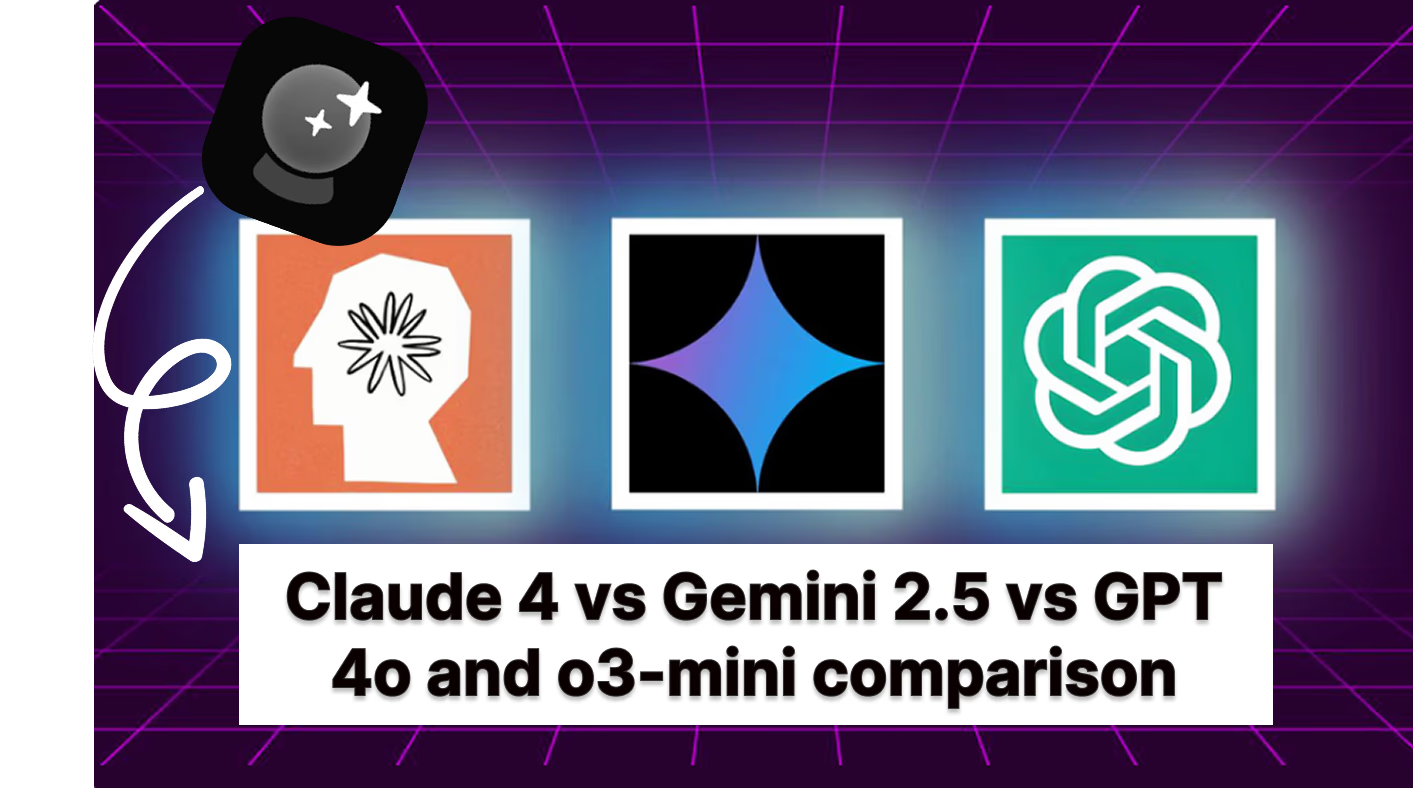
ChatGPT vs Gemini vs Claude 2026: Which AI Is Best Right Now?
As we reach the end of 2026, the AI landscape has evolved into an intense three-way battle between OpenAI’s ChatGPT (powered by the newly released GPT-5.2), Google’s Gemini (with Gemini 3 Pro and Flash variants), and Anthropic’s Claude (led by Opus 4.5 and Sonnet 4.5). These tools have become essential for professionals, creators, students, and businesses alike. But with rapid releases throughout the year—culminating in a flurry of frontier models in November and December—declaring a single “best” AI is impossible. Instead, the winner depends on your specific needs: coding, creative writing, research, multimodal tasks, or everyday productivity.
This comprehensive 2000-word comparison draws from benchmarks, user feedback, expert reviews, and real-world performance data as of December 2025. We’ll break down the latest models, features, pricing, strengths, weaknesses, and use cases to help you decide.
Table of Contents
1. ChatGPT (by OpenAI)
🔗 Official Website: https://chat.openai.com
Best for: Writing, coding, brainstorming, general AI tasks
ChatGPT is one of the most popular AI tools worldwide. It is widely used for content creation, coding assistance, learning new topics, and problem-solving.
Key Features
- High-quality AI writing
- Strong reasoning and explanations
- Code generation and debugging
- Works well for blogs, emails, scripts, and ideas
Pros
✅ Excellent content quality
✅ Best all-round AI assistant
✅ Easy to use for beginners
Cons
❌ Limited access in free plan
❌ Advanced features require paid version
Who should use ChatGPT?
If you want a single AI tool for multiple tasks, ChatGPT is the best choice.
2. Google Gemini (formerly Bard)
🔗 Official Website: https://gemini.google.com
Best for: Research, factual queries, real-time information
Google Gemini is designed to work closely with Google Search, making it powerful for research-based tasks and current information.
Key Features
- Access to live web data
- Integration with Google services
- Strong factual and analytical answers
Pros
✅ Real-time information
✅ Accurate for research
✅ Free to use
Cons
❌ Less creative writing
❌ Answers can feel robotic
Who should use Gemini?
Choose Gemini if you need up-to-date information, research, or data-backed answers.
3. Claude AI (by Anthropic)
🔗 Official Website: https://claude.ai
Best for: Long documents, summaries, ethical AI use
Claude AI is known for handling long content very well. It is commonly used for summarizing PDFs, reports, and legal or academic documents.
Key Features
- Handles very long text inputs
- Clean and structured answers
- Focus on AI safety and reliability
Pros
✅ Best for document analysis
✅ Clear and safe responses
✅ Great summaries
Cons
❌ Limited free usage
❌ Fewer integrations
Who should use Claude AI?
Claude is ideal if you work with long documents, research papers, or reports.
Feature Comparison Table
| Feature | ChatGPT | Gemini | Claude |
|---|---|---|---|
| Writing Quality | ⭐⭐⭐⭐⭐ | ⭐⭐⭐⭐ | ⭐⭐⭐⭐ |
| Coding Help | ⭐⭐⭐⭐⭐ | ⭐⭐⭐⭐ | ⭐⭐⭐ |
| Research | ⭐⭐⭐⭐ | ⭐⭐⭐⭐⭐ | ⭐⭐⭐⭐ |
| Long Documents | ⭐⭐⭐ | ⭐⭐⭐ | ⭐⭐⭐⭐⭐ |
| Free Access | Limited | Yes | Limited |
Which AI Tool Is Best for You in 2026?
- 👉 Use ChatGPT for writing, coding, and all-round productivity
- 👉 Use Gemini for research and real-time data
- 👉 Use Claude for document summaries and analysis
💡 Pro tip: Many professionals use two AI tools together for maximum efficiency.
Main Differences
- ChatGPT (OpenAI): The year started with GPT-4o as the flagship, but OpenAI faced pressure after Google’s Gemini 3 launch in November. This triggered an internal “code red,” leading to GPT-5.1 in early November and the counterpunch GPT-5.2 on December 11. GPT-5.2 (codename “Garlic”) emphasizes advanced reasoning, with variants like Thinking mode for step-by-step problem-solving and Codex optimizations for coding.
- Gemini (Google): Gemini 3 Pro arrived in mid-November, quickly topping many leaderboards for reasoning and multimodal capabilities. Follow-ups included Gemini 3 Flash (December) for speed and cost-efficiency, and enhanced “Computer Use” for browser automation. Gemini’s integration with Google Search and Workspace gives it real-time data advantages.
- Claude (Anthropic): Claude Opus 4.5 launched November 24, building on the Claude 4 family from earlier in the year. It excels in coding (leading SWE-bench Verified at ~80.9%) and safety-aligned reasoning. Sonnet 4.5 and Haiku variants offer balanced speed and capability.
Notably, xAI’s Grok 4.1 also competed strongly in some areas, but this comparison focuses on the big three as requested.
Performance and Benchmarks
Benchmarks like LMSYS Chatbot Arena (now LMArena), SWE-bench, ARC-AGI, and GPQA provide objective insights, though real-world preference often varies.
- General Reasoning and Intelligence: Gemini 3 Pro frequently ranks #1 on LMArena’s Text and Search Arenas, with strong abstract reasoning (e.g., high on ARC-AGI and Video-MMMU). GPT-5.2 closes gaps in multi-step planning and achieves near-perfect scores on math benchmarks like AIME 2025 (100% without tools in some tests). Claude Opus 4.5 shines in careful, low-hallucination reasoning but trails in raw speed.
- Coding: Claude dominates here. Opus 4.5 holds the top spot on SWE-bench Verified (80.9%), excelling at explaining logic, edge cases, and large refactors. Gemini handles massive codebases well with its long context, while GPT-5.2 is solid for prototyping but lags on complex tasks.
- Multimodal (Images, Video, Audio): Gemini leads with native multimodality, Veo 3 for video generation, and superior video understanding. ChatGPT integrates DALL-E and voice seamlessly, while Claude is strong in vision but less aggressive in generation.
- Research and Factual Accuracy: Gemini’s Google Search grounding makes it best for up-to-date info and citations. Claude minimizes hallucinations through ethical guardrails. ChatGPT is flexible but can require fact-checking.
Crowdsourced arenas like LMArena show tight races: Gemini often edges overall, GPT-5.2 for polished responses, and Claude for depth.
Features and User Experience
Each tool has unique strengths that shape daily use.
- ChatGPT: Best for conversational flow and personalization. Features like memory (remembers past chats), custom GPTs, voice mode, and introspection prompts create “magical” experiences. It’s human-like, creative, and great for brainstorming or everyday assistance. Integrations with Microsoft Copilot add enterprise value.
- Gemini: Deep Google ecosystem ties—seamless with Gmail, Docs, Search, and Workspace. Standouts include 1M+ token context for massive documents, real-time web access, and agentic tools like browser control. It’s fast, consistent, and excels at factual tasks or long-context analysis.
- Claude: Emphasizes safety, ethics, and thorough reasoning (“high EQ”). Artifacts for code/projects, strong guardrails against harm, and hybrid modes (fast vs. extended thinking). It’s preferred for structured planning, writing, and compliance-sensitive work.
All support multimodal input now, but Gemini feels most native. ChatGPT has the broadest app ecosystem (iOS/Android/web), while Claude and Gemini offer mobile apps with voice.
Pricing and Accessibility
Pricing remains competitive, with ~$20/month for premium access across the board.
- ChatGPT Plus: $20/month for GPT-5.2 access, unlimited usage (with fair limits), advanced voice, and priorities. Free tier uses older models. API: Premium pricing (~$5-15/M tokens for flagship).
- Gemini Advanced: $20/month (bundled with Google One for 2TB storage). Often free/included in Workspace plans, making it cost-effective for businesses. API: Balanced, cheaper for high-volume (~$1-10/M tokens).
- Claude Pro: $20/month for higher limits and priority. Enterprise “Max” plans start higher ($100+). API: Most expensive flagship (up to $75/M output tokens for Opus), but mid-tiers competitive.
Free tiers exist for all, but premiums unlock frontier models. For developers, Grok often undercuts on API costs, but the big three dominate enterprise.
Strengths and Weaknesses
- ChatGPT Strengths: Versatile all-rounder; creative, empathetic responses; vast ecosystem; rapid prototyping. Weaknesses: Occasional hallucinations; higher API costs; less native long-context than rivals.
- Gemini Strengths: Speed, accuracy, multimodality; Google integrations; real-time data; cost-effective scaling. Weaknesses: Sometimes sterile/verbose; less “personality” than ChatGPT.
- Claude Strengths: Best coding/explanation; safety/alignment; deep reasoning without fluff. Weaknesses: Slower on some tasks; stricter refusals; limited real-time web in base.
User sentiment (from Reddit, reviews): Many pros use multiple—Claude for code, Gemini for research, ChatGPT for writing/conversation.
Best for Specific Use Cases
- Coding/Programming: Claude (top benchmarks, logical explanations). Gemini close for large projects.
- Creative Writing/Content Creation: ChatGPT (human-like, introspective). Claude for polished/ethical edits.
- Research/Up-to-Date Info: Gemini (search grounding). Claude for synthesis without hallucinations.
- Multimodal (Images/Video): Gemini (Veo, native handling).
- Everyday/Personal Assistant: ChatGPT (memory, voice).
- Enterprise/Safety-Critical: Claude (guardrails, compliance).
- Productivity in Google Workspace: Gemini.
Conclusion: No Single Winner, But a Clear Strategy
Many experts recommend a “router” strategy: Switch based on task.
In 2025, there’s no outright “best” AI—each excels in niches. Gemini 3 often tops general leaderboards for reasoning and multimodality. Claude Opus 4.5 reigns in coding and safe workflows. ChatGPT’s GPT-5.2 offers the most balanced, user-friendly experience with the largest ecosystem.
For most users, start with ChatGPT for its versatility. Developers: Prioritize Claude. Google users/researchers: Gemini. Budget-conscious enterprises: Leverage Gemini’s bundling.
The real power comes from using them together—tools like multi-model interfaces make this easy. As 2026 approaches with rumored GPT-5.3 and beyond, expect even tighter competition. Whichever you choose, these AIs are transforming work—pick based on your needs, and experiment freely.
Final Verdict
There is no single “perfect” AI tool in 2026. The best AI tool depends on your goals and workflow. If you are just starting, begin with ChatGPT or Gemini, and add Claude later for document-heavy tasks.
AI tools are no longer optional — they are a competitive advantage.
Latest Models and Release Timeline
2025 has been a breakout year for AI advancements, with companies responding aggressively to competitors.
Frequently Asked Questions (FAQ)
Is ChatGPT free?
Yes, ChatGPT offers a free plan with limited access.
Is Gemini better than ChatGPT?
Gemini is better for real-time research, while ChatGPT is better for writing and creativity.
Can I use all three AI tools?
Yes, you can use all three depending on your needs.
This made my heart happy
Thank you so much!! Read more at aitoolscoutai.com