
Introduction: Something Feels Off About the Internet
If you have spent any time reading articles online in the past two years, you have probably felt it without being able to name it — a creeping sense that the content you are reading is somehow off. The sentences are technically correct. The information seems plausible. But there is a hollowness to it, like reading a photocopy of a photocopy. Something has been lost in translation between a human thought and the words on your screen.
What you are experiencing has a name now: AI slop.
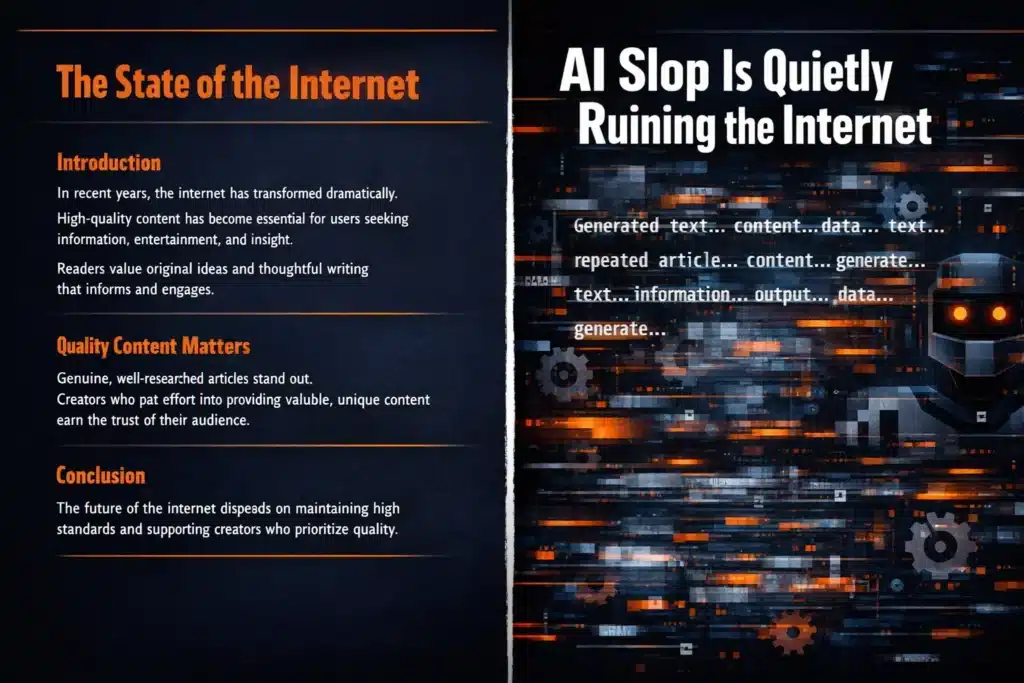
AI slop has become one of the defining problems of the modern internet. It is not just a minor annoyance or a niche concern for tech enthusiasts. It is reshaping how search engines work, how people trust online information, and how content creators compete in a world where a single person with access to a $20/month tool can produce ten thousand words in an afternoon. Whether you are a blogger, a business owner, a journalist, a student, or someone who simply Googles things, AI slop is already affecting your digital life — probably more than you realize.
This post breaks down exactly what AI slop is, where it comes from, what it is doing to the internet, and what you can realistically do about it. No jargon walls. No hedge-everything corporate language. Just a clear, honest look at one of the most consequential shifts in how information flows online today.
Table of Contents
What Exactly Is AI Slop?
At its most basic, AI slop refers to low-quality content that has been generated by artificial intelligence tools — typically large language models (LLMs) like GPT-4, Gemini, or Claude — and published online with little to no meaningful human editing, fact-checking, or creative input.
The word “slop” is deliberate and blunt. It is not just AI-generated content. Plenty of AI-assisted content is genuinely useful, carefully edited, and adds real value. This is specifically the bad stuff: the mass-produced articles that say nothing new, the product reviews that have never seen the product, the news summaries that hallucinate facts, and the SEO blog posts that circle the same three sentences for eight hundred words just to hit a word count.
Also Read : Meta-Black-Box Optimization: The Only usefull Guide You’ll Ever Need (2026 Edition)
AI slop exists on a spectrum. At one end, you have mildly padded articles where a writer used an AI tool to expand a few paragraphs. At the other extreme, you have fully automated content farms pumping out thousands of articles per day across hundreds of domains, with no human touching the text at all between the AI prompt and the “Publish” button.
What makes something AI slop rather than simply imperfect writing?
- Semantic emptiness: The text reads fluently but conveys little actual information or original thought.
- Structural sameness: Every article follows the same skeleton — intro, five bullet points, a table, a conclusion that mirrors the intro.
- Factual vagueness or outright errors: LLMs confidently fill gaps in knowledge with plausible-sounding fabrications, a phenomenon called “hallucination.”
- No discernible voice: There is no humor, no personal experience, no friction, no perspective — just smooth, neutral prose that could have been written by anyone about anything.
- Keyword stuffing with modern packaging: Old-school SEO spam was obvious. AI slop hides keyword gaming behind grammatically polished sentences.
It is worth noting that the term has been popularized across technology publications and has entered mainstream digital vocabulary relatively quickly, which itself signals how pervasive the problem has become.
A Brief History: How AI Slop Took Over
To understand why AI slop is everywhere now, you need to understand how fast the tools that produce it have evolved — and how cheap they have become.
Before 2020, AI-generated text was easy to spot. It was robotic, repetitive, and barely coherent beyond a paragraph or two. Marketers and content farms occasionally used early AI tools, but the output required so much human correction that the efficiency gains were modest.
Then came the GPT-3 moment in 2020. OpenAI’s model could produce fluid, extended prose that genuinely surprised people. Suddenly, the barrier to mass content production dropped significantly. By 2022, ChatGPT made powerful text generation available to anyone with an internet connection for free. By 2023, the floodgates opened.
The economic logic was inescapable: if you could generate a 1,500-word article in 45 seconds for pennies, why would you pay a human writer $150 and wait three days? For content farms chasing advertising revenue through search traffic, AI slop was not just tempting — it was the obvious play.
According to research from Stanford’s Human-Centered AI Institute, the volume of AI-assisted content online began growing exponentially around late 2022, with no signs of slowing. The internet, which took decades to fill with human-written content, began absorbing machine-generated text at a scale that is genuinely difficult to comprehend.
Why Is AI Slop Spreading So Fast?
Understanding the mechanics of AI slop’s spread requires looking at three forces: economics, accessibility, and a search ecosystem that — until very recently — was not designed to punish it.
The Economics Are Overwhelming
Traditional content creation is expensive. A skilled writer, researcher, or journalist costs money, takes time, and has limits on output. An LLM costs fractions of a cent per word and has no such limits. For anyone running a content-driven business on thin margins, the math is brutally simple. AI slop is not spreading because people are lazy. It is spreading because the incentive structures of the modern internet make it rational.
Advertising-supported media runs on traffic, and traffic runs on content volume and search visibility. If a website can go from publishing 10 articles a week to 10,000 articles a week, and even 2% of that AI slop ranks on Google, the revenue jump can be enormous — even if 98% of it is digital trash.
The Tools Are Genuinely Easy to Use
You do not need a technical background to produce this at scale. Tools like Jasper, Copy.ai, and dozens of others have abstracted away every technical detail. You type a topic, click a button, and get an article. Some tools even handle publishing directly to WordPress or other CMS platforms. The barrier is so low that even non-writers with no content background can flood the internet with text.
Also Read about Agentic AI Tech Stack Every Developer Must Know.
Search Engines Were Slow to Respond
For years, Google’s algorithms were optimized to reward content that matched certain signals — length, structure, keyword relevance, backlinks — without reliably distinguishing between human-crafted insight and machine-assembled gibberish that mimicked those signals. This was often engineered precisely to hit those signals. The result was that genuinely researched, carefully written human content sometimes lost traffic to AI slop that had been optimized for the algorithm rather than the reader.
Google has since updated its Search Quality Rater Guidelines and introduced more sophisticated signals — but the gap between the volume of AI slop being produced and search engines’ ability to suppress it remains wide.
The Real Damage AI Slop Does
It would be easy to frame AI slop as merely a content quality problem. It is much more than that.
It Erodes Information Trust
When readers repeatedly encounter confident, well-formatted content that turns out to be inaccurate or hollow, they stop trusting what they read online. This is not hypothetical — it is already happening. Research from Reuters Institute has tracked declining trust in digital media, and the proliferation of AI slop is accelerating that trend. When people cannot tell what is real and what is generated, they either disengage or default to a handful of brands they already know — which narrows the information ecosystem considerably.
It Actively Crowds Out Quality Content
Every SERP (search engine results page) has limited real estate. When this occupies those slots — even temporarily — the writers, researchers, and journalists who produce genuinely valuable content lose visibility. This creates a destructive cycle: quality creators see declining returns and either quit or themselves turn to AI tools to compete on volume. The market for human expertise gets compressed.
It Harms Readers Who Need Accurate Information
AI slop is not just annoying in low-stakes contexts. When it shows up in medical, legal, financial, or safety-related searches, it can cause real harm. LLMs hallucinate confidently. A person researching drug interactions, legal rights, or crisis resources who encounters AI slop dressed up as authoritative guidance is not just inconvenienced — they are potentially misled in ways that matter.
It Destroys the Discoverability of Original Ideas
The internet used to be good at surfacing niche expertise — the obscure forum post from someone who had actually solved the problem you are facing, the independent blogger who had gone deep on a topic most publications ignored. AI slop is burying that signal under noise. Genuine experts are harder to find. Original research and thought are harder to surface. The web gets shallower.
How to Spot AI Slop (Even When It’s Trying to Hide)
Identifying AI slop is getting harder as the models improve, but there are still reliable tells:
1. The “as an AI language model” reflex. Older AI slop often included phrases like “as a language model, I…” that slipped through without editing. Newer AI slop has been trained out of this habit, but watch for its stylistic cousins: “it is important to note,” “it is worth mentioning,” and “in conclusion, it is clear that.”
2. Suspiciously balanced non-opinions. AI models are trained to avoid controversy. AI slop on any topic that has a clear answer will often present “both sides” in a way that implies false equivalence, because the model is hedging rather than committing to a position.
3. The exploding introduction. This tends to have introductions that restate the title, preview the article, and then preview the preview — burning 200-300 words saying nothing before the actual content begins.
4. Bullet points as a crutch. Human writers use lists strategically. This overuses them to fill space and create the visual appearance of structured thinking without the substance behind it.
5. Facts that are almost right. LLMs interpolate plausible-sounding figures, dates, and attributions. If a statistic looks precise but has no source, treat it with suspicion.
6. No author experience or personal detail. Human content, even when professional and formal, contains traces of the writer’s experience, opinions, or stakes in the topic. This is uniformly perspective-free.
Check Out : Bhindi AI Review 2026: Features, Pricing, Use Cases & Honest Verdict
You can also use detection tools like GPTZero or Originality.AI as a starting point, though these tools are imperfect and should be used alongside critical reading rather than as a replacement for it.
AI Slop vs. Quality Content: A Side-by-Side Comparison
| Feature | AI Slop | Quality Human Content |
|---|---|---|
| Originality | Remixes existing content; rarely adds new information | Brings original research, interviews, or first-hand experience |
| Accuracy | Frequently hallucinates statistics, names, and facts | Verified through sourcing and editorial process |
| Voice | Generic, neutral, interchangeable | Distinctive; reflects the writer’s perspective and expertise |
| Depth | Surface-level; avoids complexity | Digs into nuance; addresses edge cases |
| Transparency | Often hides its AI origin | Credits authorship and sources clearly |
| Update frequency | Can be mass-published but rarely updated | More likely to be revised as information changes |
| Reader value | Designed to rank; reader is secondary | Designed to inform; ranking is secondary |
| Risk of harm | High in medical/legal/financial contexts | Lower, especially with expert authorship |
| Emotional resonance | Low to none | Can be high; connects with reader experiences |
| Source citation | Vague or missing | Specific, verifiable, linked |
This table is not about technology — it is about intent. AI-assisted content produced responsibly, by a knowledgeable writer who edits, verifies, and adds genuine value, is not AI slop. The slop lives in the gap between capability and responsibility.
Who Is Responsible for AI Slop?
This is where the conversation gets uncomfortable, because the answer is: almost everyone involved.
AI tool companies bear significant responsibility for building products that make mass, low-quality publication trivially easy — and for marketing them to exactly the audience most likely to use them that way. Framing AI writing tools as “publish-ready” rather than “draft-assistance” tools has measurably contributed to the volume of AI slop online.
Publishers and content farms are the most direct producers of AI slop. When a business decides to prioritize content volume over content quality, This is the predictable output.
Advertisers and ad networks fund AI slop by serving ads on low-quality sites, which makes those sites economically viable. Without advertising revenue, most AI slop operations would collapse overnight.
Search engines created and maintained the incentive structures that AI slop exploits. When ranking algorithms reward length, keyword density, and structural signals over genuine insight, they invite the gaming that AI slop represents. The MIT Technology Review has written critically about how search monetization models have contributed to information quality degradation well before AI entered the picture.
Readers play a role too — clicking on shallow content, sharing unverified articles, and not demanding sources sends market signals that low-quality content is acceptable. This is the least fair assignment of responsibility, but it is not zero.
What Search Engines Are Doing About AI Slop
Google, Bing, and others are not sitting still. But their responses reveal how difficult the problem actually is.
Google’s helpful content system, rolled out and updated throughout 2023 and 2024, was explicitly designed to downrank content created primarily for search engines rather than humans. The algorithm tries to evaluate whether content demonstrates expertise, experience, authoritativeness, and trustworthiness — a framework often called E-E-A-T. AI slop, in theory, should score poorly on experience and often on expertise.
In practice, the results have been mixed. Some high-volume AI slop operations have seen dramatic traffic drops. Others have adapted — adding author bio pages, reformatting content to appear more credible, or combining AI slop with just enough human input to pass surface-level evaluation.
The fundamental problem is that Google’s ability to detect AI slop algorithmically is constrained by the same thing that makes this so insidious: modern LLMs produce text that is structurally indistinguishable from human writing at scale. You can flag patterns, but the patterns shift as generators improve.
Bing, which has invested heavily in AI through its partnership with OpenAI, faces an obvious conflict of interest in policing AI slop — it is simultaneously a search engine that wants quality results and an AI tool vendor with incentives to see that tool used widely.
The honest answer is that no search engine has fully solved this problem, and none is likely to in the near term.
How to Protect Yourself and Your Brand from AI Slop
Whether you are an individual navigating the internet or a business trying to maintain content credibility, there are practical steps you can take.
For Readers and Researchers
- Check the author. A byline should link to a real person with a verifiable professional history. A generic “Staff Writer” with no LinkedIn profile is a red flag.
- Look for primary sources. Quality content links to studies, institutions, or named experts. AI slop tends to make vague references to “research” without citations.
- Use lateral reading. Instead of reading one article deeply, open multiple tabs and check whether other credible sources corroborate the key claims. This technique, recommended by the Stanford History Education Group, is one of the most effective tools for navigating a polluted information environment.
- Trust your friction. If content feels easy — if it slides by without giving you anything to push against, no new information, no surprising perspective — it may be this is engineered for frictionless consumption rather than genuine insight.
For Content Creators and Businesses
- Lead with experience. Case studies, original data, client stories, and first-person expertise are things AI slop cannot fake. These are your competitive moats.
- Be specific. AI slop generalizes. The most defensible content makes specific claims, cites specific sources, and addresses specific problems that a specific audience actually has.
- Edit for voice. If your content could have been written by anyone about anything, it will not stand out. Invest in editorial work that injects perspective, personality, and opinion.
- Avoid the volume trap. Publishing ten deeply researched, genuinely useful pieces will almost always outperform publishing a hundred AI slop articles over the long term — both for search rankings and for audience trust.
The Future: Will AI Slop Get Worse Before It Gets Better?
Probably yes — and here is why.
The tools are getting better and cheaper. Models that produce higher-quality text at lower cost are releasing faster than detection and suppression mechanisms can keep up. The economic incentives have not changed. And as AI content generation becomes normalized, the social stigma around publishing AI slop without disclosure is diminishing rather than growing.
At the same time, there are reasons for cautious optimism. Regulatory pressure is building — the EU’s AI Act, for example, includes provisions around transparency in AI-generated content that may eventually create disclosure obligations. The Guardian and other major publications have begun investing specifically in human-first content as a differentiator, betting that readers will pay a premium for content they trust.
There is also a market argument for quality: as this floods low-value informational content, genuine expertise, original reporting, lived experience, and creative voice become scarcer and therefore more valuable. The writers, creators, and publications that double down on what AI genuinely cannot replicate — perspective, experience, accountability — may find themselves in a stronger competitive position in three years than they are today.
The internet has been polluted before — by spam, by link farms, by content scrapers — and has found partial solutions each time. AI slop is a harder problem, but it is not an unprecedented one. The question is whether the platforms, search engines, regulators, and readers who collectively control the ecosystem will move fast enough to prevent the damage from becoming permanent.
Conclusion: AI Slop Is the Test the Internet Is Currently Failing
AI slop is not going away on its own. It is a structural feature of an information economy that rewards content volume and penalizes investment in quality. The tools that produce it are improving. The people using those tools are getting more sophisticated. And the systems designed to filter it out are running perpetually behind.
But that does not mean the situation is hopeless. Every time you click away from a hollow article, demand sources before sharing content, or choose to support a creator whose work actually teaches you something, you are casting a small vote for a better information environment. Every business that chooses depth over volume, and every writer who bets on voice and expertise rather than keyword density, is making the same bet.
The internet worth fighting for is one where finding genuinely useful, honest, expertly crafted information is still possible — where AI slop is the noise and human insight is still the signal. Keeping that signal alive is the real challenge of the next decade of the web.
Also Check Out : Jeff Bezos’ Project Prometheus: The Secret AI Giant That’s Quietly DISRUPTING Everything in 2026
Frequently Asked Questions About AI Slop
1. What is the simplest definition of AI slop?
AI slop is low-quality content generated by AI tools and published online without meaningful human editing, fact-checking, or added value. The key word is “slop” — it is not all AI-generated content, just the cheap, hollow, mass-produced kind.
2. Is all AI-generated content considered AI slop?
No. AI slop refers specifically to low-quality, minimally edited, and often inaccurate content published primarily to game search engines or fill space. AI-assisted content where a skilled human writer uses the tool as a starting point and then substantially edits, verifies, and improves the output is not AI slop.
3. Why is AI slop bad for SEO in the long run?
Search engines like Google are increasingly penalizing content that appears to be created primarily for algorithms rather than for human readers. AI slop tends to perform poorly on E-E-A-T signals (Experience, Expertise, Authoritativeness, Trustworthiness). Over time, websites that rely on AI slop often see significant ranking drops during algorithm updates.
4. Can AI slop get someone in legal trouble?
Potentially, yes. If AI slop contains defamatory statements, reproduces copyrighted material without authorization, or provides false information in regulated contexts (medical, legal, financial), the publisher can face legal liability. The AI tool being the generator does not transfer legal responsibility away from the publisher.
5. How can I tell if an article I am reading is AI slop?
Look for vague or missing citations, a generic and perspective-free writing style, factual claims that sound plausible but cannot be sourced, overuse of bullet points and numbered lists, a very generic author byline, and an introduction that restates the title without adding anything new. Tools like GPTZero can assist, but critical reading is still the most reliable method.
6. Do major news publishers produce AI slop?
Some do, or have experimented with doing so. Several publications were caught publishing AI-generated content with minimal oversight, leading to reputational damage and public apologies. The issue is not limited to fringe content farms — budget pressure and speed-of-publishing demands affect mainstream outlets too.
7. Is AI slop hurting search engine quality?
Yes, measurably. Multiple studies and widespread anecdotal reports from SEO professionals indicate that Google search result quality declined noticeably between 2022 and 2024, a period that overlaps precisely with the explosion of AI slop production. Google has acknowledged the problem and is working on algorithmic responses, but the arms race continues.
8. What industries are most affected by AI slop?
Health, finance, travel, legal information, e-commerce product reviews, and “how-to” content are among the hardest hit. These categories attract high search traffic and have historically been targets for content farms — AI tools have dramatically amplified those operations.
9. Are there regulations against AI slop?
Direct regulations are limited and emerging. The EU AI Act includes some transparency requirements for AI-generated content. Various platforms have policies against AI slop, with varying degrees of enforcement. In the US, there is no federal legislation directly targeting AI-generated content quality, though the FTC has signaled interest in deceptive AI content practices.
10. What is the best way for a content creator to compete against AI slop?
The most effective strategy is to invest in what AI genuinely cannot replicate: original research, lived experience, named sources, distinctive voice, accountability, and genuine expertise. Content that takes a clear position, provides verifiable specific claims, and reflects real human knowledge is currently the most durable defense against being commoditized by AI slop competitors.
This post was written by a human author and does not use AI-generated text. All external sources are linked directly for your verification.