
In the fast-paced world of autonomous vehicles, the battle for dominance in the AI self-driving taxi market is heating up. As we dive into 2026, two giants stand out: Waymo and Zoox. Both companies are pushing the boundaries of technology to make driverless rides a everyday reality across the US. But which one is truly leading the pack? In this in-depth comparison, we’ll explore their histories, tech innovations, market presence, and more to help you decide. Whether you’re a tech enthusiast, investor, or just curious about the future of transportation, understanding the AI self-driving taxi landscape is crucial.
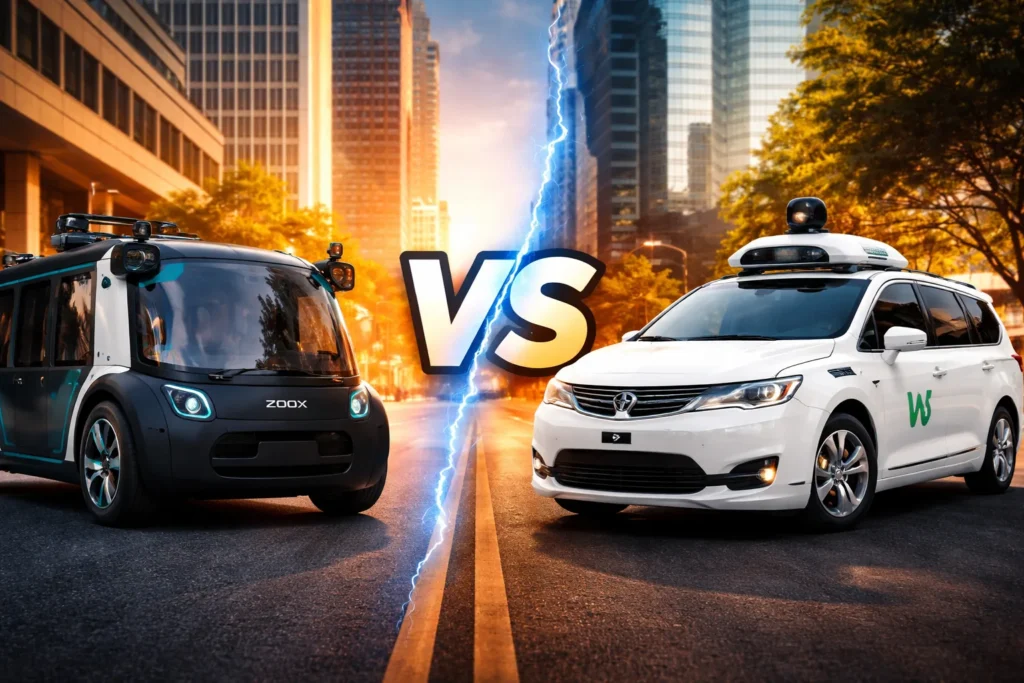
The AI self-driving taxi sector has exploded in recent years, with companies like Waymo and Zoox at the forefront. These AI self-driving taxi services promise safer, more efficient urban mobility, reducing traffic congestion and emissions. But with regulatory hurdles, tech challenges, and fierce competition, not all players are created equal. Let’s break it down.
Table of Contents
What Is an AI Self-Driving Taxi?
An AI self-driving taxi, also known as a robotaxi, is a fully autonomous ride-hailing vehicle that uses artificial intelligence to transport passengers without a human driver. These vehicles rely on advanced AI software, sensors, and real-time data to navigate roads, obey traffic laws, avoid obstacles, and safely reach destinations.
Unlike traditional taxis or ride-sharing services, an AI self-driving taxi operates at Level 4 autonomy, meaning it can handle nearly all driving tasks independently within specific, geo-fenced areas such as cities or urban zones. Passengers simply book a ride through an app, enter the vehicle, and are driven to their destination without any manual intervention.
In 2026, AI self-driving taxis are being deployed across major US cities to improve road safety, reduce traffic congestion, lower emissions, and cut transportation costs. Companies like Waymo and Zoox are leading this shift toward driverless urban mobility, making autonomous taxi services a real-world alternative to human-driven rides.
How Does an AI Self-Driving Taxi Work?
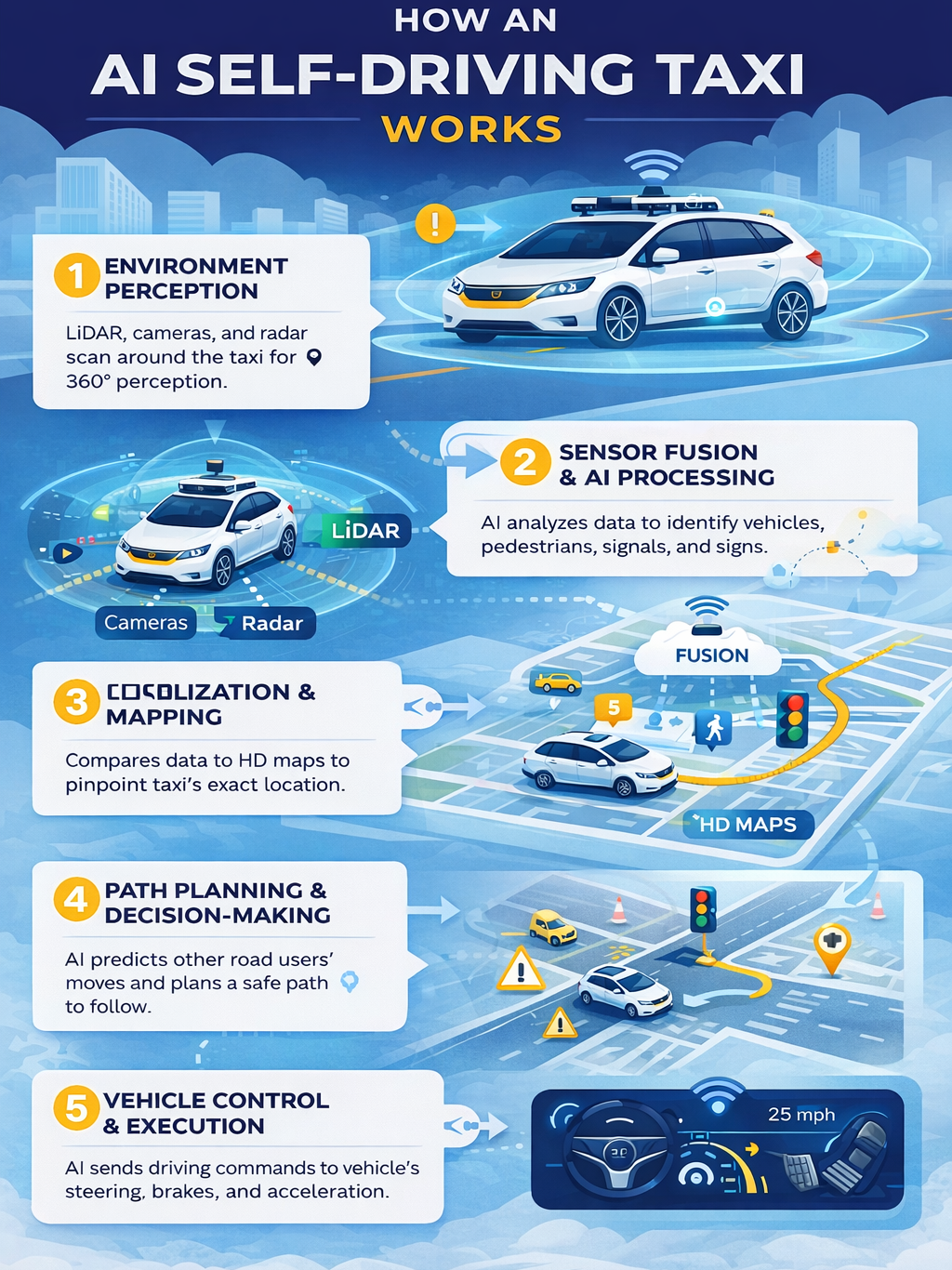
An AI self-driving taxi works by combining sensor perception, machine learning, real-time decision-making, and automated vehicle control into a single intelligent system. Here’s how the process works step by step:
1. Environment Perception
The vehicle continuously scans its surroundings using a combination of:
- LiDAR (laser mapping for 3D depth)
- Cameras (traffic signals, signs, pedestrians)
- Radar (speed and distance of nearby objects)
These sensors create a real-time 360-degree view of the road.
2. Sensor Fusion & AI Processing
All sensor data is fused together using AI models to build an accurate understanding of the environment. The system identifies:
- Vehicles, cyclists, and pedestrians
- Road lanes and intersections
- Traffic lights and road signs
This step allows the AI self-driving taxi to “see” and understand complex urban situations.
3. Localization & Mapping
The taxi compares sensor data with high-definition maps to pinpoint its exact location within centimeters. This ensures accurate navigation, even in dense city areas.
4. Path Planning & Decision-Making
Using deep learning and predictive algorithms, the AI:
- Anticipates the movement of other road users
- Chooses the safest and most efficient route
- Decides when to stop, turn, accelerate, or yield
This is where the taxi behaves like an experienced human driver—often more cautiously.
5. Vehicle Control & Execution
Finally, the AI sends commands to the vehicle’s control systems:
- Steering
- Braking
- Acceleration
Redundant safety systems continuously monitor performance to ensure fail-safe operation.
Together, these steps allow an AI self-driving taxi to operate smoothly, safely, and independently in real-world traffic conditions.
A Brief History of Waymo and Zoox
Waymo, originally a project under Google’s umbrella, has been a pioneer in the AI self-driving taxi space since 2009. It spun off into its own entity in 2016 and has since logged millions of miles on public roads. By 2026, Waymo has expanded its AI self-driving taxi operations to over a dozen US cities, including Phoenix, San Francisco, and Los Angeles. Their focus on lidar-heavy sensor suites and machine learning algorithms has made them a benchmark for safety in AI self-driving taxi deployments.
On the other hand, Zoox, founded in 2014 and acquired by Amazon in 2020, takes a more unconventional approach. Unlike Waymo’s retrofitted vehicles, Zoox designs purpose-built AI self-driving taxi pods from the ground up. These bidirectional, symmetrical vehicles eliminate the need for a traditional front or back, optimizing for urban efficiency. In 2026, Zoox has ramped up its AI self-driving taxi fleets in Las Vegas and Seattle, with plans for nationwide rollout. Their integration with Amazon’s logistics ecosystem gives them a unique edge in the AI self-driving taxi market.
Both companies have faced setbacks—Waymo dealt with legal battles over trade secrets, while Zoox navigated funding crunches pre-acquisition. Yet, their resilience has solidified their positions as leaders in AI self-driving taxi technology.
For more on the evolution of autonomous tech, check out our internal guide on the rise of autonomous vehicles in the US.
Current Market Presence in 2026
As of 2026, Waymo’s AI self-driving taxi service, known as Waymo One, operates in multiple states with a fleet exceeding 1,000 vehicles. They’ve achieved Level 4 autonomy in geo-fenced areas, meaning their AI self-driving taxi can handle most driving scenarios without human intervention. User feedback highlights reliability, with app integration seamless for hailing rides. Waymo’s partnerships with ride-sharing apps like Uber have boosted accessibility.
Zoox, meanwhile, has launched its AI self-driving taxi service in select markets, emphasizing sustainability with all-electric fleets. Their vehicles boast advanced AI for predictive navigation, adapting to real-time traffic patterns. In 2026, Zoox’s AI self-driving taxi ridership has surged thanks to Amazon Prime integrations, offering discounted rides to members. However, their rollout has been slower, focusing on quality over quantity.
Externally, learn more about Waymo’s expansions at waymo.com or Zoox’s innovations at zoox.com.
Key Technologies Powering AI Self-Driving Taxi Services
What sets these AI self-driving taxi providers apart is their tech stack. Waymo relies on a multi-sensor fusion system, combining lidar, radar, and cameras for 360-degree perception. Their AI algorithms, trained on vast datasets, excel in complex urban environments, making their AI self-driving taxi one of the safest options.
Zoox’s edge lies in its custom hardware. Their AI self-driving taxi vehicles feature redundant systems for failover safety, and bidirectional design allows for agile maneuvering in tight spaces. Zoox’s AI emphasizes holistic vehicle intelligence, where the car “thinks” as a unit rather than relying on add-ons.
In terms of software, both use deep learning for path planning, but Waymo’s simulation tools have clocked billions of virtual miles, giving it a data advantage in AI self-driving taxi refinement.
Interested in deeper tech dives? See our internal article on AI in transportation.
Comparison Table: Waymo vs Zoox
To make it easier to compare these AI self-driving taxi leaders, here’s a side-by-side breakdown:
| Feature | Waymo AI Self-Driving Taxi | Zoox AI Self-Driving Taxi |
|---|---|---|
| Founding Year | 2009 (as Google project) | 2014 |
| Parent Company | Alphabet (Google) | Amazon |
| Vehicle Design | Retrofitted Chrysler Pacifica/Jaguar I-Pace | Purpose-built bidirectional pods |
| Operational Cities (2026) | Phoenix, SF, LA, Austin, and 10+ more | Las Vegas, Seattle, expanding to SF |
| Fleet Size | Over 1,000 vehicles | Around 500 vehicles |
| Autonomy Level | Level 4 in geo-fenced areas | Level 4 with full urban focus |
| Key Partnerships | Uber, Lyft | Amazon Prime, logistics firms |
| Safety Record | 20M+ miles with minimal incidents | 5M+ miles, emphasis on redundancy |
| Pricing Model | Per-mile, similar to Uber | Subscription-integrated with Amazon |
| Sustainability | Mixed fleet, shifting to electric | All-electric |
This table highlights how Waymo leads in scale, while Zoox innovates in design for the AI self-driving taxi future.
Waymo vs Zoox Pricing: Which AI Self-Driving Taxi Is Cheaper in 2026?
Pricing is a big factor when choosing an AI self-driving taxi service, especially as these options become more common in US cities. In early 2026, Waymo and Zoox take different approaches to fares, affecting which one feels cheaper for riders.
Waymo has charged for rides since launching commercially years ago. Its pricing mirrors traditional ride-hailing like Uber or Lyft, with a base fare, per-mile, and per-minute charges, plus potential surge during busy times. In cities like San Francisco, Los Angeles, and Phoenix, a typical 5-10 mile urban trip often costs $15-30, sometimes more than human-driven alternatives due to premium positioning and operational costs. Riders appreciate the transparency—you see the exact fare upfront in the app—but many note it’s not the budget option yet.
Zoox, on the other hand, is just starting to charge in 2026. It launched public rides in Las Vegas and San Francisco in late 2025 with free trips to build ridership and gather data. Paid service began in Las Vegas early this year, with San Francisco following soon after. Zoox aims for fares comparable to traditional taxis or Uber/Lyft, potentially making it competitive or even slightly cheaper in some cases, especially with Amazon ecosystem perks like Prime discounts rumored for loyal users.
Overall, which AI self-driving taxi is cheaper? As of January 2026, Zoox edges out as the more affordable option in its operating areas, thanks to its newer entry and focus on matching market rates without premium markup. Waymo tends to run 20-40% higher for similar trips based on recent comparisons. Prices can vary by city, time, and demand, so always check the app for quotes. As both scale up, expect more competition driving costs down for AI self-driving taxi users.
For real-time fare estimates, visit Waymo’s site or Zoox’s app page.
Waymo vs Zoox Safety and Accuracy: Which AI Self-Driving Taxi Performs Better?
Safety and accuracy are top priorities for any AI self-driving taxi, and both Waymo and Zoox emphasize robust systems—but one has a clear lead in proven performance.
Waymo boasts the most extensive real-world data, with tens of millions of fully driverless miles logged by 2026. Independent analyses show its AI self-driving taxi vehicles involved in 80-90% fewer injury crashes than human drivers in comparable areas. It has handled complex scenarios like highways, dense urban traffic, and adverse weather with minimal incidents. Disengagements (when the system needs help) are rare, and Waymo publishes detailed safety reports, including crash benchmarks against human stats.
Zoox focuses on purpose-built vehicles with redundant sensors and bidirectional design for better urban accuracy. It hit milestones like 1 million autonomous miles recently, emphasizing failover systems and smooth low-speed maneuvers. However, with a smaller fleet and newer public deployments, its long-term safety data is less comprehensive than Waymo‘s.
In head-to-head, Waymo leads in safety and accuracy for AI self-driving taxi rides, thanks to billions of simulated and real miles refining its AI. Zoox shows strong potential with innovative hardware, but lacks the same scale of proven track record yet. Both exceed human driver averages in controlled tests, making AI self-driving taxi options safer overall.
Check official safety pages at waymo.com/safety or zoox.com/safety for the latest metrics.
SWOT Analysis: Scouting the Strengths and Weaknesses
In this scout analysis section, we’ll dissect the strengths, weaknesses, opportunities, and threats (SWOT) for each in the AI self-driving taxi arena.
Waymo’s SWOT
- Strengths: Massive data advantage from years of testing; strong regulatory approvals; widespread AI self-driving taxi availability.
- Weaknesses: Dependence on third-party vehicles increases costs; occasional software glitches in new markets.
- Opportunities: Expansion into trucking and delivery; global AI self-driving taxi partnerships.
- Threats: Competition from Tesla’s Full Self-Driving; potential antitrust scrutiny from Google ties.
Zoox’s SWOT
- Strengths: Innovative vehicle architecture; seamless Amazon ecosystem integration for AI self-driving taxi users.
- Weaknesses: Slower rollout pace; higher initial development costs for custom builds.
- Opportunities: Leveraging Amazon’s vast network for nationwide AI self-driving taxi dominance; e-commerce tie-ins.
- Threats: Supply chain issues for electric components; catching up to Waymo’s mileage data.
This scout analysis shows Waymo’s maturity gives it a current edge, but Zoox’s fresh approach could disrupt the AI self-driving taxi market long-term.
For similar analyses, visit our internal page on SWOT in tech industries.
Challenges and Future Outlook for AI Self-Driving Taxi
Both companies face common hurdles in the AI self-driving taxi space: regulatory changes, public trust after rare incidents, and scaling infrastructure like charging stations. In 2026, federal guidelines have eased deployments, but states like California remain stringent.
Looking ahead, Waymo might solidify its lead with more cities, while Zoox could leapfrog via Amazon’s resources. The winner in AI self-driving taxi? It depends on your priorities—scale for Waymo, innovation for Zoox.
Externally, stay updated with industry news at techcrunch.com/autonomous-vehicles.
Conclusion: Who’s Leading the AI Self-Driving Taxi Race?
In 2026, Waymo edges out as the leader in the US AI self-driving taxi market due to its broader footprint and proven track record. However, Zoox’s bold vision makes it a close contender, especially for eco-conscious riders. As AI self-driving taxi technology evolves, both are shaping a driverless future. Which one will you try first?
If you’re exploring more on mobility, read our internal roundup of top AI innovations in 2026.
Frequently Asked Questions About Waymo vs Zoox AI Self-Driving Taxi in 2026
Here are short answers to common questions about AI self-driving taxi services from Waymo and Zoox as of early 2026.
1. Which cities offer Waymo or Zoox AI self-driving taxi rides in 2026?
Waymo: Fully driverless paid rides in Phoenix, San Francisco, Los Angeles, Austin, and Atlanta. Expansions planned for many more cities like Miami, Dallas, and others throughout 2026.
Zoox: Paid rides starting in Las Vegas early 2026, with San Francisco following later. Limited areas for now.
2. Is Waymo or Zoox cheaper for AI self-driving taxi rides?
Waymo rides are often premium-priced, typically 20-40% higher than Uber/Lyft for similar trips.
Zoox is newer to charging and aims for rates comparable to traditional ride-hailing, potentially making it the more affordable AI self-driving taxi option initially.
3. Which AI self-driving taxi is safer: Waymo or Zoox?
Waymo leads with over 100 million driverless miles and 80-90% fewer injury crashes than human drivers.
Zoox has strong redundancy but fewer miles and some software recalls—no major injuries yet.
4. What vehicles do Waymo and Zoox use for AI self-driving taxi?
Waymo: Retrofitted Jaguar I-Pace SUVs (and newer models like Zeekr).
Zoox: Purpose-built bidirectional pods with no steering wheel, facing seats for up to 4 passengers.
5. Can I hail a Waymo or Zoox AI self-driving taxi right now in January 2026?
Yes for Waymo—fully driverless paid rides available now in operating cities via the Waymo One app or Uber.
For Zoox, paid AI self-driving taxi rides start early 2026 in Las Vegas.
6. Which company leads the US AI self-driving taxi market in 2026?
Waymo dominates with larger fleet (~2,500+ vehicles), more cities, and hundreds of thousands of weekly rides.
Zoox is innovative but smaller-scale, with Amazon backing for future growth.
7. Are Waymo and Zoox AI self-driving taxi services available 24/7?
Waymo: Yes, 24/7 in core markets like Phoenix, SF, and LA.
Zoox: Building toward 24/7 reliability as fleet expands in 2026.
For the latest AI self-driving taxi info, check waymo.com or zoox.com.
Also Read :
Best ai agents for productivity-2026
Written by Parth Kumar – AI & emerging technology researcher at AIToolScoutAI, covering autonomous vehicles and AI mobility trends.
5 thoughts on “👉 Waymo vs Zoox: Who Is THE MOST POWERFUL AI Self-Driving Taxi Market in the US in 2026?”
Comments are closed.