
The Chinese AI landscape has exploded in early 2026 with three revolutionary models that are challenging Western dominance in artificial intelligence. Kimi K2.5, Baidu Ernie 5.0, and GLM 4.7 Flash represent the cutting edge of Chinese AI models, each bringing unique capabilities to developers, enterprises, and researchers worldwide. This comprehensive comparison explores how these Chinese AI models stack up against each other and their international competitors like GPT-5 and Claude Sonnet 4.5.
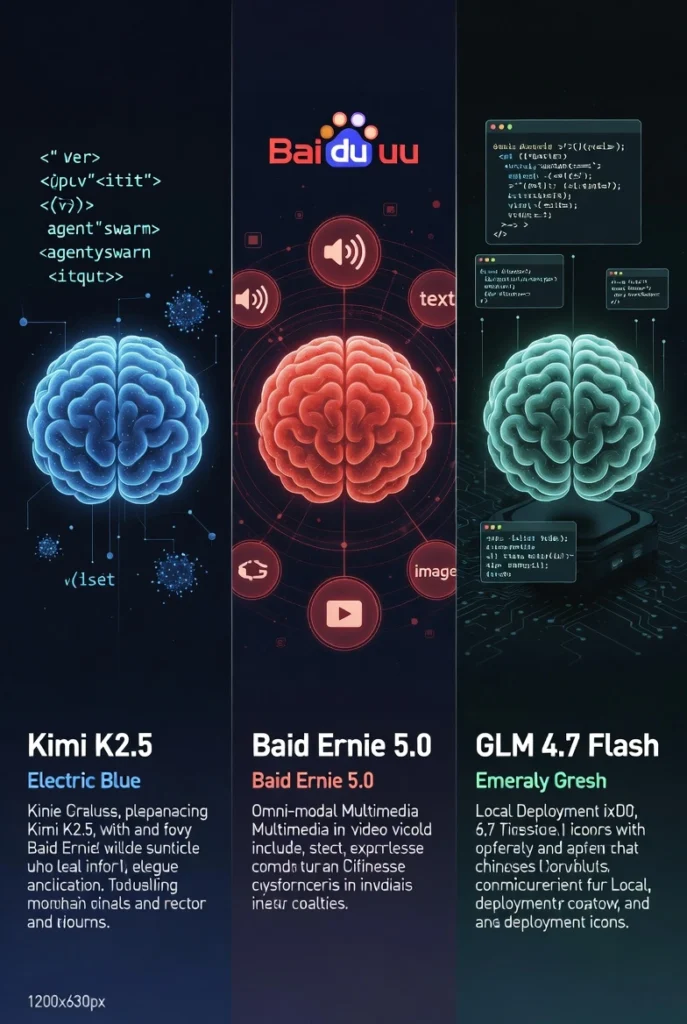
Table of Contents
Understanding the Chinese AI Revolution in 2026
The release of these three models signals a fundamental shift in global AI development. Chinese tech giants have invested billions in creating AI systems that rival Western counterparts while offering superior cost efficiency. The Chinese AI models ecosystem now represents a legitimate alternative to Silicon Valley’s AI offerings, with optimized architectures that deliver exceptional performance per compute unit despite hardware restrictions. These Chinese AI models demonstrate that innovation can thrive even under challenging geopolitical circumstances.
Kimi K2.5: The Open-Source Visual Coding Champion
Among the latest Chinese AI models, Kimi K2.5 stands out for its exceptional visual coding capabilities and innovative Agent Swarm technology.
Overview and Architecture
Released January 27, 2026, by Moonshot AI, Kimi K2.5 achieves breakthrough multimodal AI through 15 trillion mixed visual-text tokens trained atop Kimi K2-Base. Its Mixture-of-Experts architecture features 384 specialized experts with ~1 trillion total parameters, activating only 32 billion per token for efficiency. Unlike competitors that bolt vision onto language models, Kimi K2.5 was natively multimodal from inception, processing text, images, and video as interconnected data streams. Moonshot AI confirms this design enables superior cross-modal reasoning.
Key Capabilities and Features
Visual Coding Excellence: Kimi K2.5 excels at transforming visual designs into functional code. On LiveCodeBench V6, it achieved 83.1%, positioning it ahead of Claude 3.5 Sonnet (64.0%) though still behind GPT-5’s approximately 89.6%. The model can convert screenshots, UI mockups, and even video demonstrations into production-ready HTML, CSS, and JavaScript, representing a breakthrough in how Chinese AI models approach multimodal code generation.
Agent Swarm Technology: Perhaps the most innovative feature is K2.5’s Agent Swarm capability, which can spawn up to 100 specialized sub-agents working in parallel. This revolutionary approach reduces execution time by up to 4.5× for complex tasks like large-scale research, long-form writing, and batch data processing. The system uses Parallel-Agent Reinforcement Learning (PARL) to optimize task decomposition and concurrent execution.
Thinking Modes: The model offers two distinct modes – K2.5 Instant for quick responses and K2.5 Thinking for deep reasoning tasks that display the model’s chain-of-thought process. This flexibility allows developers to balance speed and accuracy based on their specific needs.
Document Generation: Powered by K2.5, Kimi’s AI document agent creates Word files and LaTeX-enabled PDFs, converts content across formats, and generates professional presentations with strong aesthetic judgment. The model produces functional Excel spreadsheets with formulas, pivot tables, and charts that remain linked as data changes.
Read About : ChatGpt vs Gemini vs Claude
Performance Benchmarks
On the challenging HLE-Full benchmark comprising 2,500 questions across mathematics, physics, and other technical domains, Kimi K2.5 achieved the highest score among all tested models, surpassing GPT-5.2, Claude 4.5 Opus, and other reasoning models. This validates that Chinese AI models using open-weights MoE architecture can match or exceed proprietary Western systems on pure intellectual tasks.
For agentic tasks, the model demonstrated exceptional capabilities on BrowseComp and WideSearch benchmarks, with results averaged over multiple runs showing consistent performance improvements through its tool-using capabilities.
Accessibility and Deployment
Kimi K2.5 is available through multiple channels:
- Free access with usage limits via kimi.com
- API access at $0.60 per million input tokens and $3 per million output tokens
- Open-source weights on Hugging Face for self-hosted deployment
- Kimi Code CLI tool for terminal-based coding assistance
The model requires approximately 600GB for INT4 quantized weights, making deployment practical on high-end workstations with multiple GPUs or cloud infrastructure. This accessibility makes it one of the most developer-friendly Chinese AI models available today.
Also Read : ChatGPT vs Gemini vs Claude 2026: Which AI Is Best Right Now?
Baidu Ernie 5.0: The Omni-Modal Enterprise Powerhouse
As one of the most advanced Chinese AI models for enterprise applications, Baidu Ernie 5.0 brings comprehensive omni-modal capabilities to businesses worldwide.
Architecture and Technical Foundation
Unveiled at Baidu World 2025 on November 13, Baidu Ernie 5.0 employs a 2.4 trillion parameter Mixture-of-Experts architecture, activating only 3% of experts per inference for exceptional efficiency. According to Baidu’s official announcement, the model was trained from the ground up with text, images, audio, and video integrated throughout, enabling sophisticated cross-modal reasoning. Built on Baidu’s PaddlePaddle framework with custom Kunlunxin AI chips (launching 2026-2027), it provides end-to-end infrastructure control.
Enterprise-Focused Capabilities
Multimodal Understanding and Generation: Ernie 5.0 can simultaneously process and generate content across text, images, audio, and video formats. This makes it particularly valuable for enterprise applications requiring rich media handling, such as automated content creation, multimedia analysis, and interactive customer service systems.
Industry Integration: Baidu has positioned Baidu Ernie 5.0 as an enterprise-first solution, already integrated into 625 partner companies via Baidu AI Cloud, including major brands like Samsung, Honor, and Vivo. Among Chinese AI models, Ernie 5.0 stands out for its deep enterprise ecosystem integration. The model powers Baidu’s AI-reconstructed search engine, where approximately 70% of top search results now appear in rich media format.
Factual Reasoning and Tool Use: The model excels in factual processing, instruction following, creative writing, and agentic planning. Its tool-use capabilities enable it to interact with external systems and databases, making it suitable for complex enterprise workflows.
Digital Human Technology: Ernie 5.0 powers Baidu’s digital human applications, which are being rolled out to global markets for applications ranging from virtual streamers to customer service representatives.
Benchmark Performance
On the LMArena Text leaderboard, Ernie 5.0 (version ERNIE-5.0-0110) scored 1,460 points, ranking #8 globally and becoming the only Chinese AI models representative in the platform’s top 10. Notably, it ranked ahead of OpenAI’s GPT-5.1-High and Google’s Gemini-2.5-Pro.
For mathematical reasoning, the model claimed the #2 spot globally, trailing only the unreleased GPT-5.2-High. This represents a significant achievement for a Chinese model, demonstrating competitive performance with the most advanced Western systems on complex logical tasks.
In benchmarks comparing Ernie 5.0 against DeepSeek, Google Gemini, and OpenAI’s GPT-5 on language, audio, and visual tasks, Baidu’s model came within a few percentage points of top performers across most categories, though it didn’t claim the top spot in every test.
Availability and Access
Users can experience Ernie 5.0 for free at ernie.baidu.com, while enterprise customers can access API services through Baidu’s Qianfan MaaS (Model as a Service) platform. The model has officially exited its preview phase as of January 2026 and is now in full production.
GLM 4.7 Flash: The Developer’s Local AI Assistant
GLM 4.7 Flash represents a unique approach among Chinese AI models, prioritizing local deployment and developer accessibility over cloud-dependent infrastructure.
Technical Architecture and Design Philosophy
Released by Zhipu AI in January 2026, GLM 4.7 Flash features 30 billion total parameters with only 3 billion active per token through MoE architecture. Positioned as the “free-tier” flagship, it’s optimized for coding, agentic workflows, and local deployment on consumer hardware. According to Z.AI’s documentation, it runs on 24GB GPUs at 60-80+ tokens/sec, making powerful AI accessible without cloud dependency. The model supports 200K token contexts using Multi-head Latent Attention (MLA), reducing memory by 73% versus standard attention.
Developer-Centric Features
Coding Excellence: GLM 4.7 Flash demonstrates exceptional coding capabilities, achieving 73.8% on SWE-bench Verified (a 5.8% improvement over GLM 4.6), 66.7% on SWE-bench Multilingual (a 12.9% improvement), and 41% on Terminal Bench 2.0 (a 16.5% improvement). The model implements a “think before acting” mechanism within programming frameworks like Claude Code, Kilo Code, TRAE, Cline, and Roo Code, showcasing how Chinese AI models are innovating in agentic coding workflows.
Frontend Aesthetics: GLM 4.7 Flash shows marked progress in frontend generation quality, producing visually superior webpages, presentations, and posters. This makes it valuable for developers who need to quickly prototype user interfaces with good design sensibility.
Tool Invocation: On the τ²-Bench interactive tool invocation benchmark, the model achieved an open-source SOTA of 84.7 points, surpassing Claude Sonnet 4.5. It scored 67 points on the BrowseComp web task evaluation, demonstrating strong agentic capabilities.
Thinking Modes: GLM 4.7 further enhances Interleaved Thinking and introduces Preserved Thinking and Turn-level Thinking. The model thinks before every response and tool calling, automatically retains all thinking blocks across multi-turn conversations in coding scenarios, and supports per-turn control over reasoning to balance latency and accuracy.
Performance and Benchmarks
On Code Arena, a professional coding evaluation system with millions of global users, GLM 4.7 Flash ranks first among open-source models and domestic models, even outperforming GPT-5.2 in certain coding tasks. The model achieved an open-source SOTA score of 84.9 on LiveCodeBench V6, demonstrating that Chinese AI models can excel in specialized domains like coding and development.
Community testing shows GLM 4.7 excels particularly at UI generation and tool calling, with users reporting “best 70B-or-less model” experiences for practical development workflows. The model’s 97% success rate indicates exceptional operational stability and reliability.
Deployment and Accessibility
GLM 4.7 Flash is available through:
- Free API tier via Z.AI’s platform
- GLM Coding Plan subscription starting at $3/month for integration with coding tools
- Open-source weights on Hugging Face for completely offline deployment
- Support for vLLM, SGLang, KTransformers, and Ollama deployment frameworks
The model’s efficient design makes it the most accessible of the three Chinese AI models for developers wanting to run powerful AI locally without cloud costs.
Detailed Feature Comparison Table
| Feature | Kimi K2.5 | Baidu Ernie 5.0 | GLM 4.7 Flash |
|---|---|---|---|
| Total Parameters | ~1 trillion | 2.4 trillion | 30 billion |
| Active Parameters | 32 billion | ~72 billion (3%) | 3 billion |
| Architecture | MoE (384 experts) | MoE (sparse) | MoE |
| Training Data | 15T mixed tokens | Native omni-modal | Text-focused |
| Native Multimodal | Yes (text, image, video) | Yes (text, image, audio, video) | Limited |
| Context Window | 256K tokens | Not specified | 200K tokens |
| Open Source | Yes (modified MIT) | No (proprietary) | Yes |
| Best For | Visual coding, agent swarms | Enterprise applications | Developer tools, local deployment |
| API Pricing | $0.60/$3 per M tokens | Enterprise only | Free tier + $3/month plans |
| Agent Capabilities | Agent Swarm (100 agents) | Enterprise workflows | Strong tool calling |
| Coding Benchmarks | 83.1% LiveCodeBench | Competitive | 84.9% LiveCodeBench, 73.8% SWE-bench |
| Mathematical Reasoning | Top on HLE-Full | #2 globally | Strong AIME scores |
| Deployment Options | Cloud, API, self-hosted | Cloud, enterprise | Cloud, API, local (24GB GPU) |
| Hardware Requirements | 600GB (INT4) | Not disclosed | 24GB GPU minimum |
| Inference Speed | Efficient (MoE) | Very efficient (3% activation) | 60-80+ tokens/sec (local) |
| License | Modified MIT | Proprietary | Open |
| Release Date | January 27, 2026 | November 13, 2025 | January 19, 2026 |
| Special Features | Agent swarm, visual coding | Digital humans, search integration | Local deployment, thinking modes |
Use Case Scenarios: Which Model is Right for You?
Choose Kimi K2.5 For:
Visual-to-code workflows, massive parallel task execution (Agent Swarm), open-source flexibility with competitive performance, multimodal reasoning, AI-powered document tools, and complex research synthesis.
Choose Baidu Ernie 5.0 For:
Enterprise multimedia processing, production cloud infrastructure, Chinese language content, factual accuracy with enterprise support, customer-facing AI (chatbots, digital humans), and Baidu ecosystem integration.
Choose GLM 4.7 Flash For:
Local AI on consumer hardware, developer productivity tools, cost efficiency with open-source access, cloud-independence, coding and software development focus, and strong agentic capabilities on limited resources.
The Cost-Performance Analysis
Kimi K2.5 offers free access with API pricing at $0.60/$3 per million tokens – significantly lower than GPT-5 or Claude. Baidu Ernie 5.0 provides enterprise pricing through Baidu AI Cloud with competitive rates and better Chinese infrastructure integration. GLM 4.7 Flash delivers the most compelling cost story with free API tiers and $3/month subscriptions, plus zero ongoing costs for local deployment on consumer hardware (24GB GPU). When evaluating Chinese AI models, cost efficiency becomes a critical advantage over Western alternatives.
The Open Source Advantage
Kimi K2.5 and GLM 4.7 Flash embrace open-source with weights on Hugging Face, enabling independent study and deployment. This open-source approach distinguishes these Chinese AI models from proprietary Western alternatives, fostering innovation and transparency. Kimi uses modified MIT licensing; GLM follows open-weight principles with vLLM/SGLang support. Baidu Ernie 5.0 remains proprietary via Baidu platforms, providing quality control but limiting flexibility.
Future Development Trajectories
Kimi’s Roadmap: Six-month release cycles suggest Kimi K3 could arrive late 2026 with extended context (1M+ tokens), enhanced agent coordination, and improved multimodal integration.
Baidu’s Strategy: Custom Kunlunxin chips signal vertical integration with deeper connections to Apollo Go autonomous driving, search, and enterprise cloud services.
Zhipu AI’s Evolution: Continued optimization for efficiency and accessibility with improvements in coding, tool integration, and potential edge deployment variants.
Integration Considerations
Deploying Chinese AI models requires careful consideration of several factors. Data Sovereignty: Self-hosting options (Kimi K2.5, GLM 4.7 Flash) provide compliance advantages. Language Performance: Strong multilingual support with particular Chinese language strength. Ecosystem Integration: Baidu Ernie 5.0 excels with Chinese infrastructure; open-source models offer custom toolchain flexibility. Hardware: Verify requirements and availability for self-hosted deployments.
Real-World Performance Insights
Kimi K2.5 users praise its visual coding quality with minimal adjustments needed for generated frontends. Agent Swarm proves transformative for research workflows. Baidu Ernie 5.0 receives positive enterprise reviews for stability and Chinese language performance, with strong ecosystem integration. GLM 4.7 Flash has developed a loyal developer following for local deployment, with excellent code generation and thoughtful problem-solving capabilities.
The Geopolitical Context
These competitive Chinese AI models signal the fracturing of the global AI landscape into distinct ecosystems. US export restrictions have accelerated innovation in efficient architectures and domestic chip production. This creates opportunities through cost-effective alternatives to Western AI, while requiring organizations to navigate compliance and technology sourcing policies carefully.
Frequently Asked Questions (FAQs)
1. Which model is best for coding tasks in 2026?
For pure coding performance among Chinese AI models, GLM 4.7 Flash edges ahead with its 73.8% SWE-bench Verified score and strong performance on coding benchmarks. However, Kimi K2.5 excels specifically at visual-to-code tasks, making it superior for frontend development from designs. Both outperform most Western alternatives at their price points.
2. Can these Chinese AI models run completely offline?
Yes, both Kimi K2.5 and GLM 4.7 Flash can be deployed completely offline using their open-source weights. These Chinese AI models offer true data sovereignty for organizations with strict privacy requirements. Kimi K2.5 requires substantial hardware (approximately 600GB for INT4 quantization), while GLM 4.7 Flash can run on a single high-end consumer GPU (24GB). Baidu Ernie 5.0 requires cloud connectivity as it’s not available for self-hosting.
3. How do these models compare to GPT-5 and Claude Sonnet 4.5?
On specific benchmarks, these Chinese AI models are competitive or superior. Kimi K2.5 topped the HLE-Full benchmark, beating GPT-5.2 and Claude 4.5 Opus. Baidu Ernie 5.0 ranked ahead of GPT-5.1-High in mathematical reasoning. GLM 4.7 Flash outperforms Claude Sonnet 4.5 on tool invocation tasks. However, Western models may still lead in certain specialized domains.
4. Are these models safe for enterprise use?
All three Chinese AI models are being used in production environments. Baidu Ernie 5.0 serves 625+ enterprise partners including Samsung and Vivo. The open-source nature of Kimi K2.5 and GLM 4.7 Flash allows thorough security auditing before deployment. Organizations should conduct their own evaluations based on specific security, compliance, and data handling requirements.
5. What are the licensing restrictions for commercial use?
Kimi K2.5 uses a modified MIT license requiring attribution for large-scale commercial deployments but is otherwise permissive. GLM 4.7 Flash follows an open license allowing commercial use (verify specific terms on Hugging Face). Baidu Ernie 5.0 is proprietary and requires commercial licensing through Baidu AI Cloud.
6. How does the Agent Swarm in Kimi K2.5 actually work?
Agent Swarm allows Kimi K2.5 to decompose complex tasks into up to 100 parallel subtasks executed by specialized sub-agents. The model uses Parallel-Agent Reinforcement Learning (PARL) to learn optimal task decomposition. A central orchestrator coordinates execution, with each agent capable of independent tool use. This reduces execution time by up to 4.5× for research, writing, and data processing tasks.
7. Can I use GLM 4.7 Flash without an internet connection?
Yes, GLM 4.7 Flash can run completely offline after initial download of model weights from Hugging Face. You’ll need appropriate hardware (minimum 24GB GPU recommended) and can use deployment frameworks like vLLM or Ollama. This makes it ideal for air-gapped environments or situations requiring complete data privacy.
8. Which model has the best multilingual support?
All three Chinese AI models demonstrate strong multilingual capabilities, but Baidu Ernie 5.0 and Kimi K2.5 show particular strength in Chinese-English translation and mixed-language contexts due to their native multimodal training. For primarily English applications, validate performance with your specific use cases, as these models were optimized with significant Chinese language data.
Also Read : Best AI Massage Chairs in 2026
9. How frequently are these models updated?
Moonshot AI released K2.5 approximately six months after K2-Base, suggesting quarterly to semi-annual major updates. Baidu typically releases annual major versions with incremental updates throughout the year. Zhipu AI’s GLM series has shown rapid iteration with versions 4.6 to 4.7 releasing within months. All three Chinese AI models companies maintain active development roadmaps with frequent improvements.
10. What hardware is required for self-hosting Kimi K2.5?
For Kimi K2.5, the INT4 quantized weights require approximately 600GB of storage. Practical deployment options include: 2× Mac Studio M3 Ultra with 512GB each (approximately $20k investment) for slower inference (~21 tokens/sec), or 8× AMD W7900 GPUs with 96GB each (approximately $70-100k) for production speeds. Cloud deployment via services like NVIDIA NIM provides a more accessible alternative.
Conclusion: The New Era of Accessible AI
The simultaneous emergence of Kimi K2.5, Baidu Ernie 5.0, and GLM 4.7 Flash marks a watershed moment in AI democratization. These Chinese AI models prove that frontier AI capabilities need not remain locked behind expensive API paywalls or proprietary systems.
For developers, the open-source availability of Kimi K2.5 and GLM 4.7 Flash provides unprecedented access to billion-parameter models that can run on accessible hardware. The cost-performance ratios of all three models challenge the Western AI pricing paradigm, potentially saving organizations thousands to millions in annual AI infrastructure costs.
For enterprises, Baidu Ernie 5.0 demonstrates that Chinese AI models providers can deliver enterprise-grade, multimodal AI systems competitive with anything from Silicon Valley, while offering better integration with Asian market infrastructure and compliance frameworks.
The competition between these three Chinese AI models – and their Western counterparts – ultimately benefits the entire AI ecosystem through accelerated innovation, improved accessibility, and expanded use cases. Whether you prioritize visual coding capabilities (Kimi K2.5), enterprise integration (Baidu Ernie 5.0), or local deployment efficiency (GLM 4.7 Flash), the Chinese AI landscape of 2026 offers compelling options worthy of serious evaluation.
As these models continue evolving through 2026 and beyond, we can expect further performance improvements, new capabilities, and potentially even more accessible deployment options. The Chinese AI models landscape continues to mature rapidly, bringing cutting-edge AI capabilities to a global audience. The era of AI monopoly is ending; the era of AI diversity and accessibility has begun.
Check Out: 👉 Waymo vs Zoox: Who Is Dominating the AI Self-Driving Taxi Market in the US in 2026?
Last Updated: January 2026 | For the latest information on these models, visit the official documentation: Kimi K2.5, Baidu Ernie, and GLM 4.7 Documentation
honestly this is such a great post thanks for sharing man. i been looking for some clear info on this for a long time and finally found it here. the way u explained everything is so simple even i could understand it lol. sometimes these blogs get way too technical but u kept it real and easy to follow. definitely gonna bookmark this page for later and share it with my friends who need to see this. keep up the good work bro!
And you’re promoting these sites?