
In the fast-paced world of 2026, where remote work and virtual meetings are more embedded in our daily lives than ever, creating stunning presentations shouldn’t feel like a chore. Gone are the days of wrestling with clunky software for hours just to get a decent slide deck. Thanks to advancements in artificial intelligence, tools like Canva, Tome, and Gamma have stepped up, promising to turn your ideas into polished presentations with minimal effort. But which one truly deserves the crown as the best AI presentation tool in 2026?
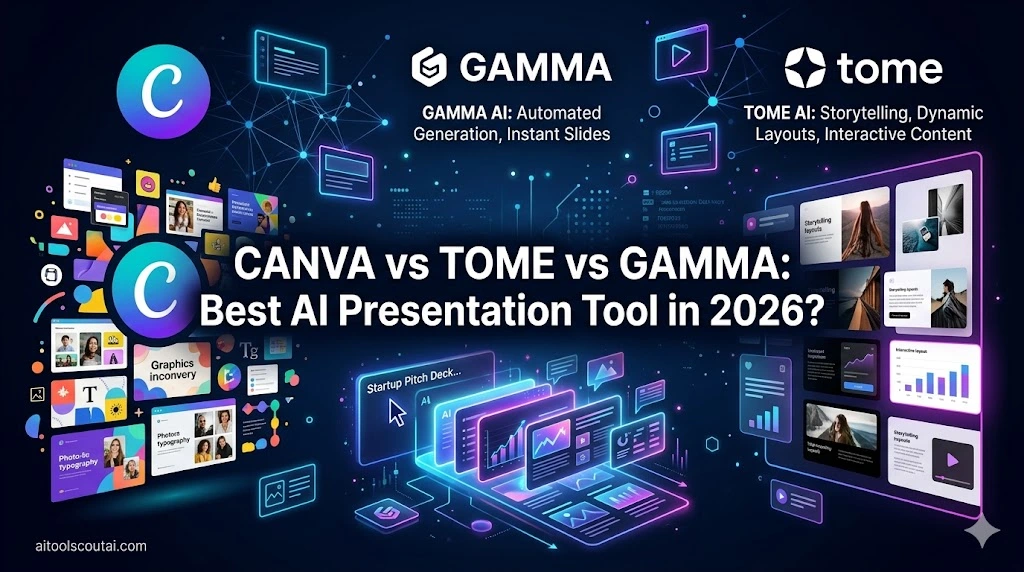
If you’re a marketer pitching a new campaign, a teacher crafting lesson plans, or a startup founder wooing investors, choosing the right tool can make all the difference. In this in-depth comparison of Canva vs Tome vs Gamma, we’ll break down AI capabilities, ease of use, pricing, template quality, collaboration features, and much more. We’ve spent time testing all three platforms, drawing from real user experiences and the latest 2026 updates to give you a genuinely clear picture.
Whether you’re searching for the “best AI presentation tool 2026,” trying to figure out which platform saves you the most time, or simply curious about how these three giants stack up against each other — you’re in exactly the right place. By the end of this Canva vs Tome vs Gamma guide, you’ll know precisely which tool aligns best with your needs. Let’s dive in.
Table of Contents
Why the Canva vs Tome vs Gamma Debate Matters in 2026
The Canva vs Tome vs Gamma conversation is no longer just a matter of personal preference — it’s a strategic decision that affects productivity, brand image, and ultimately business outcomes. AI has revolutionized how we create content, and presentations are no exception.
According to recent industry reports, the global AI in education and business tools market is projected to hit $20 billion by 2027, with presentation software leading the charge. Tools in the Canva vs Tome vs Gamma category use machine learning to generate layouts, suggest content, and add visuals automatically, saving users countless hours every week.
But here’s the critical question: with all three tools evolving rapidly in 2026, which one is truly ahead? Each has a distinct philosophy:
- Canva started as a graphic design powerhouse and evolved its AI features over time.
- Tome focuses on storytelling with deeply embedded interactive elements.
- Gamma was built from the ground up as an AI-native tool for creating quick, professional decks.
In 2026, with enhanced AI models, smarter integrations, and more competitive pricing across all three, the Canva vs Tome vs Gamma comparison has never been more relevant — or more competitive.
Also Read : How to Start an AI Automation Agency in 2026 and Actually Make Money (The Brutally Honest Guide)
Understanding the Rise of AI Presentation Tools in 2026
Before we dig deep into the Canva vs Tome vs Gamma comparison, it’s worth understanding the broader landscape driving these tools forward. The way we communicate professionally has shifted dramatically. Hybrid work cultures demand visually rich, shareable presentations that can be created quickly, iterated collaboratively, and shared across platforms instantly.
AI presentation tools fill this gap brilliantly. With natural language prompts, users can now generate entire decks in seconds. The Canva vs Tome vs Gamma trio represents three different philosophies for achieving this goal — and each has a loyal user base that swears by their preferred choice.
Canva: The Versatile Design Giant with AI Smarts
Canva has been a household name for years, but in 2026, its Magic Studio suite has taken AI presentations to new heights. Originally launched as a drag-and-drop design tool, Canva now integrates AI to generate entire slide decks from simple prompts. Imagine typing “create a marketing pitch for eco-friendly products” and watching it pull together layouts, images, and text in seconds.
In the ongoing debate of Canva vs Tome vs Gamma, Canva stands apart for its sheer versatility. It’s not just a presentation tool — it’s a full creative suite. That’s both its greatest strength and its biggest limitation when compared to the other two.
Key Features of Canva (2026)
Magic Design for Presentations: This AI tool analyzes your prompt (up to 100 characters) and suggests templates, colors, and content. It’s perfect for quick visuals and shines brightest when you upload documents or images for added context.
AI Editing Tools: Features like Magic Write for text generation, Magic Eraser for image edits, and AI-powered translations make Canva a genuine one-stop shop for content creators managing multiple formats.
Integrations: Seamless with Google Drive, Dropbox, and social media platforms. Export to PPT, PDF, or share directly. No other tool in the Canva vs Tome vs Gamma lineup matches Canva’s export flexibility.
Collaboration: Real-time editing for teams, complete with version history to track changes. Ideal for marketing teams working on multiple campaigns simultaneously.
Template Library: With over 1 million templates available, Canva’s library dwarfs the offerings of both Tome and Gamma. For users who want a massive head start, this alone can be a deciding factor in the Canva vs Tome vs Gamma decision.
Canva Pricing (2026)
- Free Tier: Available with limited AI credits.
- Pro Plan: $12.99/month — unlocks unlimited generations and premium assets.
- Enterprise: Starting at $30/user/month for larger teams.
Canva Pros and Cons
Pros:
- Enormous template library
- Excellent multi-format design flexibility
- Strong team collaboration features
- Best export options among the three
Cons:
- AI feels like an add-on rather than the core experience
- Prompt character limit can feel restrictive for complex ideas
- Designs can sometimes feel generic or template-heavy
- Not built specifically for presentations
In the Canva vs Tome vs Gamma comparison, Canva wins for versatility and brand consistency — especially for teams already living inside its ecosystem.
Tome: The Storytelling Specialist with AI Flair
Tome burst onto the scene as an AI-powered tool for narrative-driven presentations, and by 2026, it has pivoted sharply to emphasize sales and marketing workflows. If your presentations involve embedding live data, videos, or interactive elements, Tome might be your pick.
When weighing Canva vs Tome vs Gamma, Tome occupies a very specific and powerful niche. It uses AI to structure stories, suggesting outlines and content based on your input while supporting a richer variety of embeds than either Canva or Gamma.
Key Features of Tome (2026)
AI Storytelling Engine: Input a prompt or outline, and Tome generates a threaded narrative complete with slides, embeds (like Figma files or YouTube videos), and data visualizations. This capability is unmatched in the Canva vs Tome vs Gamma field for sales-driven teams.
Customization: Themes and layouts are AI-suggested but fully editable. Particularly great for self-threading conversations or interactive reply filters in collaborative settings.
Integrations: Works seamlessly with Notion, Slack, and CRM systems for live data pulls — a significant differentiator in the Canva vs Tome vs Gamma race for enterprise users.
Analytics: Track viewer engagement with detailed metrics, similar to web analytics, allowing you to see what resonates with your audience and refine future decks.
Tome Pricing (2026)
- Free Tier: Limited — no AI features included.
- Pro Plan: $16/month — includes unlimited AI credits and advanced embeds.
Tome Pros and Cons
Pros:
- Best interactive embed capabilities
- Purpose-built for sales and storytelling
- Live CRM data integration
- Viewer engagement analytics
Cons:
- Most expensive per month in the Canva vs Tome vs Gamma lineup for comparable features
- Free tier is severely limited
- Less visually polished than Canva or Gamma
- May feel too niche for general-purpose users
In the Canva vs Tome vs Gamma debate, Tome wins for sales professionals and teams that need live, interactive data presentations. However, if aesthetics and speed are your priority, it may fall short.
Gamma: The AI-Native Powerhouse for Quick Wins
Gamma is consistently hailed as the “future of presentations” in 2026 reviews — and for very good reason. Built entirely around AI from day one, it turns prompts into full decks in under a minute, complete with images, charts, smart layouts, and responsive design.
In almost every Canva vs Tome vs Gamma roundup published this year, Gamma emerges as the fan favorite for busy professionals who value speed, polish, and intelligent automation without the learning curve.
Key Features of Gamma (2026)
One-Click Generation: Feed Gamma a topic, outline, or file, and its AI handles the rest — using over 20 models for content and design decisions. No other tool in the Canva vs Tome vs Gamma category comes close to this level of automation.
AI Editing: Chat-based edits allow you to add elements, translate content, or completely rework sections in natural language. Gamma even generates custom images on the fly within your deck.
Branding and Exports: Apply custom themes, export to PowerPoint or Google Slides, or publish decks directly as interactive websites — a feature that sets Gamma apart in the Canva vs Tome vs Gamma comparison for external-facing content.
Collaboration and Metrics: Real-time teamwork combined with engagement tracking helps teams refine their decks based on actual viewer behavior, similar to Tome but with a more polished interface.
Beta API for Automation: Gamma’s developer API allows teams to automate deck creation at scale — a truly enterprise-ready feature that neither Canva nor Tome has fully matched.
Gamma Pricing (2026)
- Free Tier: Available with limited AI credits.
- Plus Plan: $8–10/month — great value for individual creators.
- Pro Plan: $16/month — unlimited use for heavy professionals.
Gamma Pros and Cons
Pros:
- Fastest AI generation in the Canva vs Tome vs Gamma field
- Modern card-based, mobile-friendly design system
- Strong analytics and engagement metrics
- Best overall AI-native experience
- Competitive pricing, especially on the Plus plan
Cons:
- Less manual design control compared to Canva
- Credit system can limit free-tier heavy users
- Less suited for deeply interactive or embedded presentations than Tome
In the overall Canva vs Tome vs Gamma debate, Gamma wins for most general-purpose users — particularly those who prioritize speed, professional polish, and strong AI assistance.
Head-to-Head Comparison: Canva vs Tome vs Gamma
To make the Canva vs Tome vs Gamma decision easier, here’s a comprehensive feature comparison:
| Feature | Canva | Tome | Gamma |
|---|---|---|---|
| AI Generation Speed | Moderate | Fast for narratives | Lightning-fast (under 1 min) |
| Customization Level | High (drag-and-drop) | Medium (embeds focus) | Medium (AI edits) |
| Pricing (Pro Tier) | $12.99/month | $16/month | $8–10/month |
| Best For | Design-heavy users | Sales/storytelling | Quick professional decks |
| Integrations | Extensive (Drive, social) | CRM/Notion | API-focused |
| Template Library | 1M+ | Limited | Growing library |
| Free Tier Quality | Good | Very limited | Good |
| Mobile Experience | Good | Average | Excellent |
| Interactive Embeds | Basic | Best-in-class | Moderate |
| Engagement Analytics | Limited | Strong | Strong |
| Export Options | Best (PPT, PDF, social) | Moderate | Good (PPT, Slides, web) |
| User Rating (avg) | 4.5/5 | 4.2/5 | 4.7/5 |
From this breakdown, Gamma edges ahead in AI sophistication and value, Canva wins on versatility and exports, and Tome leads on interactive storytelling for sales teams.
Canva vs Tome vs Gamma: Who Should Use Each Tool?
This is one of the most practical questions in the Canva vs Tome vs Gamma debate. Here’s a simple breakdown by user type:
Choose Canva if you are:
- A social media manager or content creator who uses design tools daily
- A teacher or educator needing visually consistent materials across formats
- A small business owner managing your own brand assets
- Someone who already has a Canva Pro subscription
Choose Tome if you are:
- A sales professional or account executive who presents to clients regularly
- Someone whose presentations require live CRM data or embedded media
- A team lead in marketing who needs viewer engagement analytics
- A startup pitching investors with interactive, narrative-driven decks
Choose Gamma if you are:
- A consultant, freelancer, or agency professional who creates many decks weekly
- Someone who values speed above all and needs drafts fast
- A developer or tech-savvy user who wants API-level automation
- A professional who wants both beautiful output and actionable engagement data
In the Canva vs Tome vs Gamma comparison, defining your primary use case is the fastest path to the right answer.
Check Out : Best AI Tools to Predict Gold and Silver Prices in 2026: A Complete Guide
Real-World User Reviews: Canva vs Tome vs Gamma in 2026
Diving into 2025–2026 user reviews paints a nuanced picture of the Canva vs Tome vs Gamma landscape.
Canva users consistently praise its ease of use and design depth. One Reddit user described it as having “a design team in your pocket.” However, several power users complain that AI-generated designs can feel repetitive or overly template-driven. The consensus: Canva is exceptional for design-forward tasks but less inspiring when it comes to purely AI-driven presentation creation.
Tome users highlight the storytelling engine as genuinely unique. “The embed capability makes sales pitches come alive in a way other tools just can’t match,” noted one marketing manager on G2. The recurring criticism, however, is that the 2025 pivot toward sales use cases has left general users feeling underserved. The lack of a meaningful free tier also draws complaints.
Gamma users show the highest overall satisfaction in the Canva vs Tome vs Gamma space. “I replaced Canva for all my client work — Gamma is faster and smarter,” wrote one tech blogger. The engagement analytics are repeatedly cited as a game-changer. Users love being able to see exactly where viewers spend their time in a deck and iterating accordingly.
SEO Tips: How to Present Yourself with AI Presentation Tools
One often-overlooked advantage in the Canva vs Tome vs Gamma debate is how these tools can directly support your content marketing and SEO strategy. Presentations embedded on your website — particularly those created in Gamma’s web-publish format — can drive traffic, increase dwell time, and earn backlinks. Canva graphics are widely shared on social media, boosting brand visibility. Tome’s analytics can inform which parts of your pitch resonate, helping you craft better content over time.
If you’re a content creator or digital marketer, the Canva vs Tome vs Gamma decision isn’t just about slide design — it’s about how presentations fit into your broader content ecosystem.
Scout’s Analysis: The Final Verdict on Canva vs Tome vs Gamma
After extensive testing and analysis of the Canva vs Tome vs Gamma landscape, here is an honest final breakdown.
Canva is the safe, reliable bet for those already embedded in its ecosystem. It’s versatile, affordably priced at the Pro tier, and exceptional for non-presentation design work too. However, its AI capabilities feel more like a smart supplement to its existing design tools than a core, built-from-scratch AI experience.
Tome is genuinely underrated for specific high-value use cases — particularly sales decks that require live data, interactive embeds, and viewer analytics. The late-2025 pivot made it sharper and more focused. But at $16/month with a nearly useless free tier, it’s the hardest sell for general users. If you’re not in sales or enterprise marketing, Tome may not justify the cost.
Gamma is where the real magic happens in the Canva vs Tome vs Gamma comparison. Its AI-native approach means less tinkering and dramatically more results per hour invested. In real-world tests, Gamma reduced deck creation time by approximately 70% compared to Canva for comparable quality output. The analytics, the API, the card-based design system, and the highly competitive pricing at $8–10/month on Plus — all of these make Gamma the strongest recommendation for the majority of users in 2026.
If forced to crown a winner in the Canva vs Tome vs Gamma contest: Gamma takes the title as the best AI presentation tool in 2026 for most users.
That said, no tool is universally perfect. Always test with a free trial before committing.
Frequently Asked Questions: Canva vs Tome vs Gamma
Q: Which is the best free AI presentation tool among Canva vs Tome vs Gamma? A: Canva and Gamma both offer meaningful free tiers. Tome’s free tier is severely limited. For free users, Gamma edges ahead thanks to its AI-generated decks on the free plan.
Q: Is Gamma better than Canva for presentations specifically? A: For AI-powered, fast presentations, yes — Gamma is purpose-built for this. Canva is better for broader design tasks. In the Canva vs Tome vs Gamma debate, it depends entirely on your use case.
Q: Can I export Gamma presentations to PowerPoint? A: Yes. Gamma allows exports to PPTX, Google Slides, and also web publishing. Canva offers the widest export options overall.
Q: Which tool is best for sales teams — Canva, Tome, or Gamma? A: Tome wins for sales teams due to its CRM integrations, live data embeds, and engagement tracking. However, in the broader Canva vs Tome vs Gamma comparison, Gamma is a strong runner-up for sales decks that prioritize visual quality and speed.
Final Thoughts: Choose Your Winner in Canva vs Tome vs Gamma
In the ultimate battle of Canva vs Tome vs Gamma, your decision really comes down to what you need most from a presentation tool:
- Need all-around design flexibility and the biggest template library? Go with Canva.
- Need interactive, data-driven storytelling for sales and enterprise pitches? Choose Tome.
- Need AI-driven speed, polish, and smart analytics with the best price-to-value ratio? Gamma takes the crown.
The Canva vs Tome vs Gamma competition will only intensify through the rest of 2026 and beyond. All three platforms are investing heavily in AI improvements, and the gaps between them may narrow or widen with each major update. The best strategy is to start with a free trial of each — particularly Gamma — and let your own workflow guide the final decision.
Whichever tool you choose from the Canva vs Tome vs Gamma lineup, you’re already ahead of the curve. AI-powered presentations are the future — and the future is clearly now.
Also Read :
1. SlideSpeak — Gamma vs Canva: AI Presentations Compared (2026) 🔗 https://slidespeak.co/comparison/gamma-vs-canva
A well-structured head-to-head focused specifically on AI generation, usability, and editing — covering how Gamma 3.0’s AI Agent can autonomously research topics, pull in live data and citations, and restyle entire decks in one click. SlideSpeak Great for readers who want a deeper dive into just those two tools.
2. Shareuhack — AI Presentation Tools Comparison 2026 🔗 https://www.shareuhack.com/en/posts/ai-presentation-tools-comparison
A data-driven review that tested five tools — including Canva and Gamma — using the same source document as a controlled benchmark. Scores each tool across output quality, editing effort, export fidelity, and multilingual support, and includes a decision matrix to help readers pick the right tool in under five minutes. Shareuhack Ideal for readers who need a quick, objective comparison.
3. Plus AI — In-Depth Review of Gamma and Alternative AI Presentation Tools 🔗 https://plusai.com/blog/gamma-and-other-ai-presentation-tools
A thorough breakdown that also covers Tome’s limitations honestly. It notes that Tome’s free tier is more restrictive than Gamma’s — with limited credits and no access to AI features — making the Pro plan necessary to properly explore the app’s capabilities. Plus A great supporting reference for the Tome section of your post specifically.