
The Problem Every Biker Knows But Rarely Talks About
You’ve got the gear. You’ve got the bike. But every time you hit the highway, you’re essentially operating a 200-pound machine at 70 mph with technology that hasn’t fundamentally changed in decades.
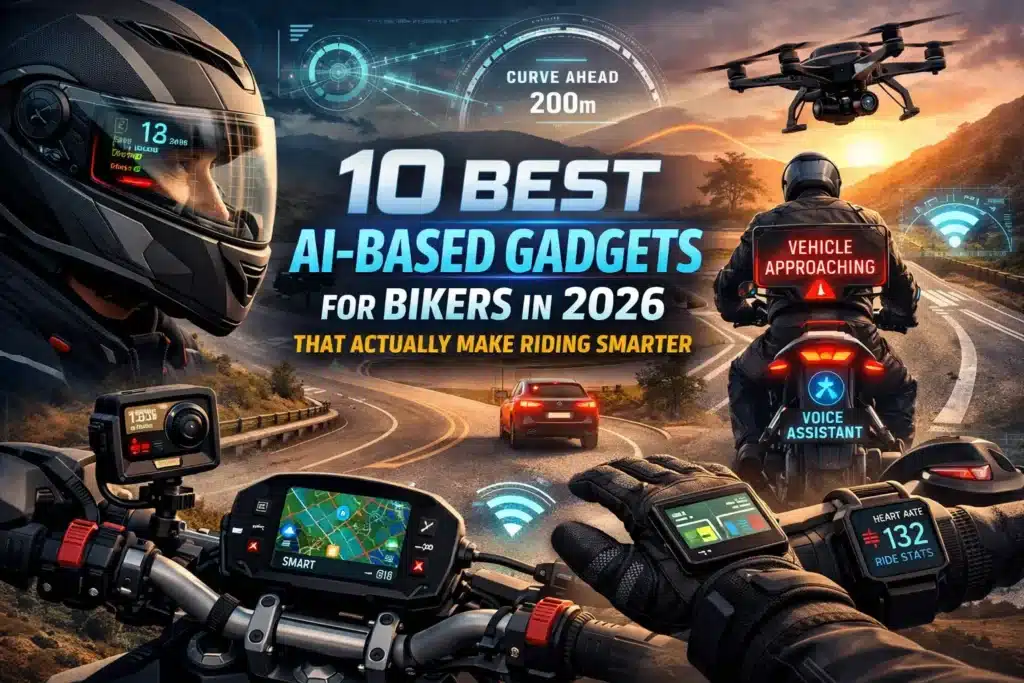
That’s changing fast. The best AI-based gadgets for bikers in 2026 aren’t just novelties — they’re closing the safety and performance gap between motorcycles and modern cars. Blind-spot warnings, real-time hazard alerts, AI-powered navigation, crash detection — these aren’t science fiction anymore. They’re shipping to doorsteps right now.
If you’re still riding without smart tech, you’re leaving both safety and convenience on the table.
Why AI Gadgets for Bikers Are Having Their Moment in 2026
The motorcycle industry has always lagged behind automotive in adopting driver-assistance technology and AI-based gadgets for bikers. A new car comes loaded with lane-keep assist, automatic emergency braking, and adaptive cruise. A new motorcycle? Maybe ABS if you’re lucky.
But the rise of miniaturized AI chips, edge computing, and smarter sensors has finally brought genuinely useful AI-based gadgets for bikers to market at prices that don’t require selling a kidney. Insurers are taking notice too — several providers now offer premium discounts for riders using certified smart safety devices.
The National Highway Traffic Safety Administration (NHTSA) reports that motorcyclists are approximately 24 times more likely to die in a crash per mile traveled than passenger car occupants (NHTSA motorcycle safety data). That’s the real driver behind this technology wave. The market is responding to a genuine crisis.
Also Read : 10 Best Humanoid Robot Factories in China (2026 Guide)
The 10 Best AI-Based Gadgets for Bikers in 2026
1. SHOEI Opticson Smart Helmet
The SHOEI Opticson integrates a heads-up display with AI-driven hazard recognition directly into the visor. It reads road conditions, flags vehicles in blind spots, and integrates with your phone for turn-by-turn navigation projected in your line of sight — no head movement required.
Why it stands out: SHOEI’s safety pedigree combined with genuine edge-AI processing (not just Bluetooth mirroring) makes this the gold standard for AI-based gadgets for bikers who prioritize safety above all.
Buy it: SHOEI Opticson on RevZilla
2. Sena 50S Mesh Intercom with AI Noise Cancellation
Sena’s flagship 50S uses AI audio processing to isolate voice communication even at highway speeds. It learns your environment over time, adapting noise filters to wind patterns specific to your riding style and bike type.
Why it stands out: This isn’t passive noise cancellation. It actively models the acoustic environment and suppresses interference dynamically.
Buy it: Sena 50S on Amazon
3. Garmin Zumo XT2 GPS Navigator
The Zumo XT2 is purpose-built for motorcycles with AI route optimization that factors in weather, surface conditions, road curvature ratings, and real-time traffic. It’s one of the most practical AI-based gadgets for bikers who do long-distance touring.
Why it stands out: Garmin’s live services integration means the AI isn’t just routing — it’s anticipating. It reroutes before you hit the problem, not after.
Buy it: Garmin Zumo XT2 on Garmin.com
4. Innovv K5 AI Dash Camera System
The Innovv K5 runs continuous front and rear recording with an AI layer that detects near-miss events, sudden braking, and erratic vehicle behavior nearby. It auto-saves and tags clips without rider input.
Why it stands out: Most bike cameras are passive recorders. The K5 is an active witness — it understands what it’s seeing and reacts accordingly.
Buy it: Innovv K5 on Innovv.com
5. Bosch Connected Horizon (OEM Integration Module)
Bosch’s Connected Horizon system is now available as an aftermarket add-on for most modern motorcycles with CAN bus access. It uses AI-processed topographic and camera data to prepare the bike’s stability and braking systems for upcoming corners — before the rider sees them.
Why it stands out: This is predictive riding assistance, not reactive. The system starts adjusting suspension and brake pre-load based on road data 2–3 seconds ahead of your position.
Buy it: Bosch Moto Solutions Partner Network
6. Cardo Packtalk Edge
Cardo’s Packtalk Edge communicates with up to 15 riders simultaneously using AI-managed mesh networking that automatically reroutes voice signals when riders spread across different terrain or signal gaps.
Why it stands out: For group riders, this is transformational. The AI handles the network management invisibly — you just talk.
Buy it: Cardo Packtalk Edge on Cardo Systems
7. Alpinestars Tech-Air 5 Smart Airbag Vest
The Tech-Air 5 processes 1,000 data points per second from embedded accelerometers and gyroscopes. Its AI algorithm detects crash trajectories in approximately 35 milliseconds and deploys the airbag before full impact.
Why it stands out: Among AI-based gadgets for bikers focused on protective gear, this is the category leader. The AI here isn’t a nice-to-have — it’s the difference between a hospital visit and walking away.
Buy it: Alpinestars Tech-Air 5 on Alpinestars.com
8. TireAlert Smart TPMS with AI Pressure Profiling
Beyond basic tire pressure monitoring, TireAlert’s AI module builds a profile of your tires’ behavior over time — flagging slow leaks, heat-related expansion anomalies, and pressure drops that fall outside your bike’s historical norms.
Why it stands out: Most TPMS systems are dumb sensors. This one learns what normal looks like for your specific setup and alerts you to deviations before they become dangerous.
Buy it: TireAlert TPMS on Amazon
9. Skully CROSS-E Smart Rearview System
Skully’s CROSS-E integrates a rear-facing 180-degree camera with AI object tracking that distinguishes between vehicles, cyclists, and stationary objects. It displays a persistent rearview feed inside the helmet visor peripheral zone.
Why it stands out: Motorcycle mirrors are a known weak point in rider awareness. This system eliminates the blind spot problem with AI-filtered visual data, not just raw camera footage.
Buy it: Skully CROSS-E on Skully.com
10. Beeline Moto 2 AI Navigation Pod
Beeline’s compact navigation pod uses AI to translate complex routes into simple directional cues — no screen-reading required while riding. The 2026 model adds predictive rerouting based on your riding pace and typical stop patterns.
Why it stands out: Simplicity done intelligently. It’s one of the best AI-based gadgets for bikers who want navigation without cognitive overload.
Buy it: Beeline Moto 2 on Beeline.com
Comparison Table: Top AI Gadgets for Bikers at a Glance
| Gadget | Primary AI Function | Price Range | Best For |
|---|---|---|---|
| SHOEI Opticson | HUD + hazard detection | $800–$1,100 | Safety-first riders |
| Sena 50S | AI noise cancellation | $300–$380 | Daily commuters, tourers |
| Garmin Zumo XT2 | Predictive routing | $500–$600 | Long-distance tourers |
| Innovv K5 | Incident-triggered recording | $200–$280 | Evidence and insurance |
| Bosch Connected Horizon | Predictive suspension/brake prep | $400–$600 | Sport and adventure riders |
| Cardo Packtalk Edge | Mesh network management | $280–$350 | Group riders |
| Alpinestars Tech-Air 5 | Crash airbag deployment | $700–$900 | All-rounder safety |
| TireAlert TPMS | Pressure profiling | $80–$140 | Touring, highway riding |
| Skully CROSS-E | 180° AI rearview | $450–$550 | Urban and highway riders |
| Beeline Moto 2 | Simplified AI navigation | $120–$160 | Minimal-distraction riders |
Scout Analysis: Are These AI-based gadgets for bikers Actually Worth It?
Market Readiness
The AI gadget space for bikers has matured significantly. Two years ago, most “smart” motorcycle gadgets were essentially Bluetooth accessories with marketing spin. In 2026, genuine edge-AI processing has arrived — devices run models locally, not just piping data to a cloud server. That shift matters for reliability, latency, and privacy.
Practical Feasibility
The installation barrier has dropped. Most of the AI-based gadgets for bikers listed here either mount externally or integrate via standard OBD/CAN bus protocols. You don’t need a dealership or specialist — a Saturday afternoon handles most installations. The exception is the Bosch Connected Horizon system, which requires some technical confidence with wiring.
Cost vs. Value
Here’s the honest math: a single crash that injures you costs thousands in medical bills, missed work, and bike repair. The Alpinestars airbag vest at $800 is cheap insurance by any rational calculation. The navigational and communication tools (Garmin, Beeline, Sena) are lifestyle purchases — worthwhile but not critical-path safety investments.
Scalability
Most of these devices offer firmware-based feature expansions. The AI models that run them are updatable — meaning the gadget you buy today will improve over its lifespan. That’s a meaningful differentiator from traditional motorcycle electronics.
Long-Term Impact
The European Union’s ACEM motorcycle safety framework (ACEM Road Safety) is actively pushing for mandatory connected safety systems on new motorcycles by 2028. The AI gadgets available today are essentially early adoption of what will become baseline equipment. Riders who build familiarity now will be ahead of the curve, not chasing it.
The Motorcycle Industry Council (MIC) in the US also publishes safety technology guidance worth reviewing: Motorcycle Industry Council.
Practical Takeaways to Upgrade to AI-based gadgets for bikers
Start with impact-weighted purchases. If your budget is limited, the Alpinestars airbag vest delivers the highest safety return per dollar. If you’re a daily commuter in heavy traffic, the Sena 50S or Skully CROSS-E deserve top priority.
Don’t buy gadgets in isolation. A smart helmet paired with good tyre monitoring and a rearview AI system creates a coherent safety ecosystem. Gadgets working together are more valuable than individual tools.
Check your insurer before buying. Several providers now offer 5–15% premium reductions for riders using certified crash detection devices. The Alpinestars Tech-Air system is already on approved lists with multiple UK and European insurers, and US adoption is growing.
Update firmware regularly. AI-based gadgets for bikers are only as smart as their latest models. Most manufacturers push updates every 3–6 months with improved detection accuracy.
External References
- NHTSA Motorcycle Safety Data: https://www.nhtsa.gov/road-safety/motorcycles
- ACEM Road Safety Framework: https://www.acem.eu/road-safety
- Motorcycle Industry Council (MIC): https://www.mic.org
- Bosch Motorcycle Solutions: https://www.bosch-motorcycle.com
- FIM (Fédération Internationale de Motocyclisme) Safety Initiatives: https://www.fim-moto.com
The Road Ahead for AI-Based Gadgets for Bikers
The gap between motorcycles and cars in terms of intelligent safety systems is closing at an accelerating pace. What’s available in 2026 would have seemed improbable in 2020. And what will be standard by 2030 — predictive collision avoidance, V2X communication between bikes and infrastructure, AI-managed adaptive riding dynamics — is already in prototype stages at labs like Bosch, Continental, and Yamaha’s R&D division.
The riders who start integrating the best AI-based gadgets for bikers now aren’t just buying useful tools. They’re developing the habits, awareness, and technical fluency to take full advantage of what’s coming. Riding will always carry inherent risk. But riding without available intelligence in 2026 is a choice, not a necessity.
FAQs: AI-Based Gadgets for Bikers
1. What are the most important AI-based gadgets for bikers to buy first in 2026?
Prioritize safety-critical devices first. An airbag vest like the Alpinestars Tech-Air 5 and a smart rearview system like the Skully CROSS-E address the highest-risk riding scenarios. Once those are covered, communication and navigation tools add meaningful quality-of-life improvements.
2. Do AI motorcycle gadgets work with all bike brands and models?
Most external AI gadgets — helmets, vests, cameras, intercoms — are brand-agnostic. Devices that integrate with the bike’s electronics (like Bosch Connected Horizon) require CAN bus compatibility, which varies by make and model year. Always check compatibility before purchasing.
3. How does an AI airbag vest like the Alpinestars Tech-Air 5 actually know when to deploy?
The vest runs a real-time algorithm analyzing data from multiple accelerometers and gyroscopes. It identifies crash-signature patterns — sudden deceleration combined with specific angular movement — and deploys the airbag in approximately 35 milliseconds. It distinguishes between aggressive braking and actual crash trajectories to avoid false deployments.
4. Are AI-based gadgets for bikers covered under motorcycle insurance?
Some insurers offer discounts for using certified crash detection devices. In the UK and parts of Europe, Alpinestars Tech-Air is on approved discount lists. In the US, adoption is growing but varies by provider. Contact your insurer directly and ask specifically about telematics or AI safety device discounts.
5. What is the battery life of AI-based motorcycle gadgets like smart helmets?
It varies significantly. The SHOEI Opticson HUD system runs approximately 8–10 hours on a full charge. The Alpinestars airbag vest lasts around 25–35 hours of standby use before needing a recharge. Most devices charge via USB-C and can top up while stored between rides.
6. Can AI motorcycle gadgets improve with software updates after purchase?
Yes — this is one of the key advantages over traditional motorcycle electronics. Most AI-based gadgets for bikers in 2026 receive firmware updates that improve detection accuracy, add features, and fix edge-case errors. Sena, Garmin, Cardo, and Alpinestars all push regular updates via companion apps.
7. Are smart motorcycle helmets with AI displays legal to use while riding?
In most jurisdictions, yes. HUD-equipped helmets that project navigation and hazard data into the rider’s peripheral vision are legal in the EU, US, UK, and Australia, as they don’t obstruct forward vision. Always verify local traffic law, as regulations evolve alongside technology.
8. What is the difference between basic Bluetooth motorcycle gadgets and genuine AI-based gadgets for bikers?
Basic Bluetooth accessories transmit audio or data between devices. Genuine AI-based gadgets process information locally using machine learning models — recognizing patterns, making predictions, and triggering responses without needing to consult a remote server. The distinction matters for reliability, response time, and offline functionality.
9. How do I know if an AI motorcycle gadget has real AI or is just marketed as AI?
Look for edge processing hardware (embedded AI chips), offline functionality claims, and adaptive behavior over time. Devices that require constant cellular connectivity for their core functions are generally using cloud AI, not local intelligence. Product specifications listing neural processing units (NPUs) or dedicated AI inference chips indicate genuine on-device AI.
10. Which AI-based gadgets for bikers offer the best value under $300?
The Sena 50S ($300–$380) is borderline but worth the stretch. Under $300 cleanly, the TireAlert Smart TPMS ($80–$140) and Beeline Moto 2 ($120–$160) offer genuine AI-driven functionality without premium pricing. The Innovv K5 AI dash cam ($200–$280) is also strong value for the incident-detection capability it provides.
2 thoughts on “10 Best AI-Based Gadgets for Bikers in 2026 That Actually Make Riding Smarter”
Comments are closed.