
The packaging industry was never supposed to be glamorous. Corrugated cardboard, heat-sealed pouches, shrink wrap — not exactly the stuff of tech headlines. But something quietly dramatic has been happening on factory floors and in R&D labs over the last few years. AI in packaging technology has moved from pilot programs and trade show demos to full-scale deployment, and in 2026, its fingerprints are on nearly every stage of the packaging lifecycle.
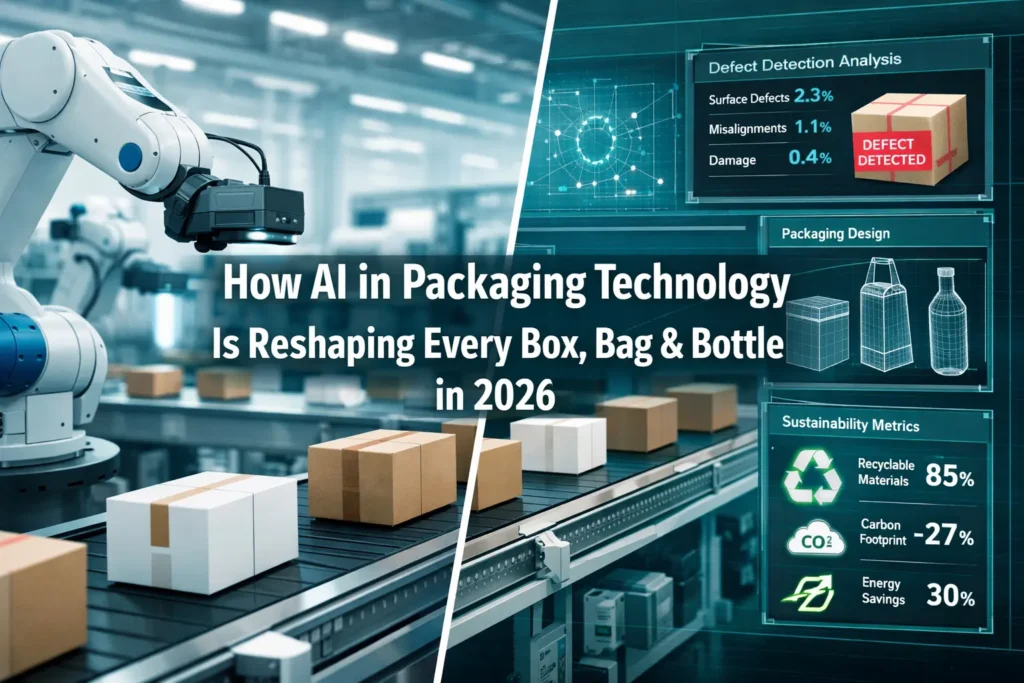
This isn’t hype. From the moment a product concept is sketched to the second a customer tears open a parcel on their doorstep, AI is now influencing decisions that were once made entirely by human intuition, slow iteration cycles, and expensive physical prototyping. The result? Faster time-to-shelf, dramatically less material waste, smarter supply chains, and packaging that actually fits the product — rather than drowning it in void fill.
Let’s break down exactly what’s happening, how it’s working, and why 2026 is the year AI in packaging technology went from “interesting experiment” to genuine industry standard.
Table of Contents
Why 2026 Is a Turning Point for AI in Packaging Technology
For years, the packaging sector lagged behind industries like automotive, finance, and healthcare in AI adoption. The barriers were real: diverse SKUs, highly variable materials, legacy equipment, and thin margins that made large capital investments feel reckless.
But three things converged to change that.
First, the cost of machine learning infrastructure fell sharply. Cloud-based AI platforms from providers like Google Cloud and Microsoft Azure made it possible for mid-sized packaging companies to access enterprise-grade AI without building proprietary systems from scratch.
Second, the pressure from retailers and brands for sustainable packaging intensified. Consumer goods giants began requiring suppliers to hit specific recyclability, lightweighting, and carbon targets. Manual optimization simply cannot meet those demands at scale — AI in packaging technology can.
Third, the talent and sensor data finally matured. Computer vision hardware became affordable. IoT sensors on packaging lines became standard. The data that AI needs to function well was finally available in the volume and quality required.
The combination of these three forces explains why, heading into 2026, AI in packaging technology is no longer a competitive advantage — it’s quickly becoming table stakes.
Read About How to use ai tools to find research papers here.
6 Core Areas Where AI in Packaging Technology Is Making the Biggest Impact
1. Intelligent Structural Design and Prototyping
Traditional packaging design required engineers to prototype, test, fail, revise, and prototype again. Depending on complexity, a single packaging redesign could take six to twelve months. AI in packaging technology has compressed that cycle dramatically.
Generative design tools trained on thousands of structural packaging datasets can now propose dozens of viable carton or tray configurations in minutes, optimizing simultaneously for compression strength, material use, shipping cube efficiency, and shelf presence. Engineers don’t replace their judgment — they redirect it. Instead of sketching from a blank page, they evaluate and refine AI-generated candidates.
Real example: Smurfit Westrock, one of the world’s largest corrugated packaging manufacturers, has integrated AI-assisted structural design tools into its engineering workflow. Their platforms evaluate flute configuration, board grade, and die-cut geometry against performance data to recommend optimized designs before a single physical sample is cut.
2. AI-Powered Quality Control and Vision Inspection
Quality control on high-speed packaging lines has always been a compromise. Human inspectors fatigue. Sampling-based inspection misses defects that occur in clusters. Camera systems from a decade ago could catch gross visible defects but struggled with subtle print inconsistencies, micro-seal failures, or minor dimensional deviations.
Modern AI vision systems running on convolutional neural networks inspect 100% of output — not a sample — at line speeds that no human could match. They detect contamination, label misalignment, seal integrity failures, and color drift in real time, triggering automatic rejection or line slowdowns before a bad batch ships.
This is one of the most commercially mature applications of AI in packaging technology. Companies like Cognex and Keyence have deployed deep-learning vision tools across food, pharmaceutical, and consumer goods packaging lines globally.
Real example: A major contract pharmaceutical packager running blister pack lines for oral solid doses implemented AI vision inspection to catch micro-tears in foil seals — defects invisible to the naked eye that could compromise product stability. Defect escape rates dropped by over 70% within the first quarter of deployment.
Check Out : Phishing Attacks in 2026: How to Spot Fake Links and Protect Yourself (Complete Guide)
3. Sustainable Packaging Optimization Through AI
No conversation about AI in packaging technology in 2026 is complete without talking about sustainability. It has become the industry’s loudest mandate, and AI is the most powerful tool for meeting it.
Lightweighting — reducing material use while maintaining structural integrity — is where AI earns its keep most visibly. By training models on mechanical testing data and real-world performance outcomes, engineers can identify exactly how much material can be removed from a structure without compromising function. The gains are often surprising: walls 8–12% thinner than what human intuition would suggest, maintaining the same stacking strength.
AI also supports recyclability by flagging when a proposed material combination — say, a metallized foil laminate over a polyethylene base — would contaminate a recycling stream. This happens at the design stage, before tooling is committed, where changes are cheap.
The Ellen MacArthur Foundation has documented extensively how packaging redesign through data-driven methods can reduce plastic use by 20–30% without sacrificing shelf life or consumer convenience. AI in packaging technology is the engine that makes this level of precision redesign scalable.
Real example: Nestlé’s packaging innovation teams have piloted AI-driven material optimization tools that evaluate recyclability scores, carbon footprint estimates, and supplier availability simultaneously — helping designers make tradeoffs that used to require weeks of cross-functional analysis in a matter of hours.
4. Predictive Maintenance on Packaging Equipment
Unplanned downtime on a packaging line is expensive in a way that most people outside manufacturing don’t fully appreciate. A high-speed form-fill-seal machine running 400 pouches per minute that goes dark for four hours doesn’t just cost labor — it costs the entire downstream logistics and retail fill-rate commitment.
AI-powered predictive maintenance systems monitor vibration signatures, temperature cycling, torque readings, and seal pressure data continuously. They identify early indicators of mechanical degradation — a bearing showing abnormal vibration frequency, a jaw heater with inconsistent temperature recovery — days or weeks before a failure occurs.
This is AI in packaging technology applied not to the package itself but to the machinery that makes it, and the ROI is often faster and more measurable than almost any other AI investment in the sector.
Real example: Tetra Pak, the Swiss-Swedish packaging giant, has rolled out predictive maintenance capabilities powered by machine learning across its equipment-as-a-service offering. Customers receive alerts and maintenance scheduling recommendations based on equipment health data streamed from sensors embedded in their filling lines.
5. AI in Packaging Supply Chain and Demand Forecasting
The packaging supply chain is nastily complex. Raw material lead times from pulp suppliers, film converters, and glass manufacturers can stretch eight to sixteen weeks. Demand signals from brand owners change constantly. Mismatches between packaging inventory and production schedules create either costly excess stock or line stoppages waiting on components.
AI in packaging technology applied to supply chain management uses historical order data, external signals like commodity prices and weather events, and real-time inventory positions to forecast demand with meaningfully higher accuracy than traditional statistical methods. This reduces safety stock requirements, cuts waste from expired or obsolete packaging materials, and improves service levels.
McKinsey’s manufacturing analytics practice has documented AI-driven supply chain improvements in the packaging sector delivering 15–25% reductions in inventory carrying cost alongside service level improvements.
Real example: DS Smith, the European corrugated packaging group, uses AI-enhanced demand sensing tools to align board production schedules with retailer replenishment signals. The system ingests point-of-sale data from retail partners alongside weather, promotional calendar, and macroeconomic variables to generate more reliable short-horizon demand forecasts.
6. Smart and Connected Packaging Enabled by AI
Perhaps the most forward-looking dimension of AI in packaging technology is what happens after the package leaves the factory. Smart packaging — incorporating QR codes, NFC chips, printed sensors, and time-temperature indicators — generates data throughout the supply chain and at consumer touchpoints. AI is what makes that data actionable.
AI models analyze the aggregated telemetry from smart packaging deployments to identify cold-chain excursions, pinpoint diversion and gray-market activity, predict remaining shelf life more accurately than fixed date codes, and generate personalized consumer engagement based on scan behavior.
The pharmaceutical and premium food sectors are leading adoption, driven by regulatory pressure for serialization and by brand owners seeking direct consumer relationships. But the technology is moving downstream into everyday consumer goods as the cost of printed electronics continues to fall.
AI in Packaging Technology: Comparison Table
Here’s a snapshot of how AI in packaging technology compares to traditional approaches across key performance dimensions:
| Capability | Traditional Method | AI-Powered Approach | Typical Improvement |
|---|---|---|---|
| Structural Design Cycle | 6–12 months | 4–8 weeks | 60–75% faster |
| QC Defect Detection | Sampling-based, ~85% capture rate | 100% inspection, >99% capture rate | 15–20% improvement in defect escape |
| Material Usage | Engineer intuition + testing | Generative + ML optimization | 8–15% material reduction |
| Equipment Downtime | Reactive maintenance | Predictive alerts | 30–50% downtime reduction |
| Demand Forecast Accuracy | Statistical baseline (~75%) | ML-enhanced (~90%+) | 15–20 percentage point gain |
| Sustainability Reporting | Manual data collection | Automated + real-time | Near-real-time vs. quarterly |
| Prototype Iterations Required | 8–15 physical rounds | 2–4 physical rounds | ~70% fewer physical samples |
| Recyclability Compliance Check | Post-design review | Embedded in design workflow | Near-zero late-stage redesigns |
Challenges That Still Exist for AI in Packaging Technology
It would be dishonest to write about AI in packaging technology without acknowledging that it is not frictionless.
Data quality remains a blocker. AI systems are only as good as the data they train on. Many packaging manufacturers have years of production records locked in siloed systems, inconsistently formatted, or simply never digitized. The investment required to clean, structure, and connect that data before AI can be applied is often underestimated.
Change management is harder than the technology. Packaging engineers and line operators who have spent twenty years solving problems through experience and instinct don’t automatically trust an algorithm that recommends a structure thinner than anything they’ve seen perform in the field. Building organizational trust in AI in packaging technology outputs is a slower process than deploying the software.
Regulatory complexity in some categories. Pharmaceutical and food packaging are heavily regulated. AI-generated design recommendations need to be validated against regulatory requirements in every market, adding friction to the adoption cycle.
Interoperability across legacy equipment. The oldest packaging lines in operation were built long before OPC-UA protocols and modern sensor architectures existed. Retrofitting them to feed data to AI systems requires investment that not every plant can justify.
None of these challenges are insurmountable. But packaging businesses entering AI deployments with eyes open to the full scope of the undertaking will achieve better outcomes than those treating it as a simple software purchase.
What the Next 24 Months Look Like for AI in Packaging Technology
AI in packaging technology in 2026 is impressive. What’s coming over the next two years will push it further.
Multimodal AI models that simultaneously interpret structural data, visual inspection outputs, supply chain signals, and consumer feedback are beginning to emerge. Instead of siloed applications — one AI for design, another for QC, another for demand forecasting — integrated platforms will enable cross-functional optimization. A single insight that a new retail channel requires smaller pack formats, for example, will automatically propagate design constraints, material sourcing needs, and capacity planning requirements across the system.
Autonomous packaging line management — where AI doesn’t just alert operators to problems but actively adjusts machine parameters to maintain quality within spec — is already in pilot in a handful of high-volume facilities. Broader commercial deployment is expected within two to three years.
And the ongoing convergence between AI in packaging technology and digital twins — virtual replicas of physical packaging lines that can simulate process changes before they’re implemented — will give manufacturers the ability to test innovations at near-zero risk before committing capital.
The direction is clear. AI in packaging technology is not a moment in time. It’s a sustained structural shift in how the industry works.
10 Frequently Asked Questions About AI in Packaging Technology
1. What exactly does AI in packaging technology mean?
AI in packaging technology refers to the use of machine learning, computer vision, generative algorithms, and data analytics across the packaging value chain — from structural design and material selection to quality inspection, supply chain management, and smart connected packaging.
2. Is AI in packaging technology only relevant to large manufacturers?
Not anymore. Cloud-based platforms have significantly reduced the entry cost. Mid-sized packaging converters and brand owners are now actively deploying AI in packaging technology through SaaS tools that don’t require building internal AI teams.
3. How does AI improve packaging sustainability?
AI in packaging technology supports sustainability through lightweighting (removing material while maintaining function), recyclability analysis at the design stage, more accurate demand forecasting that reduces over-production, and operational efficiency that cuts energy use per unit produced.
4. Can AI in packaging technology replace packaging engineers?
No — and most practitioners agree this framing misses the point. AI in packaging technology augments engineering judgment rather than replacing it. Engineers spend less time on repetitive optimization tasks and more time on complex problem-solving, customer relationships, and innovation.
5. What industries are leading adoption of AI in packaging technology?
Pharmaceutical, food and beverage, and e-commerce fulfillment are the leading sectors. Regulatory pressure on pharma, shelf-life demands in food, and unit economics pressure in e-commerce all create strong incentives for AI in packaging technology investment.
6. How does AI-powered quality control work on a packaging line?
AI vision systems use cameras positioned at critical inspection points on the line. Trained neural networks analyze each unit in real time, comparing it against learned standards for color, print registration, seal integrity, fill level, and label placement. Units outside tolerance are automatically rejected.
7. What data is needed to deploy AI in packaging technology effectively?
The requirements vary by application. Quality inspection AI needs labeled image data of good and defective units. Predictive maintenance needs time-series sensor data from equipment. Structural design AI needs historical performance test results. In all cases, data quality matters more than raw volume.
8. How long does it take to see ROI from AI in packaging technology investments?
It depends on application. Predictive maintenance typically delivers measurable ROI within six to twelve months. Quality inspection AI often pays back within a year from defect escape cost reduction alone. Supply chain and design applications may take twelve to twenty-four months to fully optimize.
9. Is AI in packaging technology secure from a data perspective?
Enterprise deployments on major cloud platforms inherit robust security infrastructure. The more pressing concern is intellectual property protection — packaging designs and formulations are competitively sensitive. Most providers offer private cloud or on-premises deployment options for customers with strict IP requirements.
10. Where can I learn more about AI in packaging technology?
Industry bodies like PMMI — The Association for Packaging and Processing Technologies and Smithers publish regular research on technology adoption trends. Events like Pack Expo and Interpack feature extensive AI and automation content from practitioners.
Final Thoughts
The packaging industry has always been shaped by constraint — material cost, shelf space, logistics physics, environmental pressure. What AI in packaging technology does is expand the solution space within those constraints in ways that human cognition, working alone, simply cannot match.
In 2026, AI in packaging technology is no longer a futuristic concept. It’s running on production lines, influencing design decisions, shaping material procurement, and generating real returns for companies willing to commit to implementation with the same seriousness they’d bring to any major capital investment.
The companies that understand this — and act accordingly — won’t just be more efficient. They’ll be building packaging capabilities that their competitors will spend years trying to replicate.
3 thoughts on “Why AI in Packaging Technology Is the Most Powerful Breakthrough Hitting the Industry in 2026”
Comments are closed.