
Every year, roughly one-third of all food produced globally goes to waste — that’s about 1.3 billion tonnes, according to the Food and Agriculture Organization of the United Nations. At the same time, nearly 800 million people go to bed hungry. These two facts sitting side by side are not just a tragedy — they’re a systems failure. And in 2026, the system is finally getting a serious upgrade.
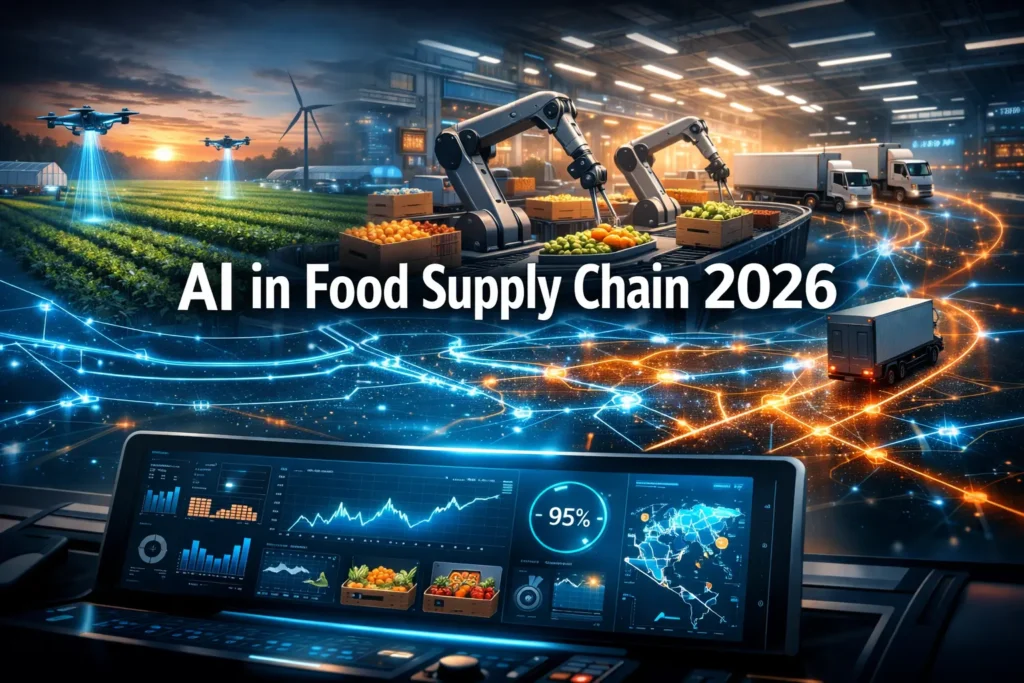
AI in food supply chain operations is no longer a pilot project or a buzzword at a conference. It’s now the backbone of how major food producers, retailers, and logistics companies are running their day-to-day operations. From the moment a seed is planted to the second a package lands on your doorstep, artificial intelligence is making decisions that humans simply can’t make fast enough or accurately enough on their own.
This post breaks down exactly how AI in food supply chain management works in 2026, what technologies are driving the change, where the real-world impact is showing up, and what businesses still need to figure out before the decade is over.
Table of Contents
Why the Food Supply Chain Was Broken to Begin With
Before we get into the technology, it helps to understand why the food supply chain has been such a persistent problem.
The traditional food supply chain is long, fragmented, and deeply dependent on paper trails, manual checks, and reactive decision-making. A farm in Maharashtra ships produce to a cold storage unit. That unit hands it off to a regional distributor. The distributor sends it to a retailer. By the time the retailer notices spoilage or demand fluctuations, the damage is already done upstream.
There’s no real-time visibility. Demand forecasting is done on gut feel and last year’s spreadsheets. Temperature deviations during transport go unnoticed for hours. Food fraud — mislabelled ingredients, fake organic certification — is nearly impossible to detect without expensive lab testing. Waste accumulates at every single node.
This is exactly the environment where AI in food supply chain operations thrives — not because AI is magic, but because the existing system was so data-poor and reactive that even moderate intelligence applied consistently creates enormous improvements.
Check Out : Best Niche AI Tools for Small Businesses in 2026 (Hidden Gems Most Owners Miss)
The Core Technologies Powering AI in Food Supply Chain in 2026
1. Predictive Demand Forecasting
One of the most commercially mature applications of AI in food supply chain management is demand forecasting. Traditional models relied on historical sales data with seasonal adjustments. Modern AI systems layer in weather patterns, social media sentiment, local events, economic indicators, and even health trend data to predict demand with far greater accuracy.
Retailers using AI-driven demand forecasting are reporting waste reductions of 20–35% on perishable goods — not because they’re ordering less, but because they’re ordering smarter. The right product, in the right quantity, arrives at the right place, at the right time.
Companies like IBM Food Trust have been building blockchain-plus-AI frameworks that let every actor in the chain access and contribute to a shared demand picture. In 2026, this has become table stakes for any mid-to-large food retailer.
2. Smart Cold Chain Monitoring
Cold chain failure is one of the most expensive problems in food logistics. A single temperature excursion during a pharmaceutical-grade food shipment — think infant formula or premium seafood — can result in entire truckloads being condemned.
IoT sensors combined with AI in food supply chain monitoring systems now flag temperature anomalies in real time, predict where failures are likely to occur based on historical data, and automatically reroute shipments before spoilage happens. What used to be discovered at the destination is now caught mid-transit.
Companies operating in this space, including players connected to the Global Cold Chain Alliance, are reporting that AI-assisted cold chain monitoring has cut spoilage-related losses by as much as 40% on some high-value commodity routes.
3. Computer Vision for Quality Control
Manual quality inspection is slow, inconsistent, and expensive. Human inspectors get tired. Standards vary. A batch of strawberries inspected by someone on hour one of their shift will be graded differently from a batch inspected in hour eight.
Computer vision systems using AI can now inspect produce at conveyor-belt speed, detecting bruising, discolouration, size inconsistencies, and contamination with a level of accuracy and consistency that no human inspector can match. These systems don’t just reject bad product — they classify it, enabling better decisions about what goes to premium retail, what goes to secondary markets, and what’s composted.
In 2026, computer vision has become a standard feature at major packing houses across Europe, North America, and increasingly in Southeast Asia — a direct result of AI in food supply chain automation becoming economically accessible to mid-sized operations, not just the giants.
4. Route Optimisation and Last-Mile Logistics
The last mile of food delivery — whether that’s a restaurant getting its morning produce delivery or a consumer receiving a grocery order — is disproportionately expensive and carbon-intensive. AI-driven route optimisation systems are now handling dynamic rerouting in real time, factoring in traffic, weather, driver fatigue data, vehicle capacity, and time-window constraints simultaneously.
This matters enormously for AI in food supply chain economics because food has shelf-life constraints that general logistics doesn’t. A delayed clothing shipment is inconvenient. A delayed seafood shipment is a write-off.
5. Supplier Risk Intelligence
The COVID-19 pandemic exposed how brittle single-source supply chains were. In 2026, AI in food supply chain procurement has matured into something closer to supplier intelligence — continuous monitoring of geopolitical risk, weather events, crop disease reports, port congestion data, and supplier financial health, all synthesised into a real-time risk score.
Procurement teams at major food companies no longer wait for a crisis to diversify. AI alerts them weeks in advance when a supplier’s risk profile starts deteriorating, allowing proactive sourcing adjustments instead of panic buying.
AI in Food Supply Chain: Key Players and Their Approaches
| Company / Platform | Core AI Capability | Primary Use Case | Notable Achievement |
|---|---|---|---|
| IBM Food Trust | Blockchain + ML | Traceability & food safety | Tracks produce from farm to fork in seconds |
| Trimble Agriculture | Predictive analytics | Farm-level yield forecasting | Used across 10M+ acres globally |
| Shelf Engine | Demand forecasting AI | Grocery ordering automation | 20%+ waste reduction for retail clients |
| Lineage Logistics | Computer vision + IoT | Cold chain & warehouse AI | World’s largest temp-controlled network |
| Walmart (Eden platform) | Image recognition | Produce quality grading | Saves hundreds of millions annually in waste |
| Palantir (AIP) | Supply chain analytics | End-to-end chain visibility | Used by major food manufacturers for resilience |
| Plenty (vertical farming AI) | Growing environment AI | Indoor crop optimisation | 350x more produce per square foot vs traditional |
Each of these approaches reflects a different layer of AI in food supply chain operations — and what’s becoming increasingly clear is that the biggest gains come not from using one of these tools, but from integrating multiple layers into a connected intelligence system.
Read : AI for Sales in 2026: The Complete Playbook to Close More Deals, Faster
What’s Actually Changed Between 2023 and 2026
Three years ago, most conversations about AI in food supply chain systems were aspirational. Proofs of concept. Pilot programmes. The ROI was hard to calculate because implementations were incomplete and integrations were messy.
In 2026, the picture is meaningfully different for several reasons:
Edge computing became affordable. AI processing no longer needs to route back to a central server. Sensors and cameras on the factory floor can run inference locally, which means faster decisions and fewer connectivity dependencies.
Foundation models changed the tooling landscape. Large language models have made it far easier to build natural-language interfaces on top of complex supply chain data systems. A procurement manager can now ask “which of our top 10 suppliers are most exposed to the current drought in southern Europe?” and get an answer in seconds — no data analyst required.
Regulatory pressure increased. The EU’s Digital Product Passport regulation is pushing food companies toward radical transparency about provenance and supply chain conditions. AI is now necessary — not optional — for compliance at scale.
Consumer expectations shifted. A growing segment of consumers now actively scan QR codes to verify sustainability claims. Brands that can’t substantiate their supply chain story are losing shelf space and customer trust. AI in food supply chain traceability is a marketing asset, not just an operational tool.
The Sustainability Argument Is Now an Economic Argument
One of the most important shifts happening in 2026 is that sustainability is no longer treated as a cost centre. The economics of AI in food supply chain sustainability are now compelling on their own terms.
Consider this: food waste that reaches landfill generates methane — a greenhouse gas far more potent than CO₂. When AI reduces food waste, companies aren’t just helping the environment. They’re reducing the cost of goods purchased but never sold, reducing disposal costs, and in many jurisdictions, reducing carbon liability under emerging emissions pricing frameworks.
The World Resources Institute’s Food and Land Use Coalition estimates that halving food loss and waste could deliver a 20–40% reduction in food system emissions. AI is one of the few tools that can operationalise that goal at the speed and scale required.
Challenges That Still Don’t Have Clean Answers
No honest post about AI in food supply chain technology can ignore the real friction points that still exist.
Data fragmentation remains a massive problem. Most food supply chains still involve dozens of suppliers, each running different ERP systems, spreadsheets, and data formats. AI is only as good as the data it trains on, and getting clean, consistent, interoperable data across a complex chain is still a grind.
Small and mid-sized producers are largely left out. The benefits of AI in food supply chain operations are currently concentrated among large corporations with the capital and technical infrastructure to implement them. A small cooperative of vegetable farmers in Uttar Pradesh or a mid-sized processor in Vietnam is not accessing these tools at the same level. Closing that gap requires investment, policy support, and better SaaS-based tooling that doesn’t require a data science team to operate.
Model interpretability matters in high-stakes decisions. If an AI system recommends rejecting a shipment from a long-term supplier, decision-makers need to understand why before they act. Black-box models create trust problems in an industry where relationships still drive business.
Cybersecurity is an underappreciated risk. As AI in food supply chain infrastructure becomes more connected and more dependent on live data feeds, it also becomes more vulnerable. A targeted attack on a major cold chain AI system could cause cascading food safety failures. This risk is only beginning to be taken seriously at the policy and infrastructure level.
What to Expect in the Next 24 Months
The trajectory of AI in food supply chain technology points toward a few near-certain developments:
Autonomous procurement agents will begin operating with limited human oversight in low-complexity commodity sourcing — buying standard ingredients within pre-set parameters without a human clicking “approve.”
AI-generated food safety reports will become standard for regulatory submissions, with systems capable of compiling audit trails, temperature logs, quality data, and traceability records into compliance documentation in minutes rather than weeks.
Cross-chain data consortiums will emerge, where competing food companies share anonymised supply chain data to collectively improve AI model accuracy — similar to how financial institutions share fraud data without sharing customer information.
Personalised nutrition supply chains — where AI manages the sourcing, assembly, and delivery of food based on individual health profiles — will move from niche to mainstream as wearable health tech adoption increases.
The AI in food supply chain story is not close to finished. If anything, 2026 represents the end of the beginning.
Real-World Impact by the Numbers
- $127 billion — estimated value of AI in food and agriculture markets by 2028 (MarketsandMarkets)
- 30–40% — reduction in food spoilage reported by retailers using AI-driven demand planning
- Up to 15% — reduction in logistics cost through AI route optimisation
- 2–5 seconds — time to trace produce from farm to retail using blockchain-AI systems, vs. days manually
- 40% — of global food companies now using some form of AI in food supply chain operations, up from under 15% in 2022
10 Frequently Asked Questions About AI in Food Supply Chain
1. What exactly does AI in food supply chain mean? It refers to the application of artificial intelligence technologies — including machine learning, computer vision, natural language processing, and predictive analytics — to manage, optimise, and monitor the movement of food from farm to consumer. Every stage, from growing and harvesting to packaging, transport, storage, and retail, can be enhanced by AI tools.
2. Is AI in food supply chain only relevant for large companies? Not anymore. While large corporations were early adopters, cloud-based AI tools and SaaS platforms have made AI in food supply chain capabilities increasingly accessible to mid-sized producers and distributors. The cost of entry has dropped significantly since 2022.
3. How does AI reduce food waste specifically? AI reduces food waste primarily through better demand forecasting (ordering closer to what will actually be sold), quality detection (identifying and diverting compromised product earlier), and cold chain monitoring (preventing spoilage during transport and storage). Each application targets a different waste point in the chain.
4. Can AI in food supply chain improve food safety? Yes, significantly. AI-powered traceability systems can identify the source of a contamination event in seconds rather than days, allowing faster product recalls and more targeted interventions. This reduces both public health risk and the economic damage of broad recalls.
5. What is the role of IoT in AI-powered food supply chains? IoT sensors generate the real-time data that AI systems analyse. Temperature sensors, humidity monitors, GPS trackers, and weight sensors in storage facilities and transport vehicles provide continuous data streams that AI models use to detect anomalies, predict failures, and optimise conditions.
6. Is AI in food supply chain environmentally beneficial? Yes. Reduced food waste means lower emissions from decomposing organic matter in landfills. Optimised logistics routes reduce fuel consumption. Smarter crop management reduces water and fertiliser use. The environmental case for AI in food supply chain technology is well-supported by current data.
7. What are the biggest barriers to AI adoption in food supply chains? The main barriers are data quality and fragmentation, high upfront integration costs, lack of technical expertise among traditional food businesses, and limited interoperability between different software systems used across the chain.
8. How does AI help with food fraud detection? AI can cross-reference documentation, sensor data, and historical patterns to flag inconsistencies that may indicate fraudulent labelling, substitution of ingredients, or fake certifications. When combined with blockchain-based traceability, it becomes extremely difficult to falsify provenance data without detection.
9. What regulations are driving AI adoption in food supply chains? Key regulatory drivers include the EU’s Digital Product Passport, the FDA’s Food Safety Modernization Act (FSMA) in the US, and emerging sustainability disclosure requirements in major markets. These regulations are creating a compliance need that manual processes cannot efficiently satisfy.
10. What does the future of AI in food supply chain look like? The direction points toward increasingly autonomous systems — AI agents that manage sourcing, logistics, and quality monitoring with minimal human input, operating within defined parameters. Expect tighter integration between farm-level AI tools, retail systems, and consumer-facing apps that provide full supply chain transparency on demand.
Read : How to Start an AI Automation Agency in 2026 and Actually Make Money (The Brutally Honest Guide)
This post reflects publicly available research and industry reporting as of early 2026. External links are included for reference and further reading. No commercial relationship exists with any company or platform mentioned.
1 thought on “How AI in Food Supply Chain Is Quietly Solving the World’s Biggest Food Crisis in 2026”
Comments are closed.