
Parents today face an unprecedented challenge: how do we harness technology’s power while ensuring our children develop essential life skills? The answer lies in carefully selected ai games for children growth that blend entertainment with meaningful learning outcomes. As we navigate through 2026, artificial intelligence has transformed educational gaming into something far more sophisticated than simple entertainment.
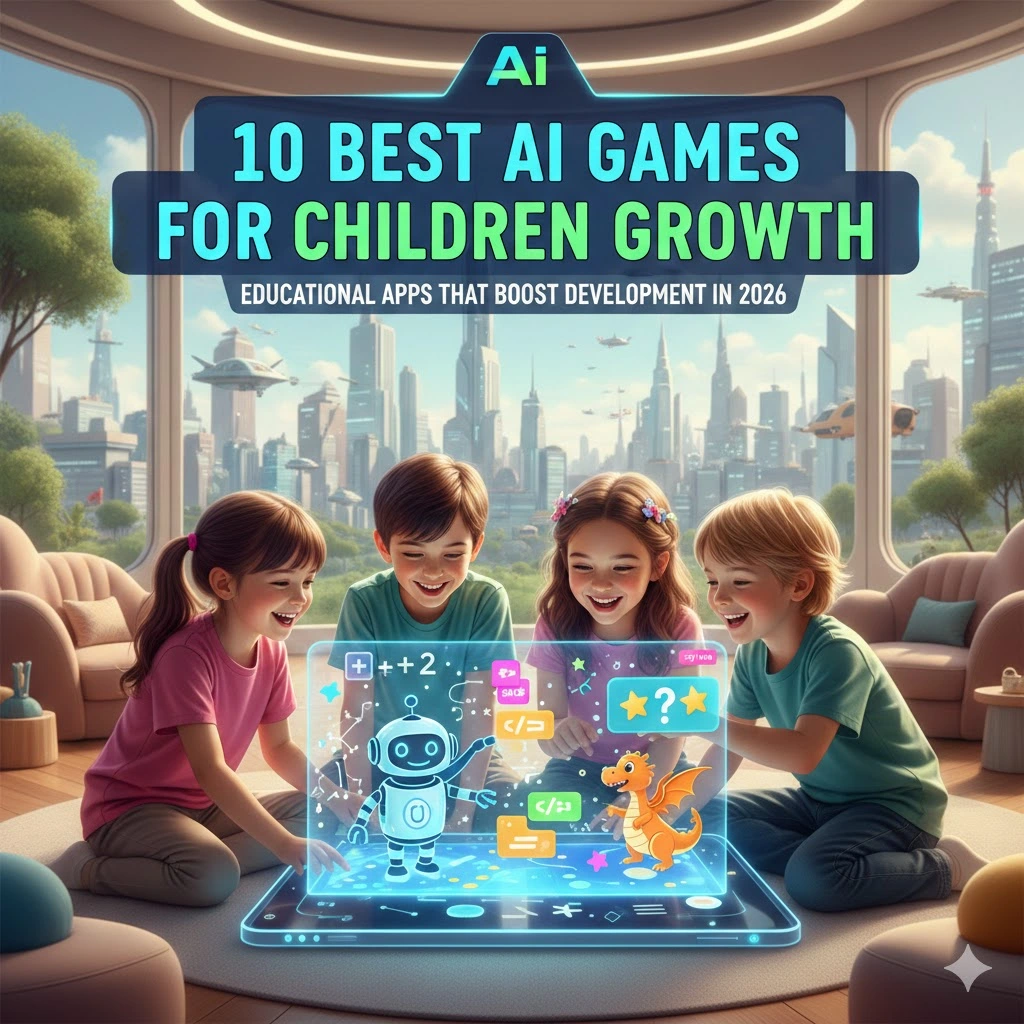
The landscape of children’s education has shifted dramatically. Traditional learning methods now work alongside intelligent systems that adapt to each child’s unique pace, learning style, and interests. These ai games for children growth aren’t just digital babysitters—they’re sophisticated tools designed by educational psychologists, neuroscientists, and child development experts who understand exactly what young minds need to flourish.
Research from Stanford University’s Digital Learning Lab shows that children who engage with quality AI-powered educational games demonstrate 34% faster skill acquisition in problem-solving compared to traditional methods alone. However, not all AI games deliver on their promises. This comprehensive guide cuts through the marketing noise to reveal which ai games for children growth actually work, backed by real developmental science.
Table of Contents
Understanding How AI Games Support Child Development
Before diving into specific recommendations, it’s crucial to understand what makes ai games for children growth genuinely effective. These aren’t your typical video games with an educational veneer slapped on top.
Modern AI-powered games for children use machine learning algorithms that observe how your child thinks, identifies their strengths and struggles, and adjusts difficulty levels in real-time. This personalization means a six-year-old who excels in math but struggles with reading gets exactly the support needed in each area.
The best ai games for children growth target multiple developmental domains simultaneously. They build cognitive abilities like memory and reasoning, foster emotional intelligence through story-based decision-making, develop fine motor skills through interactive challenges, and encourage social skills when multiplayer elements are involved.
According to the American Academy of Pediatrics’ 2025 guidelines on screen time, quality matters more than quantity. The organization now endorses educational AI games as valuable learning tools when they meet specific criteria: adaptive learning paths, clear educational objectives, age-appropriate content, parental insight dashboards, and limited passive consumption.
Also Read about Maya AI.
The Science Behind Effective Educational AI Games
Understanding the neuroscience helps parents make informed choices. When children engage with well-designed ai games for children growth, their brains form new neural pathways through repeated practice in engaging contexts. This process, called neuroplasticity, is most active during childhood.
The key difference between effective ai games for children growth and regular games is something called “desirable difficulty.” These games maintain a sweet spot where tasks are challenging enough to promote growth but not so difficult they cause frustration. AI excels at finding and maintaining this balance for each individual child.
Research published in the Journal of Educational Psychology demonstrates that children using adaptive AI learning systems show improvements across executive function skills—the mental processes that help us plan, focus attention, remember instructions, and manage multiple tasks. These aren’t just academic skills; they’re life skills that predict success well into adulthood.
Also Read : Game-Changing AI Tools for Graphic Designers: The 2026 Ultimate Guide
Top 10 AI Games for Children’s Growth in 2026
1. MindCraft Academy (Ages 6-12)
MindCraft Academy leads the pack of ai games for children growth by combining creative building with structured learning challenges. Unlike its namesake inspiration, this game integrates mathematical concepts, physics principles, and logic puzzles directly into the building experience.
The AI tutor within MindCraft Academy observes how children approach problems and suggests increasingly complex challenges. A child who quickly grasps spatial reasoning might receive advanced architecture tasks, while another who needs more practice gets scaffolded support through guided projects.
Parents appreciate the detailed progress reports that break down skill development across 47 different competencies, from geometric understanding to collaborative problem-solving. The game works equally well for individual play and cooperative missions with friends.
2. WordWizard Chronicles (Ages 5-10)
Language development takes center stage in WordWizard Chronicles, one of the most engaging ai games for children growth focused on literacy. This adventure game wraps vocabulary building, reading comprehension, and creative writing into an epic fantasy quest.
What sets this apart is the AI’s natural language processing capability. Children can speak or type responses to characters, and the game understands intent rather than requiring exact answers. This flexibility encourages experimentation with language without the fear of “wrong answers” that sometimes shuts down young learners.
The system adapts to children learning English as a second language, offering additional support and context clues. Reading specialists from the International Literacy Association praised its approach in their 2026 annual report on educational technology.
3. EmotiQuest (Ages 7-14)
Social-emotional learning represents a critical but often overlooked aspect of child development. EmotiQuest addresses this gap by creating scenarios where children practice recognizing emotions, managing conflicts, and developing empathy—making it one of the most important ai games for children growth in the non-academic domain.
The game presents age-appropriate social situations through animated characters. Children make choices about how to respond, and the AI provides feedback on the potential consequences of different approaches. Over time, children develop stronger emotional intelligence and conflict resolution skills.
Check Out : Model Context Protocol (MCP): The Developer’s Complete Guide to Smarter AI Integration in 2026
Mental health professionals have endorsed EmotiQuest as a valuable tool for building resilience and self-awareness. The game’s effectiveness comes from repeated practice in a safe environment where mistakes become learning opportunities rather than social disasters.
4. MathQuest Universe (Ages 5-13)
Mathematics anxiety affects millions of children, often stemming from one-size-fits-all teaching approaches. MathQuest Universe ranks among the best ai games for children growth specifically because it eliminates this anxiety through personalized pacing and gamified progression.
Children explore different planets, each focusing on specific mathematical concepts from basic counting to pre-algebra. The AI never lets them fail—instead, it offers hints, alternative explanation methods, and adjusts problem complexity until comprehension clicks.
Educators using MathQuest Universe in classrooms report that previously math-averse students show renewed confidence. The game’s approach aligns with research from MIT’s Education Arcade showing that mathematical learning improves when anxiety decreases and engagement increases.
5. ScienceSphere Lab (Ages 8-15)
Scientific thinking develops through hands-on experimentation, something traditional classrooms struggle to provide consistently. ScienceSphere Lab brings this experience home through virtual experiments that respond realistically to children’s manipulations, establishing it as one of the premier ai games for children growth in STEM education.
Children conduct chemistry experiments, build electrical circuits, explore biological systems, and test physics principles—all within a safe virtual environment. The AI serves as a laboratory assistant, asking probing questions that guide scientific reasoning without simply providing answers.
The National Science Teaching Association recognized ScienceSphere Lab with its 2025 Outstanding Digital Resource Award, citing its ability to develop genuine scientific inquiry skills rather than just memorization of facts.
6. CodeCrafters Junior (Ages 6-12)
Computational thinking has become as fundamental as reading and writing. CodeCrafters Junior introduces programming concepts through visual, intuitive interfaces that make it one of the most accessible ai games for children growth in computer science education.
Rather than starting with syntax and code, children direct characters through challenges by chaining together logic blocks. The AI gradually introduces more complex programming concepts—loops, conditionals, functions—as children demonstrate readiness.
What makes this particularly effective is the immediate feedback loop. Children see the results of their code instantly, understand what went wrong, and iterate quickly. This mirrors how professional programmers actually work, building foundational habits early.
7. HistoryHeroes VR (Ages 9-15)
History comes alive when children can walk through ancient civilizations rather than just reading about them. HistoryHeroes VR uses virtual reality technology combined with AI characters to create immersive historical experiences, making it one of the most memorable ai games for children growth in social studies.
Children interact with historical figures who respond intelligently to questions using natural language AI. They make decisions in historical contexts and see the potential consequences unfold. This approach develops critical thinking about cause and effect in human societies.
The game covers world history with cultural sensitivity, presenting multiple perspectives on historical events. The National Council for the Social Studies praised its balanced approach to complex historical topics.
8. ArtMind Studio (Ages 5-14)
Creativity requires both freedom and technique. ArtMind Studio balances these elements by providing AI-assisted art instruction that adapts to each child’s style and interests, positioning it among the most innovative ai games for children growth in artistic development.
Children receive personalized art lessons across multiple media—drawing, painting, sculpture, digital art, and animation. The AI analyzes their work and offers specific suggestions for improvement while celebrating individual creative choices.
Unlike rigid art tutorials, ArtMind Studio encourages experimentation. The system identifies when a child has developed sufficient basic skills to benefit from more advanced techniques, ensuring continuous growth without overwhelming beginners.
9. StrategySquad (Ages 10-16)
Strategic thinking, planning, and decision-making under uncertainty are skills that serve children throughout life. StrategySquad develops these competencies through engaging scenarios that require careful analysis and long-term thinking, making it one of the most intellectually challenging ai games for children growth.
The game presents age-appropriate strategy challenges ranging from resource management to complex problem-solving scenarios. The AI opponent adapts to the child’s skill level, always providing challenging but winnable scenarios.
Educational psychologists note that children who regularly engage with strategy games show improved executive function, better planning abilities, and enhanced capacity for delayed gratification—all predictors of long-term success.
10. WorldBuilder (Ages 8-14)
Geography, economics, environmental science, and civic responsibility converge in WorldBuilder, where children design and manage their own societies. This comprehensive approach makes it one of the most educationally rich ai games for children growth across multiple subject areas.
Children make decisions about resource allocation, environmental policies, social systems, and economic structures. The AI models realistic consequences, helping children understand complex interconnections between different societal elements.
Teachers using WorldBuilder report that students develop more sophisticated understanding of current events and global challenges. The game builds systems thinking—the ability to see how different parts of complex situations relate to and affect each other.
Read About : Best Smart Blood Sugar Monitor Watches in 2026: Complete Buying Guide
Comparison Table: AI Games Features and Benefits
| Game Name | Age Range | Primary Focus | Key AI Feature | Subscription Model | Offline Mode |
|---|---|---|---|---|---|
| MindCraft Academy | 6-12 | Creative Problem-Solving | Adaptive Challenge System | $12.99/month | Limited |
| WordWizard Chronicles | 5-10 | Language & Literacy | Natural Language Processing | $9.99/month | Yes |
| EmotiQuest | 7-14 | Emotional Intelligence | Scenario Response Analysis | $14.99/month | No |
| MathQuest Universe | 5-13 | Mathematics | Personalized Difficulty Scaling | $11.99/month | Yes |
| ScienceSphere Lab | 8-15 | STEM & Scientific Method | Interactive Experiment Modeling | $15.99/month | Limited |
| CodeCrafters Junior | 6-12 | Computational Thinking | Progressive Complexity Algorithm | $13.99/month | Yes |
| HistoryHeroes VR | 9-15 | History & Social Studies | AI Historical Characters | $16.99/month | No |
| ArtMind Studio | 5-14 | Artistic Development | Style Analysis & Feedback | $10.99/month | Yes |
| StrategySquad | 10-16 | Strategic Thinking | Adaptive AI Opponent | $12.99/month | Limited |
| WorldBuilder | 8-14 | Systems Thinking | Consequence Modeling | $14.99/month | No |
How to Choose the Right AI Games for Your Child
Selecting appropriate ai games for children growth requires more than scanning age recommendations. Consider your child’s current interests as entry points—a child fascinated by space might engage better with MathQuest Universe’s planetary theme than abstract number drills.
Assess developmental areas where your child could use additional support. If social skills need work, EmotiQuest provides targeted practice. For a child struggling with reading, WordWizard Chronicles makes literacy development feel like adventure rather than homework.
Look for games offering parental dashboards with meaningful insights. The best ai games for children growth provide detailed progress reports showing skill development over time, not just time spent or levels completed.
Consider starting with free trial periods. Most quality educational AI games offer 7-14 day trials, giving your child enough time to determine genuine interest before committing financially.
Balancing Screen Time with Other Activities
Even the best ai games for children growth should complement, not replace, other developmental experiences. The American Academy of Pediatrics recommends balancing screen-based learning with physical activity, creative play, social interaction, and outdoor exploration.
Establish clear boundaries around gaming time. Many families find success with the “earn your screen time” approach where physical activity or reading time unlocks game time. This creates healthy associations between different types of activities.
Use ai games for children growth as conversation starters. Ask your child to teach you what they learned, explain their strategy, or show you their creations. This metacognitive reflection reinforces learning and strengthens parent-child bonds.
Remember that AI games work best when integrated into a rich developmental environment, not as standalone solutions. Children need diverse experiences to develop into well-rounded individuals.
Safety and Privacy Considerations
When selecting ai games for children growth, privacy protection must be paramount. Read privacy policies carefully and understand what data companies collect, how it’s used, and whether it’s shared with third parties.
Look for games complying with COPPA (Children’s Online Privacy Protection Act) and similar international regulations. Reputable educational game developers display their certifications prominently and offer transparent data practices.
Enable parental controls and monitor your child’s interactions within games. While most educational AI games maintain safe environments, teaching children about online safety remains an essential parental responsibility.
Consider games offering local data processing where possible. Some ai games for children growth now perform AI calculations on-device rather than sending information to cloud servers, providing an additional privacy layer.
The Future of AI in Educational Gaming
The trajectory of ai games for children growth points toward increasingly sophisticated personalization. Emerging technologies like emotion recognition through camera analysis will enable games to detect frustration or boredom and adjust accordingly.
Integration with formal education represents another frontier. Schools are beginning to adopt AI game platforms that align with curriculum standards, allowing seamless transition between classroom learning and home practice.
Virtual reality and augmented reality technologies will make ai games for children growth even more immersive. Imagine learning ancient history by walking through historically accurate reconstructions or understanding physics by manipulating virtual objects that behave according to real physical laws.
However, technology alone never determines educational outcomes. The most promising future for ai games for children growth involves thoughtful integration with human guidance, ensuring technology amplifies rather than replaces the irreplaceable elements of childhood development.
Expert Recommendations and Best Practices
Educational psychologists emphasize that ai games for children growth achieve maximum effectiveness when parents remain involved. This doesn’t mean hovering over every gaming session but rather maintaining awareness of what children are learning and creating opportunities to apply those skills in real-world contexts.
Developmental specialists recommend rotating through different types of ai games for children growth rather than focusing exclusively on one area. A well-rounded approach addresses cognitive, social, emotional, physical, and creative development.
Set realistic expectations about outcomes. While these games accelerate learning in specific domains, they’re tools within a larger developmental ecosystem. Children still need sleep, nutrition, physical activity, social connection, and emotional support to thrive.
Consider your child’s unique developmental trajectory. Some children show early affinity for certain subjects while taking longer to warm up to others. The best ai games for children growth allow children to progress at their own pace without comparison to arbitrary benchmarks.
Making AI Games Part of a Comprehensive Growth Strategy
The most successful parents approach ai games for children growth as one component within a holistic development plan. These games work best when combined with physical activities, creative unstructured play, social interactions, outdoor time, and family bonding.
Create a balanced weekly schedule that includes diverse experiences. Perhaps weekday mornings include 30 minutes of educational AI games focused on academic skills, while afternoons prioritize physical activity and social play. Weekends might emphasize family activities and creative projects.
Use insights from ai games for children growth to inform other learning opportunities. If your child shows particular interest or aptitude in an area revealed through game analytics, explore that interest through books, hands-on projects, or extracurricular activities.
Remember that childhood isn’t just preparation for future success—it’s a valuable experience in itself. The best ai games for children growth respect this by making learning joyful rather than treating children as productivity machines.
Frequently Asked Questions
What age should children start using AI educational games?
Children as young as 4-5 can benefit from carefully selected AI educational games designed for early learners, though the most sophisticated ai games for children growth target ages 6 and up when abstract thinking capabilities emerge more fully.
How much time should children spend on AI learning games daily?
Developmental experts recommend 30-60 minutes daily for ai games for children growth, integrated within the American Academy of Pediatrics’ overall screen time guidelines of 1-2 hours total for children over 6 years old.
Are AI games better than traditional educational methods?
AI games complement rather than replace traditional education, offering personalized pacing and immediate feedback that’s difficult to achieve in classroom settings, making them powerful supplementary tools when used appropriately.
Can AI games replace tutors for struggling students?
While ai games for children growth provide excellent supplementary support, students with significant learning challenges often benefit from combining these tools with human tutors who offer emotional support and alternative explanation strategies.
Do AI educational games actually improve academic performance?
Research from institutions like Stanford and MIT indicates that quality AI educational games can accelerate skill acquisition by 25-40% compared to traditional methods alone, particularly when integrated into comprehensive learning approaches.
Are there free AI games for children’s development?
Several quality ai games for children growth offer free versions with limited features or operate on freemium models, though most comprehensive platforms require subscriptions ranging from $9.99-$16.99 monthly for full access.
How do I know if an AI game is actually educational?
Look for games developed with input from educational psychologists, aligned with curriculum standards, offering parental progress dashboards, and receiving endorsements from educational organizations like the International Literacy Association or National Science Teaching Association.
Can AI games help children with learning disabilities?
Many ai games for children growth include accessibility features and adaptive learning algorithms particularly beneficial for children with ADHD, dyslexia, or other learning differences, though consultation with special education professionals remains important.
What’s the difference between AI games and regular educational apps?
True ai games for children growth use machine learning to analyze individual learning patterns and continuously adapt content difficulty, explanation methods, and pacing, while basic educational apps follow predetermined progression regardless of individual performance.
How can parents monitor what children learn from AI games?
Quality ai games for children growth provide parent dashboards showing detailed progress across specific skills, time spent, areas of strength and challenge, plus many include weekly summary emails highlighting developmental milestones achieved.
Also Read : Unlock Your True Self: 50+ AI Personality Questions That Actually Work in 2026
External References:
For more information on child development and screen time, visit the American Academy of Pediatrics at https://www.aap.org
To explore research on educational technology effectiveness, check the Stanford Graduate School of Education at https://ed.stanford.edu
For curriculum alignment and educational standards, visit the National Education Association at https://www.nea.org
2 thoughts on “10 Best AI Games for Children Growth: Educational Apps That Boost Development in 2026”