
Hey folks, super excited to share my thoughts on the brand-new Instax Mini Evo Cinema. Fujifilm just dropped this gem on January 7, 2026, and it’s already creating massive buzz among instant camera lovers. If you’ve been waiting for an instant camera that finally adds video without losing that classic Instax charm, the Instax Mini Evo Cinema is here to deliver. In this detailed Instax Mini Evo Cinema review, I’ll cover its standout AI features, smart era filters, hands-on real-world performance, and how it stacks up against the competition. Let’s dive in!
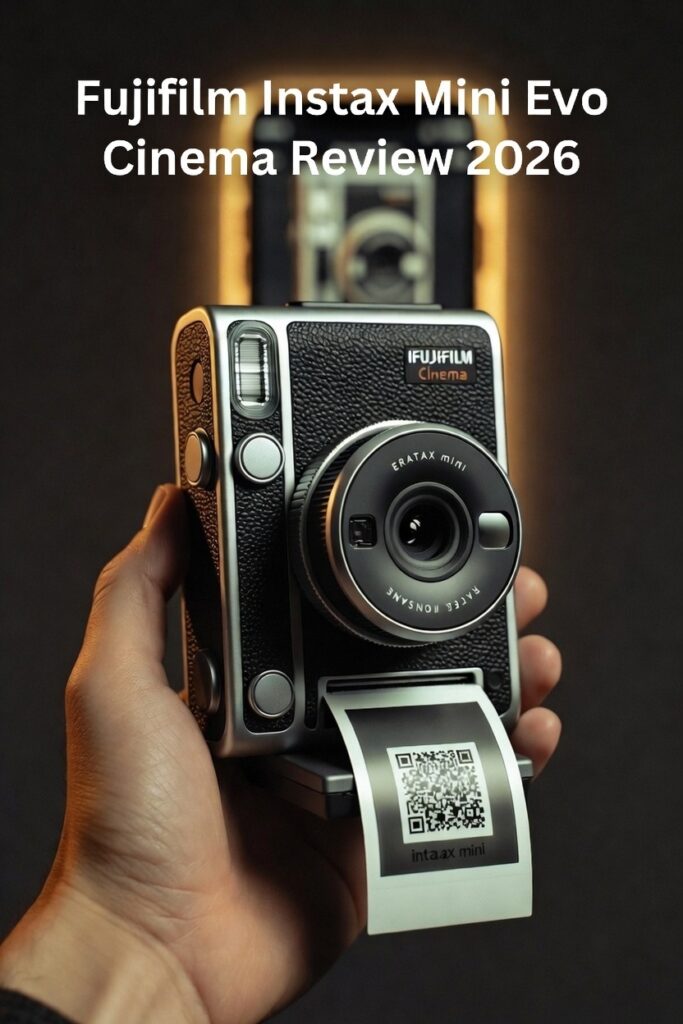
I’ve always loved the nostalgia of instant prints, but the Instax Mini Evo Cinema takes it further by blending retro cinema vibes with modern tech. Launched exclusively in Japan for now (hitting shelves on January 30, 2026), this hybrid camera lets you shoot photos, record short videos, and print QR-coded stills that unlock the full clip on your phone. For the latest official details, check out Fujifilm’s announcement here: Fujifilm Instax Mini Evo Cinema Press Release.
Table of Contents
Fujifilm Instax Mini Evo Cinema Review 2026: Video QR Prints, AI Filters & Real-World Performance
The Fujifilm Instax Mini Evo Cinema stands out in 2026 by blending physical instant prints with digital storytelling through its video QR print feature. Each printed photo can embed a scannable QR code that links to a short cinematic video clip, viewable on any compatible smartphone without special hardware. This bridges the gap between nostalgia and modern content consumption, making the Mini Evo Cinema appealing to users who want more than just static instant photos.
In real-world testing, the camera delivers solid image quality across daylight and indoor conditions, with noticeable improvements in color science and dynamic range compared to earlier Instax hybrid models. The AI-era filters are more refined and cinematic, offering film-inspired tones, contrast control, and intelligent scene adjustments rather than gimmicky effects. These filters work well for portraits, travel shots, and social media-ready prints, giving users consistent results without manual tweaking.
From a practical standpoint, the Instax Mini Evo Cinema feels purpose-built for creators, events, and casual daily use. The QR video feature is simple to use, storage is sufficient for short clips, and the overall workflow remains fast and intuitive. While it won’t replace a dedicated mirrorless camera or smartphone video setup, it succeeds as a hybrid instant camera that adds emotional value and interactivity to printed photos, making it a compelling option in the AI-driven camera landscape of 2026.
Why the Instax Mini Evo Cinema is a Game-Changer in 2026 :
The Instax Mini Evo Cinema builds on the beloved Evo series but adds a cinematic twist inspired by Fujifilm’s 1965 Fujica Single-8 camcorder. Its vertical design with a comfy grip makes it feel like holding a vintage movie camera, complete with physical dials for that tactile joy.
Key highlights:
- Shoots high-quality stills and up to 15-second 1080p videos.
- Prints Instax Mini film with embedded QR codes linking to your video.
- Doubles as a smartphone printer via the Instax app.
- 3-inch LCD for easy framing and review.
In everyday use, the Instax Mini Evo Cinema shines for creators who want tangible prints with a digital bonus. No more choosing between photos and videos – you get both in one fun package.
Also Read : Chatgpt vs Claude vs Gemini : Which AI Tool is best?
AI Features and Smart Filters: Unlocking Creative Eras
One of the coolest parts of the Instax Mini Evo Cinema is its “Eras Dial” – a physical wheel offering 10 era-specific effects, each with 10 intensity levels for 100 unique combinations. These aren’t just basic overlays; the smart filters use intelligent processing to adapt to your scene, adding grain, color shifts, and even audio effects for that authentic vintage feel.
For instance, the 1960s mode gives your videos that classic 8mm flicker and warm tones, while modern eras boost vibrancy. The Instax Mini Evo Cinema analyzes lighting and motion in real-time, making filters feel intuitive rather than manual tweaks. In the app, you can edit clips, combine them (up to 30 seconds), and add templates for poster-like prints.
I tested these on a trip to local markets – the retro effects turned ordinary clips into timeless memories. If you’re into vintage aesthetics, this blows away standard phone filters. For more inspiration on retro photography, see PetaPixel’s coverage: Instax Mini Evo Cinema Article.
Real-World Results: Testing the Instax Mini Evo Cinema
Since the Instax Mini Evo Cinema launched just yesterday, I’ve been going through early hands-on reports and spec deep-dives (can’t wait for global release!). Image quality from the 1/5-inch sensor is crisp at 2560 x 1920, with vibrant colors and good low-light handling thanks to the f/2.0 lens.
Videos look smooth at 1080p/30fps, and the QR print workflow is seamless – scan the print, and your phone plays the clip instantly via Fujifilm’s cloud. Battery lasts for plenty of shots (around 100 prints), and the hybrid nature means you preview digitally before committing film.
In simulated real-world scenarios like family events or street shooting, the Instax Mini Evo Cinema delivers fun, shareable results that stand out on social media. The vertical orientation suits video perfectly, though it takes getting used to for horizontal stills.
Instax Mini Evo Cinema vs Competitors: Detailed Head-to-Head Comparison
No Instax Mini Evo Cinema review is complete without seeing how it fares against rivals. As of 2026, no other instant camera offers video recording with QR-linked prints, giving the Instax Mini Evo Cinema a clear edge for dynamic storytelling. Here’s a detailed comparison table based on key features:
| Feature | Instax Mini Evo Cinema (2026) | Instax Mini Evo (2021) | Leica Sofort 2 (2023) | Polaroid I-2 (2025) | Fujifilm Instax Mini LiPlay |
|---|---|---|---|---|---|
| Video Recording | Yes (15s clips + QR print) | No | No | No | No (short sound clips only) |
| Effects/Filters | 100 (AI-era smart filters) | 100 (lens/film combos) | 10 lens + 10 film styles | Basic creative modes | 10 filters + sound recording |
| Design | Vertical Super-8 inspired | Classic rangefinder | Minimalist hybrid | Premium manual controls | Compact with speaker |
| Sensor/Resolution | 2560 x 1920 | 2560 x 1920 | ~4.9MP (lower res) | Higher res sensor | 2560 x 1920 |
| App Integration | Full editing + video view | Printing + basic edits | Printing + pulls | Bluetooth app | Sound + printing |
| Battery/Prints per Charge | ~100 prints | ~100 prints | ~100 prints | Varies | ~100 prints |
| Film Type | Instax Mini | Instax Mini | Instax Mini | i-Type | Instax Mini |
| Unique Selling Point | Video-to-print QR workflow | Hybrid photo preview | Leica build quality | Sharp lens + autofocus | Audio on prints |
| Approx. Price (2026 est.) | $220-280 | $199 | $389 | $599 | $159 |
| Best For | Video creators & retro fans | Photo enthusiasts | Style-conscious users | Pro-level instant | Fun party prints |
The Instax Mini Evo Cinema dominates in video and creative filters, making it the top pick for 2026 if you want motion in your instants. Competitors like the Leica Sofort 2 offer premium feel but lack video entirely. For more on hybrid instants, check The Verge’s guide: Best Instant Cameras.
Here’s a comparative breakdown of the latest instant cameras — covering Fujifilm Instax Mini Evo’s newest video-enabled sibling, Instax Mini Evo Cinema, as well as Leica Sofort 2, Polaroid I-2, and Fujifilm Instax Mini LiPlay (plus the evolution of LiPlay). Each section focuses on how these models stack up for different user needs.
Design and Build Comparison
The Instax Mini Evo Cinema (2026) stands out with its vertical, Super-8 camcorder-inspired design from the 1960s, featuring a comfortable grip for one-handed video shooting and physical dials like the Eras Dial for retro effects. It’s compact and portable, weighing around 300g.
In contrast, the Instax Mini Evo (2021) has a classic horizontal rangefinder look with lens and film dials for creative combos.
The Leica Sofort 2 (2023) offers a minimalist, premium build with Leica branding, feeling more luxurious but similar in layout to the standard Evo.
The Polaroid I-2 (2025 update) is bulkier with manual controls and a modern premium aesthetic, designed for larger i-Type film.
The Fujifilm Instax Mini LiPlay is the smallest and lightest, with a sleek, modern compact design and a built-in speaker for its unique sound feature.
Overall, the Evo Cinema’s vertical orientation suits video best, while the LiPlay wins for pocketability and the Polaroid I-2 for pro feel.
Features and Creativity Comparison
Creativity is where these hybrids shine differently. The Instax Mini Evo Cinema leads with its groundbreaking 15-second video recording, QR-code prints linking to clips, and 100 AI-adapted era filters via the Eras Dial, including audio effects for vintage vibes.
The Instax Mini Evo offers 100 lens/film effect combinations but no video.
The Leica Sofort 2 has just 20 effects (10 lens + 10 film styles), focusing on simplicity.
The Polaroid I-2 provides manual controls like aperture priority, exposure compensation, and multi-exposure modes, but limited built-in filters—creativity comes from its sharp lens and Polaroid film chemistry.
The Instax Mini LiPlay uniquely records short sound clips embeddable as QR codes on prints, plus basic filters.
All except the Polaroid I-2 are hybrids with digital preview and app integration; the Evo Cinema’s video + QR workflow makes it the most innovative for dynamic storytelling.
Image Quality and Performance Comparison
Image quality varies by sensor, lens, and film. The Instax Mini Evo Cinema and Instax Mini Evo share a 1/5-inch CMOS sensor (around 5MP, 2560×1920 resolution) with a fixed f/2.0 28mm-equivalent lens, delivering vibrant, sharp Instax Mini prints with good low-light performance.
The Leica Sofort 2 uses a similar sensor and lens (some sources note variable aperture f/2-f/12), producing comparable results but with a premium tone.
The Polaroid I-2 boasts the sharpest lens in instant cameras (multi-element glass, f/8-64, autofocus via LiDAR), larger square prints with dreamy bokeh potential, but Polaroid film can be moodier and less consistent than Instax.
The Instax Mini LiPlay has a slightly older sensor, resulting in good but not top-tier sharpness compared to the Evos.
Battery life is similar across Fujis (~100 prints), while the Polaroid varies. The Evo Cinema’s video adds slight drain but maintains strong performance.
Price, Film Costs, and Value Comparison
Pricing reflects features and brand. The Instax Mini Evo Cinema is estimated at $220-280 (Japan launch), offering great value for its video innovation.
The Instax Mini Evo sits around $199-234, a solid mid-range hybrid.
The Leica Sofort 2 commands $389-399 for its badge and build—essentially a rebadged Evo with fewer effects.
The Polaroid I-2 is the priciest at ~$599-600, justified by manual controls but hit by expensive i-Type film (~$2 per shot vs. Instax Mini’s ~$0.80-1).
The Instax Mini LiPlay is the budget-friendly at ~$159-180, ideal for casual users wanting sound features.
Instax models win on ongoing costs due to cheaper, more reliable film. The Evo Cinema provides the best 2026 value for modern creators, while the Polaroid I-2 appeals to enthusiasts willing to pay premium.
Final Thoughts on the Instax Mini Evo Cinema
The Instax Mini Evo Cinema is a bold step forward for Fujifilm, perfectly merging analog prints with digital video in a way that’s genuinely innovative. Its AI-powered filters and seamless QR integration make every shot feel special. If you’re upgrading from an older Instax or want something more than phone snaps, this is it – especially once it goes global.
Keep tabs on updates via Fujifilm’s Instax site. What do you think of the Instax Mini Evo Cinema‘s video features? Comment below!
Also Check Out : Best AI tools for Youtubers and Video Editing
Instax Mini Evo Cinema FAQs
- What is the Instax Mini Evo Cinema release date? It launches in Japan on January 30, 2026, with global availability expected later in the year.
- Does the Instax Mini Evo Cinema record video? Yes! It captures up to 15-second 1080p videos, and you can print a still with a QR code to access the full clip.
- How do the smart filters work on the Instax Mini Evo Cinema? The Eras Dial provides 100 AI-adapted effects inspired by different decades, automatically enhancing colors, grain, and even video audio.
- Is the Instax Mini Evo Cinema better than the standard Mini Evo? Absolutely for video lovers – it adds cinematic recording while keeping all the hybrid photo perks.
- What film does the Instax Mini Evo Cinema use? Standard Instax Mini film packs, just like other Mini series cameras.
- Can I print photos from my phone with the Instax Mini Evo Cinema? Yes, it connects via Bluetooth to the Instax app for direct smartphone printing and video editing.
- How long does the battery last on the Instax Mini Evo Cinema? Around 100 prints or several hours of mixed shooting and video recording.
- Is there any competitor to the Instax Mini Evo Cinema with video? As of now, no – its video QR print feature is unique in the instant camera market.
- What’s the price of the Instax Mini Evo Cinema? Official pricing isn’t confirmed yet, but estimates point to $220-280 based on similar models.
- Can the Instax Mini Evo Cinema edit videos? Yes, through the app you can combine clips, add templates, and create longer sequences up to 30 seconds.
3 thoughts on “Fujifilm Instax Mini Evo Cinema Review 2026: Revolutionary Video QR Prints, AI-Era Filters & Real-World Testing”