
Your dog just started limping. Your cat stopped eating. Your rabbit is breathing a little differently. And it’s 11 PM on a Sunday.
What do you do?
A decade ago, your only options were to panic, wait until Monday, or pay a steep emergency vet fee. Today, AI pet health monitoring has changed that equation in a big way. From apps that analyze your pet’s symptoms in seconds to smart collars that track sleep and activity 24/7, artificial intelligence is no longer just a buzzword — it’s a working tool sitting in your pocket.
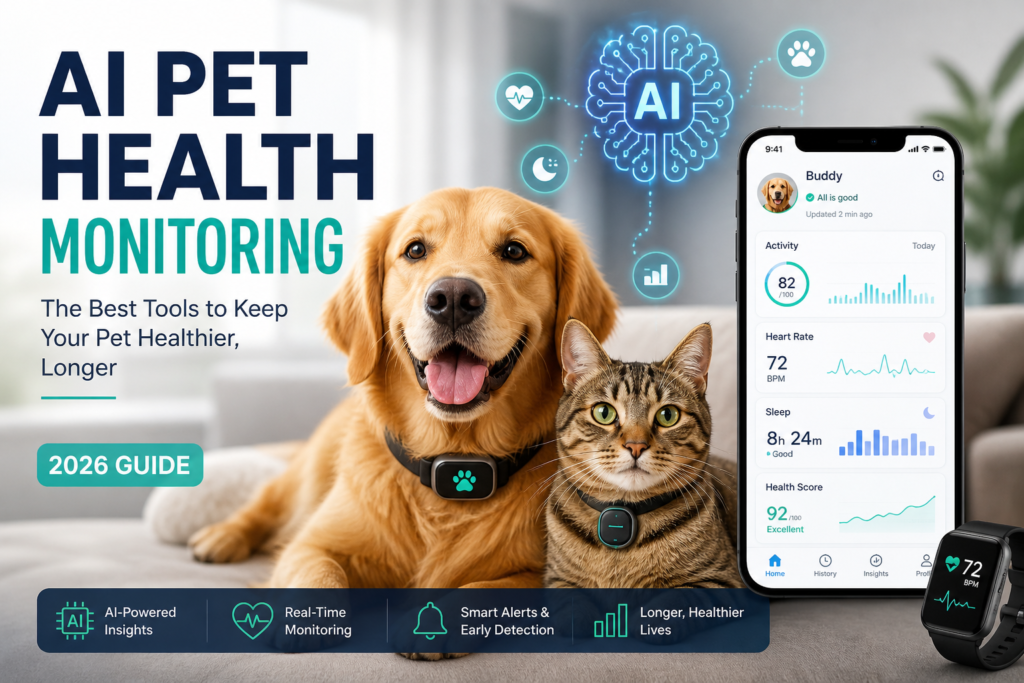
But here’s what nobody tells you clearly: AI is a tool, not a vet. Knowing when to use it and when to put down the phone and drive to a clinic — that’s the knowledge that could genuinely save your pet’s life.
This guide covers everything you need to know about AI pet health monitoring in 2026: the best apps, devices, and platforms; how they actually work; what they cost; how they compare to traditional vet care; and — critically — when technology is simply not enough.
Whether you’re a first-time pet parent or a seasoned multi-pet household, this post will help you use these tools wisely.
Table of Contents
What Is AI Pet Health Monitoring, and Why Does It Matter?
AI pet health monitoring refers to the use of artificial intelligence, machine learning, and connected devices to track, assess, and improve the health of companion animals. This covers a broad spectrum — from apps powered by large language models that help you interpret symptoms, to GPS collars that detect behavioral anomalies before you’d notice them yourself.
The numbers behind this trend are hard to ignore. According to the American Pet Products Association, Americans spend over $35 billion on veterinary care annually. Routine vet visits, specialist referrals, diagnostic labs, and emergency visits all add up fast. AI pet health monitoring tools don’t eliminate those costs — but used correctly, they can reduce unnecessary emergency visits, help you catch problems earlier, and make your conversations with your actual vet far more productive.
More importantly, pets can’t talk. They mask pain instinctively — especially cats. By the time a behavioral change is obvious to a pet owner, a health issue may already be advanced. AI pet health monitoring gives you a layer of insight that’s continuous, not just during annual checkups.
The Big Players: AI-Powered Pet Health Apps and Devices
Let’s break down the most significant tools currently available for AI pet health monitoring, what they actually do, and who they’re best suited for.
Also Read : Maya AI
1. PetDx — AI-Powered Cancer Detection for Dogs
Website: https://petdx.com
Cancer is one of the leading causes of death in dogs over the age of 10. PetDx has developed a liquid biopsy test called OncoK9, which analyzes your dog’s blood for the presence of circulating tumor DNA. The analysis behind interpreting these molecular signals relies heavily on machine learning models trained on thousands of canine cancer cases.
This is not a smartphone app — it’s a clinical-grade laboratory test ordered through your veterinarian. But the AI component is central to how the results are interpreted and reported. PetDx’s system can detect over 30 types of canine cancers, often before symptoms develop.
Who it’s for: Dog owners whose pets are 7 years or older, large breeds with elevated cancer risk (Golden Retrievers, Bernese Mountain Dogs, Boxers), and anyone whose vet has flagged early concern.
What makes it stand out in AI pet health monitoring: Most tools react to symptoms. PetDx aims to find cancer before symptoms exist. That’s a fundamentally different — and potentially lifesaving — approach.
Cost: Typically ranges between $300–$500 per test, ordered through a vet. Not something you do monthly, but worth discussing at your next senior pet wellness visit.
2. Vetster — On-Demand AI-Assisted Telehealth for Pets
Website: https://vetster.com
Vetster is one of the most well-known names in pet telehealth. It connects pet owners with licensed veterinarians through video, phone, or chat consultations — available 24 hours a day, 7 days a week. While Vetster itself is a human-to-human (well, human-to-vet) service, AI pet health monitoring features are integrated into the platform through triage tools that help route your concern to the right specialist and pre-screen symptom severity before your appointment.
Think of it as the bridge between a symptom checker and an actual professional opinion. The AI handles intake; a real, licensed vet handles diagnosis.
What Vetster vets can do:
- Assess non-emergency symptoms
- Provide prescription refills for existing conditions in eligible states/provinces
- Offer behavioral guidance
- Help you decide whether an in-person visit is truly necessary
- Advise on nutrition, parasite prevention, and post-surgery care
What they cannot do:
- Physically examine your pet
- Perform bloodwork or imaging
- Treat emergencies (they’ll direct you to an emergency clinic)
Cost: Appointments typically range from $50–$120 depending on the vet’s specialty and your location. That compares favorably to an average in-person vet visit cost of $250–$400 when you factor in exam fees, lab work, and medications.
Vetster is a legitimate, regulated telehealth service and a genuinely useful component of a AI pet health monitoring strategy for the millions of pet owners who live far from specialty vets or who struggle with after-hours access.
3. Fi Smart Dog Collar — Activity and Behavioral Tracking
Website: https://fi.com
The Fi collar is one of the most impressive pieces of consumer hardware to emerge from the AI pet health monitoring space. It’s primarily known as a GPS tracker — and it does that exceptionally well — but its health monitoring features go much deeper.
The Fi collar tracks:
- Steps and activity levels — compared daily and weekly to your dog’s personal baseline
- Sleep quality and duration
- Nap frequency and patterns
- Location history — useful for spotting if your dog is sleeping in unusual spots (a possible pain indicator)
- Anomaly alerts — the app flags when behavior falls significantly outside your dog’s normal patterns
The AI component works in the background constantly, building a profile of your individual dog’s rhythms and flagging deviations. That’s a fundamentally smarter approach than generic thresholds. A Greyhound and a Border Collie have wildly different “normal” activity levels — Fi’s system accounts for that.
Who it’s for: Dog owners who want passive, continuous AI pet health monitoring without having to remember to open an app or log anything. It runs in the background.
Limitations: Fi is dogs-only, and it tracks behavior rather than biological metrics (no heart rate or temperature sensors). But behavioral change is often the first indicator of illness, pain, or cognitive decline — making this data genuinely clinically relevant.
Cost: The collar hardware costs around $149, with a monthly subscription starting at approximately $9.99/month for the GPS and AI health features.
4. Whistle — Health and GPS Tracker for Dogs and Cats
Website: https://www.whistle.com
Whistle is another leading name in AI pet health monitoring hardware, and unlike Fi, it works for both dogs and cats. The Whistle Health device attaches to your pet’s existing collar and tracks activity, rest, calories burned, and a feature called Behavior Health Insights, which uses AI to detect unusual behaviors like excessive scratching, licking, or drinking.
The scratching and licking detection is particularly clever — it uses the accelerometer data to identify the specific motion signatures of these behaviors and flags them automatically. Excessive scratching can indicate allergies, parasites, or skin conditions; excessive licking might signal pain, anxiety, or a GI issue. Catching these patterns through AI pet health monitoring before they escalate is genuinely useful.
Cost: Whistle devices run about $80–$130, with plans starting around $9.95/month.
5. PetPace Smart Collar — Clinical-Grade Biometric Monitoring
Website: https://petpace.com
PetPace takes AI pet health monitoring to a clinical level that most consumer devices don’t attempt. It monitors:
- Heart rate and heart rate variability
- Respiration rate
- Body temperature
- Activity and posture
- Calorie expenditure
- HRV-based pain and stress indicators
This is the kind of data that, in human medicine, would come from a hospital-grade wearable. PetPace makes it accessible for pets — and it’s used not just by individual pet owners but also by veterinary hospitals and research institutions.
The AI-powered alert system notifies you (and can notify your vet directly) when readings fall outside preset healthy ranges. For senior pets, pets with chronic conditions like heart disease or epilepsy, or post-surgical recovery, this level of AI pet health monitoring is genuinely comparable to the kind of monitoring that once required a hospital stay.
Cost: PetPace is priced at a premium — collars typically cost $200–$300, with monthly subscription fees in the $25–$35 range. For a pet with a serious chronic condition, this can still be significantly cheaper than frequent vet check-ins.
AI Symptom Checkers for Pets: Do They Actually Work?
Symptom checkers have become one of the most talked-about features in AI pet health monitoring. The concept is straightforward: you describe what you’re observing in your pet, and an AI system helps you assess whether it’s urgent, manageable at home, or something that warrants a vet visit.
Several platforms offer this:
Pawp (https://pawp.com) includes an AI-powered triage tool alongside a $19/month membership that gives you access to 24/7 vet chat. The combination of AI triage and human follow-up is smarter than either alone.
Chewy’s Connect with a Vet (https://www.chewy.com) offers free telehealth consultations for Chewy customers, with AI-assisted intake before connecting you to a vet nurse or veterinarian.
FirstVet (https://firstvet.com) operates similarly to Vetster, using AI to pre-screen appointments and connect you with licensed vets for video consultations.
Are AI Symptom Checkers Reliable?
Here’s the honest answer: they are useful screening tools, not diagnostic tools. The best ones are built with veterinary input and are designed specifically to direct you to care — not to replace it.
A good AI symptom checker for AI pet health monitoring should:
- Ask clarifying follow-up questions (not just match keywords)
- Give you urgency guidance (“see a vet now,” “monitor for 24 hours,” “this can wait for a routine appointment”)
- Be transparent about its limitations
- Not make definitive diagnoses
The risk is in treating a “low urgency” AI response as a green light to ignore something serious. AI symptom checkers work best when you treat them as the first step in a conversation, not the final word.
AI Diet and Activity Tracking for Pets
One of the quieter but genuinely impactful arms of AI pet health monitoring is nutrition and activity optimization. Obesity is the most common preventable health problem in pets — over 50% of dogs and cats in the US are classified as overweight or obese by their vets. Excess weight contributes to joint disease, diabetes, heart disease, and shortened lifespan.
Smart Feeders
SureFeed (https://www.sureflap.com) makes microchip-activated feeders that can track exactly how much each pet eats, even in multi-pet households. When paired with their app, you get a feeding log that’s genuinely useful for AI pet health monitoring — a sudden drop in appetite is often the first sign of illness.
Arf Pets and PETLIBRO make gravity and programmable feeders with portion control and smartphone-based scheduling, useful for regulating caloric intake.
Activity and Calorie Tracking
Both the Fi collar and Whistle devices estimate calorie burn based on activity and the pet’s weight and breed profile. This data, reviewed alongside feeding logs, gives you a rough energy balance — whether your pet is eating more than they’re burning.
Neither is a substitute for a vet nutritionist’s assessment, but both give you more data to work with than the alternative: guessing.
AI-Powered Nutrition Apps
JustFoodForDogs (https://www.justfoodfordogs.com) uses AI-assisted formulation to generate customized meal plans for dogs based on age, weight, activity level, and health conditions. Vets who specialize in nutrition review the outputs. This is a solid example of AI pet health monitoring extending into preventive wellness rather than just reactive health management.
Comparison Table: AI Pet Health Monitoring Tools at a Glance
| Tool | Type | Species | Key AI Feature | Monthly Cost | Best For |
|---|---|---|---|---|---|
| PetDx OncoK9 | Lab Test | Dogs | ML-based cancer DNA detection | One-time $300–$500 | Senior dogs, cancer screening |
| Vetster | Telehealth App | All pets | AI triage + live vet video | $50–$120/visit | After-hours consultations |
| Fi Collar (Series 3) | Smart Collar | Dogs | Behavioral anomaly detection, GPS | $9.99–$19.99/mo | Active dogs, daily tracking |
| Whistle Health | Smart Tracker | Dogs & Cats | Behavior pattern AI (scratching, licking) | $9.95/mo | Multi-species households |
| PetPace | Clinical Collar | Dogs & Cats | Biometric monitoring, HRV pain alerts | $25–$35/mo | Chronic illness, senior pets |
| Pawp | App + Telehealth | All pets | AI triage + 24/7 vet chat | $19/mo | Budget-conscious households |
| SureFeed | Smart Feeder | All pets | Intake tracking per pet | $0 (hardware only) | Multi-pet food monitoring |
| FirstVet | Telehealth App | All pets | AI symptom pre-screening | $30–$75/visit | First-opinion consultations |
Cost Comparison: AI Pet Health Monitoring vs. Traditional Vet Care
Let’s talk money — because this is often where pet owners get the most value from understanding AI pet health monitoring tools.
Traditional Vet Care Costs (US Averages, 2026)
| Service | Average Cost |
|---|---|
| Routine wellness exam | $50–$250 |
| Emergency visit (after-hours) | $250–$1,000+ |
| Blood panel (basic) | $80–$200 |
| X-Ray | $150–$400 |
| Specialist consultation | $200–$600 |
| Dental cleaning | $500–$1,200 |
| Annual cost (healthy adult dog) | $700–$2,000 |
| Annual cost (senior/chronic illness dog) | $2,000–$6,000+ |
AI Pet Health Monitoring Costs (Annual Estimates)
| Tool Combination | Annual Cost |
|---|---|
| Fi Collar subscription only | ~$120–$240 |
| Vetster (4 consultations/year) | ~$200–$480 |
| Pawp membership | ~$228 |
| PetPace + Vetster combo | ~$540–$840 |
| Full stack (Fi + Pawp + PetDx once) | ~$650–$950 |
The key insight: A single prevented emergency vet visit ($250–$1,000) can pay for an entire year of AI pet health monitoring subscriptions. The value isn’t in replacing vet care — it’s in knowing when you can wait and when you truly can’t, and in catching problems early when they’re cheaper (and more treatable).
When AI Pet Health Monitoring Is NOT Enough: Always See a Vet
This section may be the most important in this entire post. Every honest AI pet health monitoring conversation has to include this: AI cannot replace physical examination, diagnostic imaging, bloodwork, or clinical judgment.
Always Go to the Vet — No App Replaces Emergency Care
Rush your pet to an emergency vet clinic immediately if you observe:
- Difficulty breathing — open-mouth breathing in cats, labored breathing in dogs
- Collapse or sudden inability to stand
- Pale, white, blue, or grey gums — a critical circulation emergency
- Suspected poisoning — chocolate, xylitol, grapes, rat poison, medications
- Uncontrolled bleeding
- Bloated, hard, distended abdomen — especially in deep-chested dogs (GDV/bloat is fatal without surgery)
- Seizures lasting more than 2–3 minutes or cluster seizures
- Complete loss of appetite for more than 48 hours in dogs, 24 hours in cats
- Urinary blockage — especially in male cats; this becomes fatal within 24–72 hours
- Eye injuries or sudden vision loss
- Difficulty giving birth
No AI pet health monitoring tool, no telehealth platform, no symptom checker should be consulted before calling an emergency vet in these situations. Time matters more than triage.
Conditions That Require In-Person Diagnostics (Not Telehealth)
Some conditions look subtle but require physical tools to diagnose:
- Heart murmurs (require a stethoscope and often echocardiogram)
- Internal injuries
- Masses or lumps that need aspiration or biopsy
- Dental disease (requires anesthesia and probing)
- Orthopedic injuries (require palpation and X-rays)
The role of AI pet health monitoring in these cases is to help you recognize that something is wrong and get to the right professional. It is not to give you confidence that everything is fine.
How to Build an AI Pet Health Monitoring Routine That Actually Works
Rather than treating these tools as novelties, the most effective pet owners use AI pet health monitoring systematically. Here’s a practical framework:
Passive Layer (Always On): Fit your pet with a smart collar (Fi or Whistle for most pet owners; PetPace for pets with chronic conditions). Let it run in the background. You don’t need to check it daily — the app will alert you to significant deviations.
Active Layer (Weekly or as Needed): Use the data from your device to answer: Is my pet sleeping more or less than usual? Are steps down this week? Any unusual behaviors flagged?
Reactive Layer (When Something Seems Off): Before you panic or before you dismiss it, use a telehealth platform like Vetster or Pawp to get a professional second opinion. This is the right place for AI pet health monitoring to shine — bridging the gap between “I noticed something” and “I need to drive to the vet.”
Preventive Layer (Annually): Combine your AI-generated health data logs with your annual vet visit. Bring printouts or screenshots of activity trends, feeding logs, and behavioral changes. This makes your vet visit significantly more informative.
Screening Layer (For At-Risk Pets): If you have a senior dog (7+) or a breed with elevated cancer risk, ask your vet about PetDx OncoK9. Early detection through AI pet health monitoring at the clinical level is one of the most meaningful things you can do for a dog in their golden years.
Check Out : Integrate AI in Excel in 2026
Privacy, Data, and Your Pet’s Information
One aspect of AI pet health monitoring that doesn’t get enough attention: what happens to your pet’s data?
Most platforms collect behavioral, location, and health data from your pet’s device. This data is used to improve AI models — which benefits future users but means your pet’s patterns are being shared (usually anonymized) with a technology company.
Before committing to any AI pet health monitoring platform, check their privacy policy for:
- Whether data is sold to third parties
- How long data is retained
- Whether you can delete your data
- Who owns the health data generated (you, or the company?)
This matters more as AI pet health monitoring becomes more sophisticated and potentially shares data with insurance companies or breeders.
The Future of AI Pet Health Monitoring
The trajectory of AI pet health monitoring over the next five years is genuinely exciting. Here’s what’s actively in development or early deployment:
Computer Vision for Pet Health: Apps that analyze photos or videos of your pet’s eyes, gait, coat condition, or body weight. Researchers are already training models to detect early-stage cataracts, skin conditions, and limb asymmetry from short video clips. Some telehealth platforms are already using this to augment virtual consultations.
Wearables with Continuous Glucose Monitoring: For diabetic pets, continuous glucose monitors equivalent to what human diabetics use are in development for dogs and cats. Paired with AI pet health monitoring platforms, these could enable automated insulin management recommendations.
AI-Assisted Pathology: Digital pathology tools are allowing AI to review tissue samples and blood smear images with accuracy that rivals human pathologists. This is accelerating diagnosis times in veterinary labs significantly.
Integration with Pet Insurance: Some forward-looking insurers are beginning to offer discounts for pets using continuous AI pet health monitoring devices — similar to how auto insurers offer discounts for safe driving apps.
The pet health technology space is evolving faster than most people realize, and the tools that feel cutting-edge today will likely feel basic within three years.
Final Thoughts
AI pet health monitoring is not hype. It’s a maturing set of tools that, used wisely, can meaningfully improve your pet’s quality of life and longevity — while also reducing your financial stress and giving you peace of mind at 11 PM on a Sunday.
The key word in all of this is wisely. Use these tools as layers of support around great veterinary care — not as substitutes for it. Know your emergency warning signs. Trust your instincts as a pet owner. And let technology help you be a better-informed advocate for the animal in your care.
The best investment in your pet’s health is still a trusted, regular veterinarian. AI pet health monitoring just makes everything between those visits smarter, faster, and more connected.
Frequently Asked Questions About AI Pet Health Monitoring
1. What is AI pet health monitoring?
AI pet health monitoring refers to the use of artificial intelligence tools — including apps, smart wearables, and telehealth platforms — to continuously or periodically assess, track, and improve the health of companion animals. These tools analyze behavioral patterns, biological signals, and owner-reported symptoms to surface health insights that would otherwise go unnoticed between vet visits.
2. Is AI pet health monitoring safe to rely on?
AI pet health monitoring tools are safe to use as supplementary tools, not replacements for veterinary care. The best platforms are transparent about what they can and cannot do. None of them should be used to make definitive diagnoses or to delay emergency care when serious symptoms are present.
3. What is the best AI pet health monitoring app in 2026?
There’s no single “best” — it depends on your pet’s needs. For ongoing activity and behavior tracking, the Fi collar (dogs) or Whistle (dogs and cats) are excellent. For on-demand professional consultations, Vetster or Pawp are strong choices. For cancer screening in senior dogs, PetDx OncoK9 is clinically significant. Most serious pet owners benefit from using a combination.
4. Can AI detect if my pet is in pain?
Some AI pet health monitoring tools are getting close to this. PetPace, for example, uses heart rate variability — a known pain biomarker — to generate pain and stress alerts. Behavioral AI on platforms like Fi and Whistle can flag unusual stillness or changes in movement that often accompany pain. However, none of these replace a hands-on veterinary pain assessment.
5. How accurate are AI pet symptom checkers?
AI symptom checkers for pets vary in accuracy. The best ones use veterinary-vetted decision trees and are designed to guide urgency rather than diagnose. They tend to be accurate at identifying when a situation is clearly emergent (high urgency) or clearly benign (low urgency), with more uncertainty in the middle ground. Treat them as informed triage tools, not diagnostic conclusions.
6. Are AI pet health monitoring tools worth the cost?
For most pet owners, yes — particularly when you calculate the potential savings from one avoided emergency visit. A year of Fi’s subscription costs about the same as one non-emergency after-hours vet consultation. The value scales up significantly for households with senior pets, pets with chronic conditions, or pet owners who live far from 24/7 veterinary facilities.
7. Does AI pet health monitoring work for cats?
Yes, though options are somewhat more limited than for dogs. Whistle and PetPace both support cats. Telehealth platforms like Vetster and FirstVet serve all species. Symptom checker apps generally work for cats. The main gap is in GPS-based smart collars, which are predominantly designed for dogs (cats typically stay within home ranges where GPS adds less value).
8. Can I share AI pet health monitoring data with my vet?
Yes, and you should. Most platforms allow you to export or share reports from within the app. Bringing activity logs, behavioral trend data, or feeding records to your annual vet visit adds meaningful context to the appointment — especially for senior pets where subtle changes over time are diagnostically important.
9. What is PetDx and how does AI play a role?
PetDx is a veterinary diagnostics company that offers OncoK9, a liquid biopsy blood test for dogs that screens for over 30 types of cancer. Artificial intelligence and machine learning are central to how the molecular signals in the blood sample are analyzed and interpreted. Results are reported through your veterinarian. It represents one of the most clinically serious applications of AI pet health monitoring currently available.
10. Is Vetster a real vet service?
Yes. Vetster connects pet owners with licensed, regulated veterinarians and veterinary technicians in their region. It uses AI for intake and triage, but the consultations themselves are with real professionals. It is subject to the same veterinary licensing regulations as in-person practices in jurisdictions where it operates.
11. Can AI pet health monitoring help with weight management?
Yes. Smart feeders, activity trackers, and calorie-estimation tools are among the most practical applications of AI pet health monitoring for weight management. Tracking your pet’s daily activity against their food intake gives you real data to work with rather than guessing — and a vet or vet nutritionist can help you interpret and act on that data.
12. What are the limitations of smart pet collars?
Smart pet collars (like Fi, Whistle, or PetPace) track movement and behavioral patterns well, but have limitations. They don’t measure internal health directly (with the exception of PetPace, which monitors biometrics). They can produce false alerts if the collar shifts. They require charging (every few days to once a week, depending on the model). And they require a subscription to access AI features. They are best understood as early-warning systems, not diagnostic devices.
13. Is pet telehealth covered by pet insurance?
This varies by insurer and plan. A growing number of pet insurance providers — including Trupanion, Nationwide, and Lemonade Pet — are beginning to offer telehealth consultation coverage as part of their plans or as add-ons. Check your specific policy, and look for this feature when comparing new policies. It’s a benefit worth prioritizing given how useful platforms like Vetster are.
14. How is AI pet health monitoring different for senior pets?
Senior pets (generally 7+ for dogs, 10+ for cats) benefit more from continuous AI pet health monitoring than younger animals because the baseline-deviation approach catches age-related decline earlier. Changes in sleep patterns, activity levels, and behavioral routines are often the first signs of cognitive dysfunction, arthritis, heart disease, or endocrine problems in older pets. Tools like PetPace, which monitor biometrics, become especially relevant for this age group.
15. Will AI eventually replace veterinarians?
No — and the serious players in AI pet health monitoring are clear about this. What AI will do is make vets better-informed, give pet owners better tools to recognize problems early, reduce unnecessary visits for minor concerns, and improve outcomes by catching disease earlier. The physical exam, the clinical relationship, the ability to perform surgery, and the judgment that comes from years of medical training — none of that is going anywhere. AI is a tool in the veterinarian’s toolkit, and in the pet owner’s toolkit. It’s not a replacement for either.
Last updated: 2026 | This post contains no sponsored content. Tool recommendations are based on features and value assessment only.