
How AI Decoding Ancient Languages That Baffled Scholars for Centuries
For thousands of years, certain ancient scripts sat in museums, on cave walls, and in dusty manuscripts — completely silent. Brilliant linguists spent entire careers trying to crack them and came away empty-handed. Then came machine learning. Today, AI decoding ancient languages is no longer science fiction. It is an active, rapidly evolving field reshaping how we understand human history.
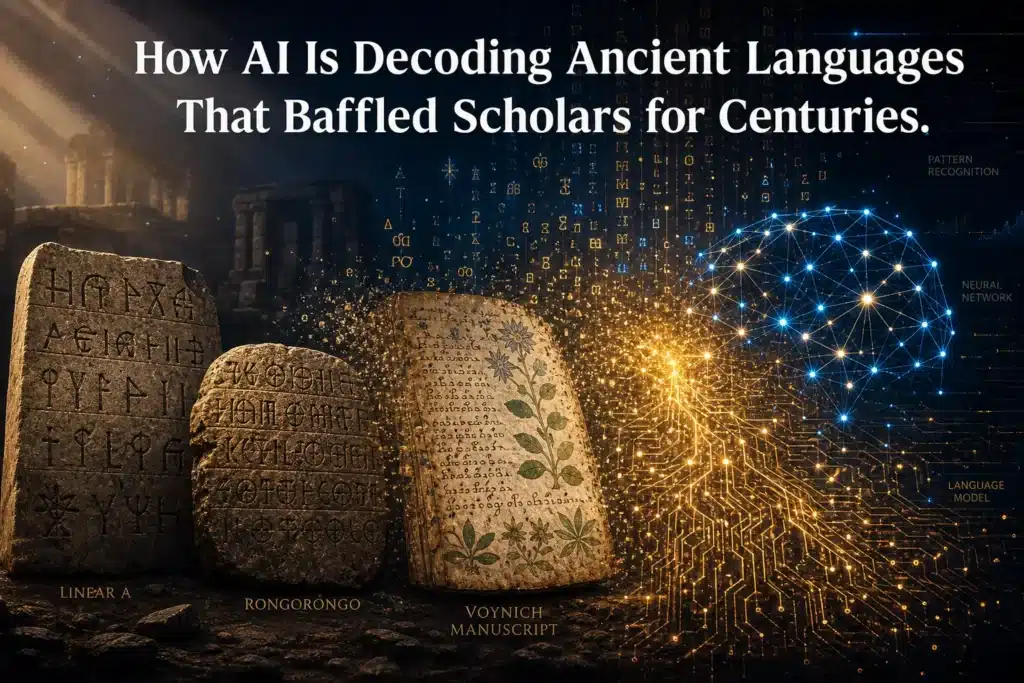
From the undeciphered tablets of Bronze Age Crete to the mysterious glyphs carved on Easter Island, AI is doing something that decades of human scholarship could not: finding patterns in chaos, connecting the invisible threads between symbols, and — in some cases — offering the first plausible translations ever proposed.
This post walks you through exactly how AI decoding ancient languages works, what tools researchers are using, what has been achieved so far, and where the field is headed next. Whether you are a linguistics enthusiast, a history buff, or just someone fascinated by the edge of what technology can do, this is a story you will not want to miss.
Table of Contents
Why Ancient Languages Are So Hard to Crack
Before diving into the AI side, it helps to understand what makes ancient scripts so brutally difficult to decode in the first place.
Human language decipherment usually requires what linguists call a bilingual anchor — a text written in both an unknown script and a known language. The Rosetta Stone is the most famous example. It contained the same priestly decree written in Ancient Egyptian hieroglyphics, Demotic script, and Ancient Greek. Because Greek was already understood, scholars could reverse-engineer the hieroglyphics.
But many ancient scripts have no Rosetta Stone equivalent. There are no known translations, no living descendants who speak the language, and sometimes no clear understanding of even what language family the script belongs to. Traditional decipherment requires:
- A sufficient corpus of inscriptions (enough data to detect patterns)
- Knowledge of related language families
- Understanding of cultural and historical context
- An enormous amount of human intuition and guesswork
This is exactly where AI decoding ancient languages changes the equation. Machine learning does not rely on cultural intuition or prior assumptions about language families. It relies on statistical patterns — and that makes it uniquely suited to tackling scripts that have no obvious anchor.
Read : What is MAYA AI?
The Most Famous Undeciphered Scripts AI Is Tackling
Linear A: The Script That Outlasted Every Scholar
Linear A was the writing system of the Minoan civilization, which flourished on the island of Crete roughly between 1800 and 1450 BCE. Thousands of clay tablets bearing Linear A inscriptions have been found, and yet — despite over a century of effort — it has never been deciphered.
The reason is painful in its simplicity: we do not know what language the Minoans spoke. Linear B, a related script, was cracked in 1952 by architect Michael Ventris, who showed it represented an early form of Greek. But Minoan was not Greek. It appears to be a language isolate — unrelated to any language we currently know — which makes traditional comparative linguistics almost useless.
This is precisely where AI decoding ancient languages offers a genuinely new approach. Researchers at MIT and elsewhere have applied neural network models to Linear A by training them on Linear B and other ancient Mediterranean scripts. The idea is to use what we know about Linear B’s phonetic structure to propose phonetic values for Linear A symbols that appear in similar positions. Progress is slow, but the models are surfacing patterns that human researchers simply cannot perceive at scale.
You can read more about ongoing Linear A research at The Oxford Handbook of the Bronze Age Aegean, which tracks scholarship on Minoan inscriptions.
Rongorongo: Easter Island’s Encoded Mystery
Rongorongo is a system of glyphs carved into wooden tablets found on Rapa Nui (Easter Island). It is one of only a handful of writing systems believed to have been invented independently — meaning it was not borrowed from any other known script. That makes it uniquely alien to standard linguistic analysis.
The corpus of Rongorongo is tiny: fewer than 30 surviving artifacts, with just a few thousand glyphs total. This creates a fundamental problem for AI decoding ancient languages because machine learning models typically need large datasets to perform reliably. Training a model on a few thousand symbols is like trying to learn English from a single paragraph.
However, researchers have made creative workarounds. By training models on the visual structure of glyphs rather than phonetic content — essentially asking the AI to group and cluster similar symbols and detect repeating sequences — teams in computational linguistics have begun building a kind of grammar skeleton for Rongorongo, even without knowing what it means. The Rongorongo Database maintained by independent researchers remains a key resource for these efforts.
The leading hypothesis is that Rongorongo may encode liturgical chants or astronomical observations. If an AI can identify structural periodicity in the glyphs that matches known astronomical cycles, that would be an extraordinary breakthrough.
The Voynich Manuscript: The World’s Most Mysterious Book
No discussion of AI decoding ancient languages is complete without the Voynich Manuscript — a 240-page illustrated book, carbon-dated to the early 15th century, written in a script that no one in the world has ever successfully translated.
The manuscript contains sections on plants (most of which do not correspond to real species), astronomical diagrams, naked human figures in green pools, and dense paragraphs of flowing, elegant text in an entirely unknown script. It has defeated some of the greatest cryptographers in history, including teams from the US Army and Navy during World War II.
What makes it so difficult? Several things. First, the text appears to follow genuine linguistic structure — it has consistent word-frequency distributions, something called Zipf’s Law, which most natural languages follow. This suggests it is not pure nonsense. But it could be an elaborate cipher, a constructed language, or a language so obscure that no related family has survived to help us compare.
Multiple AI attempts have been made. In 2019, a team from the University of Alberta used an AI system trained on 400 languages and claimed the manuscript might be encoded Hebrew, written without vowels. More recently, transformer-based models (similar to the architecture behind ChatGPT) have been applied to find semantic clustering in the Voynich script — attempting to understand which words appear near which other words and what that might reveal about meaning.
None of this has cracked the code yet. But AI decoding ancient languages has produced something genuinely valuable for the Voynich Manuscript: it has narrowed the field of plausible hypotheses significantly, ruling out pure randomness and reinforcing the idea that there is structure worth chasing.
How Google DeepMind Is Approaching Ancient Scripts
Google DeepMind — arguably the most sophisticated AI research organization on the planet — entered the ancient language space in a significant way with a project called Ithaca, published in Nature in 2022.
Ithaca is a deep learning model trained on ancient Greek inscriptions. Its purpose is restoration and attribution — given a damaged or incomplete ancient Greek text, it can suggest what the missing words probably were, and it can predict when and where a text was written based on linguistic style.
The results were striking. When tested against a dataset of ancient inscriptions, Ithaca correctly restored missing text with roughly 62% accuracy. When expert historians worked alongside Ithaca (rather than against it), their accuracy improved from 25% to 72%. This is a landmark demonstration of human-AI collaboration: neither the AI nor the human alone performed as well as both working together.
DeepMind’s approach to AI decoding ancient languages is not about replacing historians. It is about giving them a tool that can process thousands of inscription variations simultaneously and surface the statistically most plausible reading. You can read the original Ithaca paper at DeepMind’s research portal.
DeepMind has also collaborated with projects involving ancient Egyptian hieroglyphics and Proto-Sinaitic script — the early alphabet form from which most modern writing systems descend. These are not fully undeciphered, but they have significant gaps, and AI-assisted restoration is filling them rapidly.
How Machine Learning Models Are Trained on Dead Languages
One of the most common questions people have about AI decoding ancient languages is a practical one: how do you train an AI on a language that nobody speaks and that barely anyone can read?
The answer is surprisingly clever, and it comes in several flavors depending on the specific problem.
1. Cross-Lingual Transfer Learning
The most powerful approach currently being used involves training a model on many known languages and then applying what it learned to an unknown one. The intuition is that all human languages share certain deep structural properties — things like word order tendencies, morphological patterns, and phonological constraints. If a model has internalized these across 400 languages, it can use that knowledge to generate informed hypotheses about an unknown script.
Models like mBERT (multilingual BERT from Google) and XLM-RoBERTa (from Meta AI) are trained on 100+ languages simultaneously and have been adapted for ancient language work. You can explore these models on Hugging Face, the world’s leading open-source AI model platform.
2. Graphical and Visual Encoding
For scripts like Rongorongo where we do not even have a phonetic hypothesis, researchers encode the visual structure of glyphs as data. Each glyph becomes a high-dimensional vector representing its visual properties — strokes, curves, enclosed spaces, orientation. Then clustering algorithms group similar glyphs and look for combinations that appear with statistical regularity.
This is essentially asking the AI to identify the alphabet before trying to read the words — a foundational step that human researchers have always had to do manually.
3. Sequence Modeling and Pattern Detection
Ancient texts, like all texts, have structure. Letters combine to form syllables, syllables combine to form words, words cluster with certain other words. Sequence models — particularly Long Short-Term Memory networks (LSTMs) and transformer architectures — can detect these patterns even when the semantic content is completely unknown.
By building a statistical grammar of an unknown script, researchers create a structural map that can later be anchored once a bilingual clue (however small) is found. This anchoring strategy is sometimes called leverage decipherment.
4. Bayesian Probabilistic Approaches
Some teams at MIT’s Linguistics department and the Santa Fe Institute have used Bayesian models that embed hypotheses about language families directly into the decipherment process. The model assigns probabilities to different phonetic interpretations based on prior knowledge about how languages work, then updates those probabilities as it processes more data. Research papers on this approach are freely available at arXiv.org, the open-access repository for academic preprints.
Comparison Table: AI Tools and Their Applications in Ancient Language Decipherment
| Tool / Model | Developed By | Primary Application | Scripts Worked On | Key Strength | Limitation |
|---|---|---|---|---|---|
| Ithaca | Google DeepMind | Text restoration & dating | Ancient Greek inscriptions | 72% accuracy with human collaboration | Requires existing partial decipherment |
| mBERT | Cross-lingual transfer | Proto-Sinaitic, Linear B | Pre-trained on 100+ languages | Struggles with true isolate languages | |
| XLM-RoBERTa | Meta AI | Multilingual representation | Egyptian hieroglyphics | Strong at low-resource languages | Needs transliterated training data |
| LSTM Sequence Models | Various academic teams | Pattern/structure detection | Linear A, Rongorongo | Works without phonetic knowledge | Cannot infer meaning independently |
| Transformer LLMs | OpenAI / Academic labs | Hypothesis generation | Voynich Manuscript | Fast semantic clustering | High hallucination risk |
| Bayesian Decipherment | MIT / Santa Fe Institute | Probabilistic phonetics | Undeciphered Semitic scripts | Principled uncertainty modeling | Computationally expensive |
The Real Limitations of AI Decoding Ancient Languages
As exciting as the progress is, responsible reporting on AI decoding ancient languages requires being honest about the walls these tools keep running into.
The Corpus Problem
Machine learning needs data. For most undeciphered scripts, the surviving corpus is heartbreakingly small. Linear A has roughly 7,000 signs across all known tablets. Rongorongo has fewer than 15,000 glyphs. The Voynich Manuscript has around 35,000 words. These are tiny datasets by modern AI standards. A GPT-4 class model was trained on hundreds of billions of words. Asking it to generalize from 15,000 glyphs is a fundamentally different challenge.
The Meaning Gap
Even if an AI successfully identifies the phonetic structure of an ancient script — figures out which symbol makes which sound — that is still a long way from understanding meaning. Reading is different from comprehending. If the underlying language is extinct with no living relatives, knowing how to pronounce the words does not tell us what they mean. AI decoding ancient languages can crack structure; it cannot conjure semantic meaning from nothing.
Hallucination and Confirmation Bias
Large language models are known to confidently generate plausible-sounding but factually incorrect outputs — a behavior called hallucination. In the context of ancient scripts, this is dangerous. A model that is subtly biased toward, say, Semitic language structures might find patterns that appear to confirm a Semitic interpretation of the Voynich Manuscript even when the evidence is ambiguous. Rigorous peer review and human skepticism remain essential counterweights.
The One-Size-Fits-All Problem
Not all ancient scripts are the same kind of problem. Some are undeciphered because the language is unknown (Linear A). Some are undeciphered because the script is unknown (Rongorongo). Some may be ciphers rather than natural languages (Voynich). Each scenario requires a different algorithmic approach, and no single AI model handles all three equally well.
Ethical Concerns Around AI in Ancient Language Research
The intersection of AI decoding ancient languages and ethics is more complex than it might first appear.
Intellectual Ownership of Indigenous Heritage
Scripts like Rongorongo belong to the cultural heritage of the Rapa Nui people. If AI produces a translation of those tablets — even a partial one — who owns that knowledge? Do tech companies have the right to train models on materials that indigenous communities consider sacred? UNESCO has raised these concerns explicitly in its framework on cultural heritage and digital technology, and they deserve serious attention.
The Danger of False Certainty
When an AI publishes a “translation,” there is enormous pressure — from media, from institutions, from funding bodies — to treat it as definitive. The 2019 claim about the Voynich Manuscript encoding Hebrew generated enormous media coverage. But most scholars were skeptical and the claim has not been validated. Overstating AI certainty in a field as nuanced as epigraphy can mislead the public and distort research priorities.
Bias in Training Data
If a model is trained primarily on Indo-European languages because those are the best-documented ancient languages, it will carry an Indo-European bias into its analysis of unrelated scripts. This is not just an accuracy problem — it is an epistemological one. We may be projecting our own linguistic heritage onto scripts that represent radically different ways of organizing language and thought.
Digital Colonialism in Archaeology
There is a growing concern in academic circles that the race to “decode” ancient languages is being driven by Western tech institutions rather than the communities whose ancestors created those scripts. When a Silicon Valley team announces an AI breakthrough on a Mesoamerican or Pacific script, the framing often centers the technology rather than the culture. Responsible AI decoding ancient languages must involve collaboration with descendant communities from the very beginning.
The Future of AI Decoding Ancient Languages
Despite the limitations and ethical complexities, the future of AI decoding ancient languages is genuinely exciting — and it is coming faster than most people expect.
Multimodal AI and Archaeological Context
The next generation of AI models will not just analyze text in isolation. They will integrate visual data (images of artifacts, stratigraphy maps, architectural layouts), archaeological metadata (where a tablet was found, what other objects surrounded it), and linguistic data simultaneously. This multimodal approach could unlock context clues that pure text analysis misses entirely.
Larger Multilingual Pretraining
As models are pretrained on increasingly diverse language families — including Dravidian, Austronesian, Afroasiatic, and Sino-Tibetan languages — they will be better equipped to handle language isolates and unusual structural features. The current bias toward Indo-European languages in pretraining data is a known problem that researchers are actively working to fix.
Crowdsourced Annotation
Platforms that allow thousands of non-specialist volunteers to annotate glyphs and transcribe inscriptions are generating training data at a scale that no academic team could produce alone. Projects like Zooniverse have applied this crowdsourcing model to ancient documents, and combining crowd-generated transcriptions with AI analysis is emerging as a powerful hybrid strategy for AI decoding ancient languages.
Quantum Computing and Cryptographic Approaches
The Voynich Manuscript, if it is a cipher, may require computational power that even today’s supercomputers cannot deliver at scale. Quantum computing — still nascent but advancing rapidly — may eventually allow researchers to test decipherment hypotheses at speeds that would render currently intractable ciphers suddenly solvable.
Real-Time Collaboration Platforms
The next decade will likely see the rise of dedicated platforms where historians, linguists, AI researchers, and indigenous cultural authorities can collaborate in real time — combining the AI’s pattern-recognition abilities with the nuanced cultural knowledge that no algorithm currently possesses.
Check Out How AI can be Integrated in Excel!
What Has Already Been Achieved: A Quick Recap
It is worth stepping back to appreciate how much AI decoding ancient languages has already accomplished:
- DeepMind’s Ithaca model improved historian accuracy on ancient Greek texts from 25% to 72% through human-AI collaboration.
- MIT researchers have proposed the most statistically coherent phonetic assignments yet suggested for Linear A symbols.
- Neural network clustering of Rongorongo glyphs has produced the most detailed glyph taxonomy ever assembled, giving future researchers a structured working alphabet to test against.
- Transformer models have definitively ruled out the hypothesis that the Voynich Manuscript is pure random nonsense — confirming that structured meaning is encoded somewhere within it.
- Cross-lingual AI models have filled gaps in thousands of damaged ancient Greek and Latin inscriptions, recovering historical records that were previously unreadable.
These are not small wins. They represent genuine scientific progress on some of the hardest puzzles in human history.
Conclusion
We are living through a genuinely extraordinary moment. For the first time, the tools exist to seriously challenge the silence of scripts that have defied humanity’s best minds for centuries. AI decoding ancient languages will not replace the linguist, the archaeologist, or the cultural historian. But it gives them something they have never had before: a tireless collaborator that can process millions of data points, detect invisible patterns, and generate hypotheses faster than any human team.
Linear A may yet speak. Rongorongo may one day surrender its secrets. Even the Voynich Manuscript — that maddening, beautiful, infuriating mystery — may eventually yield to an algorithm that finds the key humans have always been too close to see.
The past is not gone. It is encoded. And AI decoding ancient languages is learning, slowly and methodically, how to read it.
Frequently Asked Questions (FAQs)
1. What does “AI decoding ancient languages” actually mean? It refers to the use of machine learning models, neural networks, and computational linguistics tools to analyze, interpret, and attempt to translate ancient or undeciphered scripts without relying solely on human expertise. AI decoding ancient languages leverages statistical pattern recognition to find structures that human scholars may miss.
2. Has AI successfully decoded any completely unknown ancient language? Not fully — no. AI decoding ancient languages has produced significant partial breakthroughs, particularly in restoring damaged texts in known ancient languages like Greek, and in structural analysis of unknown scripts. But no fully undeciphered script like Linear A or Rongorongo has been completely translated yet.
3. What is Google DeepMind’s Ithaca model? Ithaca is a deep learning model developed by Google DeepMind specifically to restore missing text in ancient Greek inscriptions and date or locate inscriptions based on linguistic style. It is one of the most significant real-world applications of AI decoding ancient languages to date.
4. Why is Linear A so hard to decipher even with AI? Linear A represents an unknown language with no confirmed relatives. Without a bilingual anchor or a related known language to compare it to, even the most sophisticated AI decoding ancient languages tools cannot infer meaning — only structure. The language itself remains the missing piece.
5. Could AI ever crack the Voynich Manuscript? Possibly — but it depends on what the Voynich Manuscript actually is. If it is a natural language written in an unknown script, AI decoding ancient languages tools have a realistic shot. If it is an elaborate hoax with no underlying meaning, no amount of AI analysis will produce a coherent translation.
6. What are the biggest limitations of using AI on ancient scripts? The major limitations include small corpus sizes, the inability to derive meaning from structure alone, hallucination risks in large language models, and biases introduced by training data dominated by Indo-European languages. AI decoding ancient languages is powerful but not omnipotent.
7. Are there ethical concerns with AI analyzing indigenous scripts? Absolutely. Scripts like Rongorongo belong to living indigenous communities, and there are serious questions about intellectual ownership, cultural consent, and the framing of who gets credit for breakthroughs. Ethical AI decoding ancient languages research must involve descendant communities as equal partners.
8. What machine learning architectures are most used for ancient language work? Transformer models, LSTMs, Bayesian probabilistic models, and cross-lingual pretrained models like mBERT and XLM-RoBERTa are the most commonly applied. Each handles a different aspect of AI decoding ancient languages, from phonetic inference to structural clustering.
9. How does crowdsourcing help AI decode ancient languages? Platforms like Zooniverse allow thousands of volunteers to annotate and transcribe ancient texts, generating labeled training data at scale. This crowd-generated data feeds directly into AI decoding ancient languages models, dramatically expanding the available corpus for training.
10. What ancient language breakthroughs can we realistically expect in the next decade? Partial translations of Linear A syllabic content, a complete structural taxonomy of Rongorongo glyphs, and significant narrowing of hypotheses for the Voynich Manuscript are all realistic goals. Full decipherment of a currently unknown language using AI decoding ancient languages alone remains unlikely without a new bilingual discovery — but stranger things have happened.
This post was written for educational and informational purposes. All external links are provided for reference and belong to their respective organizations.