
There’s a moment in every real technological breakthrough where something that once sounded like a bad sci-fi pitch becomes Tuesday morning’s news. We’ve seen it with image recognition, real-time translation, and language generation. Now, quietly but with serious momentum, AI smell technology is having that exact moment — and it might just be the most underrated breakthrough of this decade.
Smell is our most ancient sense, evolutionarily speaking. It’s wired directly into the limbic system, the emotional and memory center of the brain. It kept our ancestors alive, warned them of predators, guided them toward food. And for most of human history, it was also deeply, stubbornly impossible to digitize.
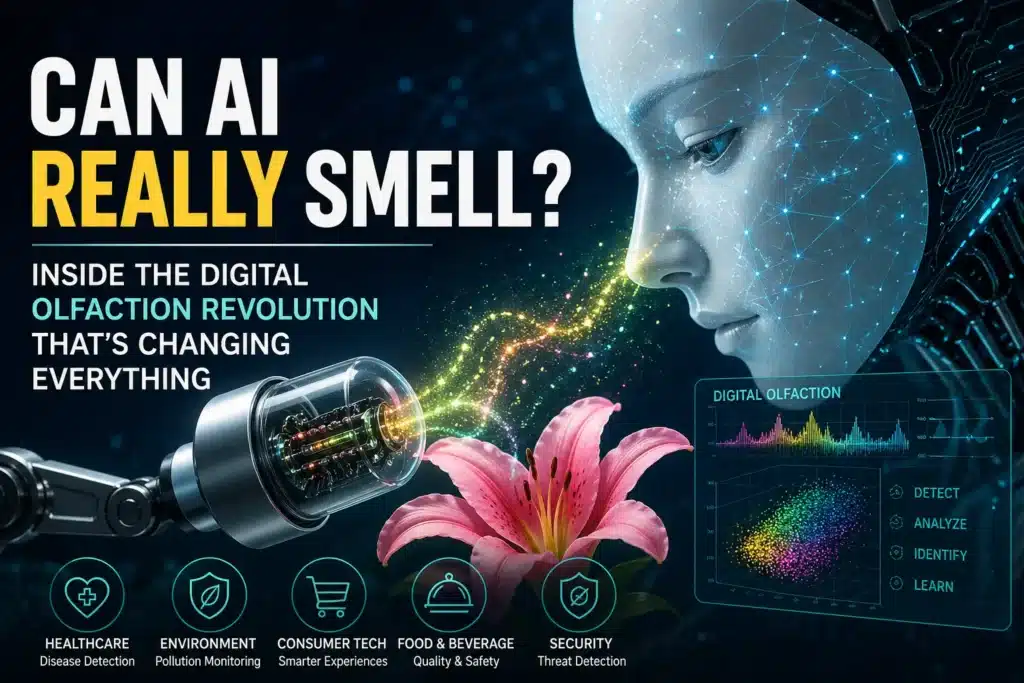
That’s changing fast. AI smell technology has moved from laboratory oddity to a legitimate field with commercial deployments, peer-reviewed breakthroughs, and billions of dollars flowing in. This post unpacks everything — what electronic noses are, what Google and Osmo actually proved, where the technology is already being used today, and what comes next.
Table of Contents
What Exactly Is AI Smell Technology — And Why Is Everyone Suddenly Paying Attention?
AI smell technology refers to the use of artificial intelligence, machine learning, and chemical sensor arrays to detect, classify, analyze, and even predict odors. It sits at the crossroads of chemistry, neuroscience, materials science, and computer science — and it’s moving fast enough that ignoring it is no longer an option for industries like healthcare, food production, and fragrance.
The reason this field is gaining urgency is straightforward: smell carries information that no other sense can access. The human body produces hundreds of volatile organic compounds (VOCs) that shift based on health status, stress, and metabolic changes. Spoiling food generates specific chemical signatures. Counterfeit luxury products often smell subtly but measurably different from authentic ones. AI smell technology is building the tools to read all of these signals consistently, at scale, and in real time.
The numbers back the momentum. The global electronic nose market was valued at approximately $1.8 billion in 2023 and is projected to reach $3.5 billion by 2030, growing at a CAGR of roughly 9.8% (MarketsandMarkets). That growth isn’t speculative hype — it reflects real commercial deployments across multiple industries.
What Is an Electronic Nose (E-Nose) and How Does It Actually Work?
The electronic nose — or e-nose — is the hardware at the heart of most AI smell technology applications. Think of it as a device that mimics the biological olfactory system using an array of chemical sensors paired with a pattern recognition engine.
The human nose contains approximately 400 types of olfactory receptors, and the brain interprets the combination of signals from all of them to produce the perception of a smell. An e-nose works on a parallel principle: it uses multiple sensors, each with a slightly different chemical sensitivity, and reads their combined response as a unique “fingerprint” for any given odor.
The key components of a modern e-nose system are:
Sensor Array — Typically built from metal oxide semiconductors, electrochemical sensors, conducting polymer arrays, or quartz crystal microbalances. Each sensor responds differently to different airborne compounds, creating a multi-dimensional response matrix.
Signal Processing Unit — Raw sensor data is noisy and inconsistent. The processing unit normalizes, filters, and prepares the data for analysis.
AI Pattern Recognition Engine — This is where AI smell technology does its real work. Machine learning models — from support vector machines to deep convolutional neural networks — are trained on large datasets of odor samples and learn to recognize patterns in sensor responses that correspond to specific smells or chemical conditions.
Early e-noses from the 1980s and 1990s were crude by today’s standards. They could broadly distinguish categories of odors but lacked the precision needed for real-world deployment. The transformation happened when modern AI was layered on top — suddenly, the same sensor hardware began performing at an entirely different level. IEEE’s technical resources on sensor systems and pattern recognition offer a useful technical foundation for anyone looking to go deeper: https://www.ieee.org/
How Did Google and Osmo’s Research Rewrite the Rules of AI Smell Technology?
This is the section that caused genuine excitement across both the AI and chemistry research communities.
In 2023, researchers from Google and a company called Osmo — a spinout from Google Research — published a landmark study in the journal Science that fundamentally changed how scientists think about olfaction. The team built what they called a “principal odor map” — a navigational chart of the smell universe, generated using a graph neural network trained on the three-dimensional molecular structures of odor-producing compounds.
The training dataset contained approximately 5,000 molecules paired with 55 odor descriptors — things like “floral,” “musky,” “woody,” “earthy,” and “sweaty.” The AI didn’t just memorize which labeled molecules smelled a certain way. It learned to read molecular geometry — because smell is determined primarily by the three-dimensional shape of molecules, not just their chemical formula — and map those shapes to human perceptual outcomes.
The test was the genuinely remarkable part. The AI smell technology was presented with molecules it had never been trained on — completely novel chemical structures — and asked to predict how human panelists would describe their smell. Its predictions matched those of trained expert human perfumers with statistically comparable accuracy.
That’s the kind of result that rewrites textbooks. The conventional wisdom for decades was that predicting smell from molecular structure was essentially impossible — the relationship was too complex, too nonlinear, too subjective. This research challenged all of that directly.
Osmo’s broader mission extends beyond academic papers. The company aims to give machines a sense of smell as reliable and standardized as the cameras and microphones in every device we own. You can read about their ongoing work at https://www.osmo.ai.
The downstream implications of this AI smell technology breakthrough are significant. Chemists can now virtually screen molecules for their likely smell profile before synthesizing them in a lab. Drug companies can predict whether new compounds will create aversion through smell. And the database of mapped odor-molecule relationships continues to grow with every experiment.
Also Read : The best way to use ChatGPT in 2026
Can AI Smell Technology Really Detect Diseases Before Symptoms Even Appear?
Let’s be direct about something first: AI smell technology in medical diagnostics is not a replacement for clinical medicine, and nothing presented here should be taken as medical advice. But as a complementary screening tool and an area of active research, the evidence is mounting in a way that is very hard to dismiss.
The science rests on a well-established biochemical reality: disease alters the body’s metabolic processes, and those changes produce measurable shifts in the VOCs we exhale, secrete through skin, and release in other ways. Different diseases leave different molecular footprints. AI smell technology is learning to read those footprints.
Cancer Detection
Multiple peer-reviewed studies have demonstrated that dogs can detect certain cancers — lung, colorectal, ovarian, bladder — with accuracy exceeding 90% in controlled conditions. AI-powered e-nose systems are attempting to replicate this without biological variability. Research published in Cancer Biomarkers and PLOS ONE has shown that exhaled breath analysis using AI can detect lung cancer biomarkers with sensitivity above 85% in early-stage patients — before conventional imaging would typically flag anything suspicious.
Owlstone Medical, a Cambridge-based company, has developed what they call a “Breath Biopsy” platform — a clinical tool that collects VOC profiles from exhaled breath and runs them through trained AI models. Their ATLAS clinical trial is actively studying this approach for colorectal cancer detection. More on their platform is available at https://www.owlstone.co.uk.
Malaria
In 2019, research from the London School of Hygiene & Tropical Medicine demonstrated that AI smell technology-assisted VOC analysis could identify malaria infection in children with meaningful accuracy — including in asymptomatic carriers who showed no outward signs of illness. The WHO estimated that malaria killed over 619,000 people in 2021, with the vast majority of deaths concentrated in regions with limited diagnostic infrastructure. A non-invasive, fast, and low-cost smell-based test could meaningfully change outcomes in these settings. More on the global disease burden is available at https://www.who.int/news-room/fact-sheets/detail/malaria.
Parkinson’s Disease
The most emotionally compelling story in this space involves a Scottish woman named Joy Milne, who noticed her husband’s body odor changed years before his Parkinson’s diagnosis. She mentioned this to researchers at the University of Manchester, who worked with her to identify the specific sebum-based compounds responsible for the change. That discovery is now being used to develop a clinically scalable test — and AI smell technology is central to making it reproducible at scale without requiring a superhuman nose.
Diabetes
Elevated acetone in the breath of diabetic patients — especially during ketoacidosis — has been reliably detected by AI-enhanced e-nose systems. While blood glucose testing remains standard, AI smell technology could provide a genuinely non-invasive complement for continuous monitoring.
Is AI Smell Technology Making the Food We Eat Safer and Less Wasteful?
Food safety is arguably the most commercially mature application of AI smell technology today, and for sensible reasons. The stakes are extremely high, the technology integrates naturally into existing industrial workflows, and the return on investment is measurable and rapid.
The underlying problem in food quality control is that human sensory inspection is inconsistent, doesn’t scale, and fatigue makes it unreliable over long shifts. Chemical lab testing is accurate but slow. AI smell technology sits neatly between those options — faster than a lab, more consistent than a human, and increasingly accurate enough to replace both in many contexts.
Spoilage Detection
Meat, fish, and dairy spoil through predictable chemical pathways. Fish produces compounds like trimethylamine and dimethylamine as it degrades. Bacterial activity in meat generates specific VOC signatures. AI-powered e-nose systems can detect these markers at concentrations well below what the human nose would perceive — catching spoilage earlier, reducing health risk, and minimizing product loss.
Alpha MOS, a French company specializing in sensory analysis instrumentation, has deployed AI smell technology systems in food production facilities across Europe, Asia, and North America. Their platforms are used for everything from quality grading of coffee and cocoa to detecting off-notes in packaged beverages. Their technology portfolio is documented at https://www.alpha-mos.com.
Food Authentication and Fraud Prevention
Olive oil fraud is a well-documented and persistent problem. The International Olive Council has consistently found that a significant percentage of products labeled “extra virgin” fail to meet the actual standards for that classification. AI smell technology is being used to chemically fingerprint genuine extra virgin olive oil, creating a molecular baseline that makes fraudulent labeling dramatically harder to get away with. The same approach is applied to wine authentication, honey verification, whisky origin tracing, and high-value spice verification.
Smart Packaging and Real-Time Monitoring
Emerging applications of AI smell technology include micro-sensors embedded in food packaging that continuously monitor the internal atmosphere of the package and flag approaching spoilage — not based on a printed date, but on actual real-time molecular analysis. The FDA’s food safety modernization framework actively encourages technology-driven monitoring: https://www.fda.gov/food/food-safety-modernization-act-fsma.
How Is AI Smell Technology Quietly Transforming the Entire Perfume Industry?
Fragrance creation is one of the most intuition-driven, experience-dependent crafts in existence. Master perfumers — called “noses” in the industry — spend up to a decade developing the ability to recall and manipulate hundreds of raw aroma materials. They work through sensory memory, emotional association, and years of trial and error.
AI smell technology isn’t replacing that expertise. But it is becoming a genuinely powerful creative partner that the smartest companies in fragrance are already using.
Symrise, one of the world’s largest fragrance and flavor houses, partnered with IBM Research to build an AI system called Philyra, trained on thousands of existing fragrance formulas and consumer preference data. In 2019, Philyra co-developed two commercial fragrances for the Brazilian market — real products, sold to real consumers — in collaboration with a human perfumer. The AI generated novel formula concepts; the human evaluated, refined, and validated.
Speed and Cost Efficiency
Traditional fragrance development involves many rounds of physical formulation and sensory testing, which can drag out for months. AI smell technology can screen thousands of molecular combinations virtually before a single physical sample is mixed, dramatically compressing development timelines and reducing raw material consumption.
Personalization
There’s growing commercial interest in using AI smell technology to create genuinely personalized fragrances based on individual preference profiles, skin chemistry interactions, and emotional associations. Consumers answer structured preference questionnaires; the AI generates a bespoke formula. It’s mass personalization at a scale that human perfumers couldn’t achieve alone.
Sustainable Alternatives
Ingredients like agarwood, rosewood, certain musks, and ambergris are either endangered, ethically fraught, or prohibitively expensive. AI smell technology is accelerating the discovery of synthetic alternatives that smell nearly identical to these natural sources, opening a more sustainable path for the industry without sacrificing quality.
How Does AI Smell Technology Actually Compare to the Human Nose?
This is the question everyone asks first, and the answer is genuinely nuanced. Neither is simply “better.”
| Factor | Human Nose | AI Smell Technology (E-Nose) |
|---|---|---|
| Receptor types | ~400 olfactory receptor types | Typically 6–32 sensors per array |
| Estimated odors detectable | Up to 1 trillion combinations | Depends on training data; rapidly expanding |
| Detection sensitivity | Parts-per-trillion for some compounds | Often sub-ppb; frequently exceeds human range |
| Fatigue and drift | Adapts within minutes; emotional state affects performance | No fatigue; consistent 24/7 performance |
| Objectivity | Highly subjective; shaped by memory and culture | Objective; returns numerical, reproducible data |
| Novel molecule prediction | Cannot predict unfamiliar smells | AI models now predict novel odors with expert-level accuracy |
| Contextual/emotional understanding | Very strong; smell triggers complex memory and emotion | Limited; contextual learning is still early-stage |
| Scalability | Cannot be industrially scaled | Deployable at scale across production lines |
| Speed of analysis | Instantaneous perception | Near-real-time; milliseconds to seconds |
| Training investment | Up to 10 years for expert perfumers | Days to weeks with sufficient labeled data |
What this comparison makes clear is that AI smell technology and the human nose are complementary, not competitive. The human nose leads on nuance, emotional resonance, and contextual meaning. AI smell technology leads on consistency, sensitivity, scale, and the detection of chemical signals invisible to human perception. The optimal future — which is already starting to take shape in fragrance labs and food facilities — involves both working together.
What Are the Real Challenges Preventing AI Smell Technology From Going Mainstream?
Despite impressive progress, honest reporting on AI smell technology has to acknowledge the genuine obstacles the field is working through.
The Vocabulary Problem: Human smell language is notoriously inconsistent. What one trained professional calls “green” another calls “herbal” and a third calls “fresh.” Building reliable training datasets for AI smell technology is difficult when the ground truth labels themselves are subjective and variable. Standardized odor lexicons are being developed, but adoption is slow.
Sensor Drift: Chemical sensors in e-noses don’t stay stable indefinitely — their sensitivity profiles shift over time as materials degrade or surface chemistries change. An AI model trained on Month 1 data may underperform on the same hardware at Month 6. Managing drift requires regular recalibration and adaptive algorithms.
Real-World Mixture Complexity: Most controlled research involves single compounds or simple mixtures under laboratory conditions. Real environments — hospitals, factories, food processing facilities, human bodies — produce extraordinarily complex, overlapping odor signatures. Getting AI smell technology to perform reliably in noisy, high-interference real-world conditions remains an active and difficult research challenge.
Data Scarcity: There’s no ImageNet for smells — no massive, well-labeled public dataset that researchers can use to benchmark models and drive consistent progress. The Osmo research significantly improved this situation, but the field still needs far more structured data.
Hardware Size and Cost: High-performance sensor arrays with sophisticated AI remain relatively expensive and physically bulky for many consumer applications. Bringing AI smell technology meaningfully into smartphones and wearables requires miniaturization the industry hasn’t fully cracked yet.
Check Out : Meta Black Box AI Optimisation
Where Is AI Smell Technology Headed in the Next 10 Years — And Should You Be Excited?
The short answer: yes, with both eyes open.
The next decade of AI smell technology will be shaped by several converging forces that are already clearly in motion.
Next-Generation Sensor Materials: Research into nanomaterial-based sensors — graphene, carbon nanotubes, metal-organic frameworks — promises arrays that are more sensitive, more selective, faster to respond, and significantly smaller than anything currently deployed. These materials, combined with AI, will push e-nose performance beyond the biological nose on nearly every measurable metric.
Smartphone Integration: Multiple research groups and startups are developing sensor modules that attach to or integrate with standard smartphones, bringing AI smell technology to everyday users. Early products from companies like Aryballe and Aromyx are already exploring this space, and the trajectory looks similar to how smartphone cameras evolved from gimmick to essential tool over a decade.
IoT and Industrial Integration: In industrial settings, AI smell technology is increasingly embedded in IoT ecosystems — networks of distributed sensors feeding continuous data to centralized AI platforms that monitor air quality, detect equipment failures through chemical off-gassing signatures, track product freshness, and flag safety hazards simultaneously.
Mental Health and Biochemical Monitoring: Emerging research suggests that stress, anxiety, and emotional states produce measurable shifts in body odor chemistry. AI smell technology could theoretically enable non-invasive emotional wellness monitoring — though this application raises serious questions about privacy and consent that the field will need to address directly and proactively.
Digital Scent Reproduction: The longer-range, more speculative frontier involves not just detecting smells but reproducing them on demand — a chemical synthesizer guided by AI that can recreate any mapped odor. Combined with virtual and augmented reality environments, this opens the door to genuinely multisensory digital experiences. Companies like OVR Technology are already building scent delivery hardware for VR applications, with AI smell technology serving as the underlying intelligence: https://ovrtechnology.com.
AI smell technology is not a gimmick. It is not a niche laboratory curiosity waiting for its moment. It is a maturing discipline with real commercial deployments, improving benchmark performance, growing research investment, and a rapidly expanding footprint across healthcare, food, fragrance, environmental monitoring, and industrial safety. The nose — artificial or biological — is becoming one of the most powerful sensing tools of the coming decade.
10 Frequently Asked Questions About AI Smell Technology
1. What is AI smell technology in simple terms?
AI smell technology is the combination of artificial intelligence and chemical sensor arrays to detect, analyze, classify, and predict odors. These systems can identify specific molecules in the air, classify them against trained patterns, and increasingly predict how new, never-before-smelled compounds would actually smell to a human nose.
2. How accurate is AI smell technology compared to a trained human nose?
It depends on the task. For detecting specific compounds at low concentrations, AI smell technology frequently outperforms the human nose, which fatigues quickly and is influenced by memory and emotion. For nuanced, contextual, and emotionally meaningful smell recognition, human noses still have advantages — though the gap is narrowing as AI models improve.
3. What did the Google and Osmo research actually demonstrate?
The 2023 landmark study showed that a graph neural network trained on molecular structures could predict how entirely novel, never-before-tested molecules would smell to human panelists — with accuracy statistically comparable to trained expert perfumers. This proved that the relationship between molecular structure and smell perception is learnable by machines at an expert level.
4. Can AI smell technology detect cancer?
Promising research indicates that breath-based VOC analysis using AI can detect certain cancers — particularly lung and colorectal — with meaningful sensitivity in early-stage patients. However, this is still an active area of clinical research and is not currently approved as a diagnostic tool. It should be understood as a developing complementary screening technology.
5. Which industries are currently using electronic nose AI systems?
The most commercially active deployments of AI smell technology are in food quality control, pharmaceutical manufacturing quality assurance, environmental monitoring, fragrance and flavor development, and medical research. Industrial applications are the most mature; consumer-facing applications are emerging.
6. What is an electronic nose and how is it different from a regular sensor?
An electronic nose uses an array of multiple chemical sensors, each with a different sensitivity profile, combined with AI pattern recognition. Unlike a single sensor that measures one thing, an e-nose creates a multi-dimensional response “fingerprint” for any odor — much like how the human nose uses hundreds of receptor types simultaneously. The AI interprets the combined pattern.
7. How is AI smell technology being used in the perfume industry today?
Fragrance companies are using AI smell technology to virtually screen novel molecules for their smell profiles before physical synthesis, accelerate formula development, generate personalized fragrance concepts based on consumer preference data, and identify sustainable synthetic alternatives to scarce or ethically problematic natural ingredients.
8. Is digital olfaction the same thing as AI smell technology?
Digital olfaction is the broader term — it encompasses all technologies aimed at digitizing smell, including recording, transmitting, and eventually reproducing odors. AI smell technology is the core enabling layer within digital olfaction, providing the intelligence that makes sense of raw sensor data and drives prediction and classification.
9. What are the biggest barriers to widespread adoption of AI smell technology?
The main barriers are: inconsistent human odor vocabulary making training data noisy; sensor drift over time requiring recalibration; difficulty handling complex real-world odor mixtures; limited large-scale public molecular smell datasets; and hardware that remains too bulky and expensive for most consumer applications.
10. What does the next decade look like for AI smell technology?
Expect nanomaterial-based sensors with dramatically improved performance, smartphone-integrated e-nose modules for everyday use, broader and more validated clinical diagnostic applications, deeper IoT integration in industrial settings, and early-stage digital scent reproduction for immersive media. AI smell technology is on a clear trajectory from specialized industrial tool to mainstream everyday technology — and it’s moving faster than most people realize.
1 thought on “AI Smell Technology: Can Machines Really Smell? Inside the Digital Olfaction Revolution (2026)”