
Every year, the world generates over 430 million metric tons of plastic. Less than 9% of it is ever recycled. The rest ends up in landfills, incinerators, or the ocean — and roughly 8 million metric tons find their way into marine ecosystems annually. These aren’t alarming estimates from activist groups. These are figures from the United Nations Environment Programme, and they point to a materials design failure that has been decades in the making.
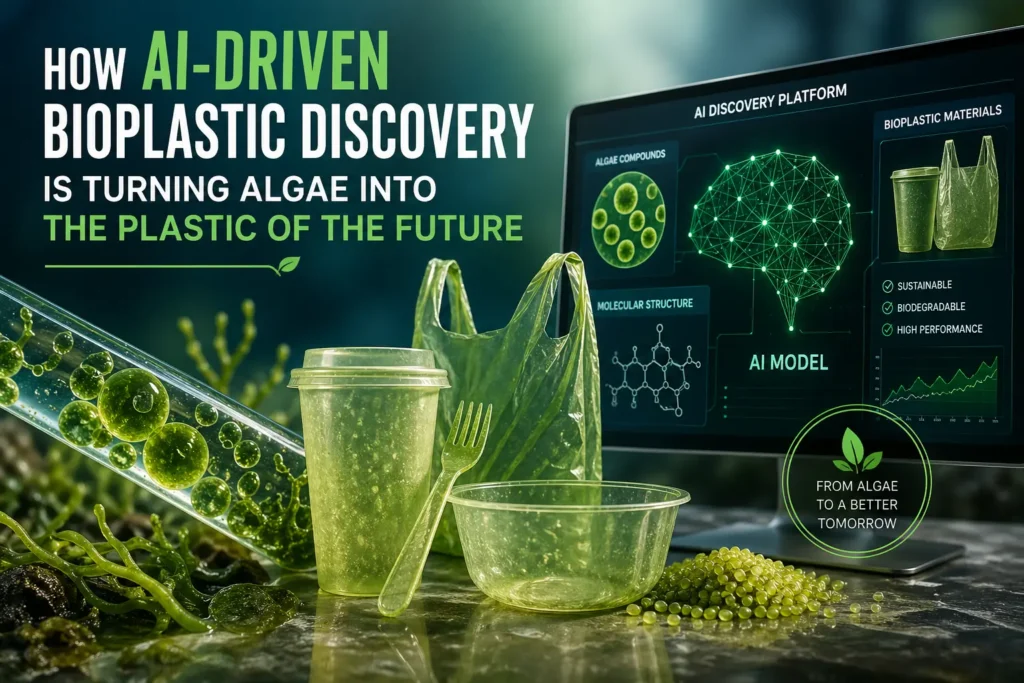
Here’s the thing though — AI-driven bioplastic discovery is quietly changing the equation. Not in the slow, incremental way that most sustainability progress has moved, but in a genuinely disruptive way. The convergence of machine learning, algal biology, and computational materials science is compressing a decade of polymer R&D into months. And the material sitting at the center of all this? Algae — the fast-growing, carbon-hungry, ocean-cleaning organism that most people associate with summer pond scum.
AI-driven bioplastic discovery isn’t a research fantasy. It’s an active, funded, commercially progressing discipline that’s already put products on shelves and changed the way materials scientists think about what’s possible. This post breaks down exactly what’s happening, what the data shows, and why the timeline for solving the algae-polymer puzzle has never looked shorter.
Table of Contents
What Exactly Is AI-Driven Bioplastic Discovery, and Why Is Everyone Suddenly Talking About It?
Bioplastics — materials derived from biological feedstocks rather than fossil fuels — have existed in various forms since the 19th century. Celluloid, the world’s first commercial plastic, was derived from cellulose. But modern high-performance bioplastics like PHAs (polyhydroxyalkanoates), PLA (polylactic acid), and bio-based polyurethanes are structurally far more complex — and developing them through conventional lab methods is genuinely painful.
Traditional polymer discovery works through a grind of hypothesis, synthesis, and characterization. A researcher identifies a candidate molecular structure, spends weeks synthesizing a small batch, runs it through mechanical testing, thermal analysis, and degradation studies, then adjusts and repeats. A single development cycle can cost tens of thousands of dollars and several months of researcher time. At that pace, exploring the full molecular diversity of algae-derived polymers would take centuries.
AI-driven bioplastic discovery reorganizes this entire pipeline around prediction rather than trial and error. Machine learning models — trained on databases of known polymer structures and their measured properties — can screen millions of molecular candidates in silico, identify the ones most likely to meet specific performance targets, and deliver a ranked shortlist to the lab before a single gram of material is synthesized. The result is a development process that is dramatically faster, cheaper, and more likely to find genuinely novel solutions.
The numbers back this up. The global bioplastics market was valued at approximately $10.5 billion in 2023 and is projected to reach $29.7 billion by 2032, driven largely by regulatory pressure, corporate sustainability commitments, and the falling cost of bio-based feedstocks. Grand View Research’s bioplastics analysis shows compound annual growth rates above 14% — a trajectory that only makes sense if the material development pipeline is accelerating. AI-driven bioplastic discovery is a core reason it is.
Check Out our Guide on how Google’s NotebookLM is helping out students.
Why Is Algae the Most Exciting Raw Material for Next-Generation Bioplastics?
Before getting into the mechanics of machine learning models, it’s worth understanding why algae is the feedstock that researchers keep coming back to — because it isn’t arbitrary.
Certain microalgal species, particularly Spirulina platensis, Chlorella vulgaris, and Nannochloropsis oceanica, naturally accumulate polyhydroxyalkanoates under metabolic stress conditions — specifically when they’re grown with excess carbon and limited nitrogen. PHAs are thermoplastic polyesters that can be processed using standard plastic manufacturing equipment and biodegrade in soil in as little as 3 to 6 months. By comparison, conventional polyethylene takes anywhere from 200 to 500 years to decompose under natural conditions.
Beyond PHAs, algae produces agar, carrageenan, alginate, and cellulose-based compounds that can be engineered into flexible films, rigid containers, and composite materials. The National Renewable Energy Laboratory (NREL) has spent over two decades studying algal biomass pathways, and their data on photosynthetic efficiency and polymer yield across different algal cultivation systems has become essential reference material for AI-driven bioplastic discovery teams.
The productivity argument for algae is compelling. Algae grows 20 to 30 times faster than terrestrial energy crops like corn or sugarcane. It can be cultivated in seawater, on marginal land, or in photobioreactors fed directly on industrial CO₂ emissions — making it genuinely carbon-negative in optimized systems. It requires no pesticides and competes with no food production. On a per-hectare basis, algae can produce significantly more polymer precursor biomass than any land-based alternative.
Here’s the catch: algal biology is enormously complex. The same species can produce a completely different polymer profile depending on light intensity, salinity, temperature, CO₂ concentration, nitrogen availability, and growth phase. There are over 30,000 known algal species, and each responds differently to cultivation variables. The number of biological and chemical combinations is effectively infinite. That’s not a problem you can brute-force in a laboratory. It’s exactly the problem that AI-driven bioplastic discovery was designed to solve.
How Does Machine Learning Actually Accelerate the Polymer Research Cycle?
This is where AI-driven bioplastic discovery becomes technically compelling — and where the results justify the hype.
A conventional R&D cycle in polymer science looks roughly like this: identify a promising molecular hypothesis, spend one to three months synthesizing a candidate material, run it through a battery of mechanical and chemical tests, revise the hypothesis based on the results, repeat. Total time from initial concept to a material worth piloting commercially: 10 to 15 years. Total cost: potentially hundreds of millions of dollars.
An AI-driven bioplastic discovery workflow restructures that sequence entirely:
- Data ingestion: The model ingests a training dataset of known polymer structures paired with experimentally measured properties — tensile strength, Young’s modulus, glass transition temperature, biodegradation rate, oxygen permeability. Databases like the Cambridge Structural Database and the Polymer Genome project at Georgia Tech provide foundational structural data.
- Molecular encoding: Polymer structures are encoded as numerical vectors that machines can process. Graph neural networks are particularly effective here, because they represent molecular topology — atoms as nodes, bonds as edges — without flattening the structural information that conventional fingerprint methods lose.
- Property prediction: The trained model predicts the physical and chemical properties of uncharacterized molecular candidates. Current graph convolutional networks report R² values above 0.90 for well-characterized polymer classes — meaning the model explains over 90% of observed variance in measured data.
- Inverse design: The process runs in reverse. You specify the target properties — “I need a polymer with >40 MPa tensile strength, >150°C heat deflection temperature, and >80% biodegradation within 6 months in marine conditions” — and generative models propose molecular structures likely to satisfy those constraints.
- Experimental validation: Rather than synthesizing 500 candidates, you synthesize 8 to 15. The hit rate on those candidates is dramatically higher because the low-probability options were eliminated computationally.
This isn’t theoretical. Research teams applying graph convolutional networks to polymer property prediction have demonstrated screening speeds millions of times faster than physical experimentation, with accuracy sufficient to meaningfully reduce the number of experimental iterations needed to reach commercial-grade materials.
Which AI Models and Tools Are Being Used in Leading Bioplastic Labs?
AI-driven bioplastic discovery draws on several distinct model architectures, each suited to a different part of the research pipeline.
Graph Neural Networks (GNNs) are the workhorse of molecular property prediction. The Polymer Genome initiative, a collaborative project between Georgia Tech and multiple industrial partners, uses GNN-based models to predict over 30 polymer properties simultaneously — and makes many of those predictions accessible through a public interface that smaller research teams can use without building their own model infrastructure.
Variational Autoencoders (VAEs) and Diffusion Models are applied to inverse design — generating novel molecular candidates from target property specifications. These generative models can explore chemical space beyond what human researchers would intuitively hypothesize, which is one of the most genuinely novel contributions of AI-driven bioplastic discovery to materials science.
Reinforcement Learning (RL) is being applied to optimize algal cultivation and fermentation conditions. Rather than running hundreds of manual experiments to find the optimal carbon-to-nitrogen ratio for maximizing PHA accumulation in Chlorella, an RL agent can run adaptive experiments — in simulation or in a real automated bioreactor — and converge on optimal conditions in a fraction of the time.
Transfer Learning is critical when experimental data is scarce — which it frequently is for novel algal biopolymers. Models pre-trained on the Materials Project database (which contains data on hundreds of thousands of inorganic and organic materials) can be fine-tuned on small algal polymer datasets and still produce accurate predictions, dramatically lowering the data requirements for entering the AI-driven bioplastic discovery pipeline.
Natural Language Processing (NLP) is a newer entry into this space — models trained on the scientific literature can extract structure-property relationships from decades of published research that were never assembled into a structured database, effectively expanding the training data available to predictive models.
What Real-World Results Has AI-Driven Bioplastic Discovery Delivered So Far?
Stats and models are one thing. Commercial outcomes are what actually validate the approach.
Checkerspot (Berkeley, CA): One of the clearest demonstrations of what AI-driven bioplastic discovery can look like in practice. Checkerspot uses microalgal oil as a feedstock for high-performance polyurethanes, applying combinatorial analytics to screen algal lipid profiles against performance targets. Their partnership with WNDR Alpine produced ski boots and bindings made from algae-derived polymers — commercially sold products, not prototypes. Their platform is an early but genuine example of computational tools reducing the path from algal biomass to consumer product.
Ginkgo Bioworks (formerly Zymergen): Before its acquisition by Ginkgo, Zymergen was arguably the most advanced example of AI-driven bioplastic discovery at the platform level. Their system combined machine learning, high-throughput robotics, and genetic engineering to optimize microbial strains for biopolymer production — iterating on biological systems at a pace that manual research couldn’t match. Ginkgo has continued developing this infrastructure at scale.
TotalEnergies Corbion: The joint venture producing PLA at commercial scale uses real-time process AI to optimize fermentation parameters for lactic acid bacteria — a direct application of AI-driven bioplastic discovery principles to a living production system. Their Luminy PLA grades are now in commercial packaging, food service, and textile applications globally.
Novamont (Italy): The makers of the Mater-Bi family of biopolymers have integrated computational chemistry tools into their R&D workflow, reducing development timelines on new polymer grades by an estimated 30–40% compared to purely experimental approaches. Their ongoing work with starch-polyester blends is increasingly guided by in silico property prediction.
These examples span startup platforms, industrial joint ventures, and established biopolymer producers — which signals that AI-driven bioplastic discovery isn’t a niche academic exercise but a methodology that works across organizational types and scales.
How Does Traditional Polymer Development Compare to AI-Driven Bioplastic Discovery?
| Aspect | Traditional Discovery Method | AI-Driven Bioplastic Discovery |
|---|---|---|
| Time to Candidate Identification | 2–5 years | 3–12 months |
| Compounds Screened Per Cycle | Hundreds (physical) | Millions (in silico) |
| Cost Per R&D Cycle | $500K–$5M+ | $50K–$500K (model + targeted validation) |
| Property Prediction Basis | Empirical trial and error | ML models (R² > 0.85–0.92) |
| Researcher Hours Per Cycle | Very high | Significantly reduced |
| Training Data Requirement | Low (expert intuition-driven) | High (requires curated datasets) |
| Novelty of Output | Incremental improvements | Access to unexplored chemical space |
| Biodegradation Modeling | Post-synthesis testing only | Predictable pre-synthesis |
| Scale-Up Modeling | Manual process optimization | Reinforcement learning enabled |
| Scalability | Limited by lab throughput | Scales with computational resources |
| Hit Rate on Experimental Synthesis | ~5–10% | 30–60% (reported for trained models) |
The tradeoffs are real — AI-driven bioplastic discovery demands better data infrastructure and upfront computational investment. But the compression of timelines and the ability to explore molecular spaces unreachable by trial and error represent a structural shift in what’s achievable within a given R&D budget.
Who Is Funding AI-Driven Bioplastic Discovery, and Where Is the Money Going?
The funding picture tells you a lot about where the field is actually headed.
U.S. Department of Energy (BETO): The Bioenergy Technologies Office has committed over $300 million to algae-related research since 2010, with a growing proportion directed toward computational tools for strain optimization and polymer pathway prediction. Their 2023 algae program overview explicitly prioritizes machine learning integration as a key research lever.
EU Horizon Europe: The European research funding program has channeled significant capital into “circular bio-based economy” projects, including initiatives that combine machine learning with algal biomass valorization. The EU’s target of 25% bio-based plastics in packaging by 2030 creates institutional pressure that keeps this funding flowing.
Academic Institutions: Stanford’s Department of Materials Science and Engineering has active computational polymer design programs. The Materials Project — a DOE-funded open database from Lawrence Berkeley National Laboratory — provides freely accessible materials data that underpins many AI-driven bioplastic discovery efforts globally. Georgia Tech’s Polymer Genome initiative has published extensively on GNN-based polymer property prediction.
Private Capital: BASF, Covestro, and Dow all operate computational materials science divisions. NatureWorks (world’s largest PLA producer), Danimer Scientific, and Corbion are building or acquiring machine learning capability as a core discovery tool. The Ellen MacArthur Foundation’s New Plastics Economy initiative has been instrumental in aligning ESG-focused capital with the bioplastics transition — creating a market pull that funds the underlying discovery work.
Venture capital has also entered the space meaningfully. Checkerspot, Ginkgo Bioworks, and several stealth-mode biopolymer startups have collectively raised hundreds of millions of dollars in recent years — much of it premised on the idea that AI-driven bioplastic discovery can compress the time from lab discovery to commercial production enough to deliver competitive returns.
What Are the Hardest Problems AI-Driven Bioplastic Discovery Still Hasn’t Cracked?
Honesty matters here. The field is genuinely exciting, but it’s not without serious unsolved problems.
Thin training data for novel biopolymers: Machine learning models are only as good as their training datasets. For algal PHAs and other biopolymers from microalgae, the validated structure-property database is sparse compared to conventional synthetic polymers. This limits predictive accuracy on genuinely novel candidates — which are precisely the candidates most worth finding. Data scarcity is arguably the most significant bottleneck in AI-driven bioplastic discovery right now.
The lab-to-bioreactor gap: Accurately predicting that a particular algal metabolic pathway will yield a desirable polymer under idealized conditions is very different from producing that polymer at scale in a 10,000-liter photobioreactor. Scale-up introduces light penetration gradients, hydrodynamic shear stress, contamination dynamics, and CO₂ mass transfer limitations that current molecular models don’t capture. Bridging the prediction-to-production gap remains a hard engineering challenge.
Multi-objective optimization trade-offs: High biodegradability and high mechanical performance often pull in opposite directions at the molecular level. Many algae-derived PHAs that excel on environmental metrics fall short on tensile strength or impact resistance compared to conventional polyethylene or polypropylene. AI-driven bioplastic discovery has made this trade-off landscape faster to map, but it hasn’t moved the Pareto frontier enough to close the performance gap in all application categories.
Regulatory lag: A perfectly optimized AI-discovered biopolymer still has to navigate EN 13432 (European compostability certification), ASTM D6400 (U.S. compostability standard), and food contact regulations before it can go into packaging. These timelines operate on bureaucratic clocks that algorithms can’t accelerate. ASTM International’s biodegradable plastics standards define the certification pathway, and the testing alone takes 6 to 12 months.
What Does the Next Decade of AI-Driven Bioplastic Discovery Actually Look Like?
Looking forward — and being careful not to over-promise — the trajectory points toward several concrete developments.
Foundation models for materials science: Just as large language models generalize across text tasks, materials foundation models trained on comprehensive molecular databases will become the backbone of AI-driven bioplastic discovery. Google DeepMind’s GNoME (Graph Networks for Materials Exploration) identified over 2.2 million new crystal structures — a preview of what similar approaches will yield in polymer science. The polymer equivalent is in active development at multiple institutions.
Self-driving labs: Fully autonomous discovery loops — where a model proposes a candidate, a robotic platform synthesizes it, an automated system characterizes it, and the results feed directly back into the model — are already operational in pharmaceutical research. Carnegie Mellon’s Accelerated Materials Design and Discovery (AMDD) program is building this infrastructure specifically for polymer and materials science. Self-driving labs will make AI-driven bioplastic discovery faster by another order of magnitude.
CRISPR-guided algal strain engineering: Machine learning predictions of which metabolic pathways in algae maximize PHA yield will increasingly be paired with CRISPR-based genetic edits to create purpose-designed strains. This is AI-driven bioplastic discovery at the biological level — not just predicting what molecules to make, but redesigning the organisms that make them.
Standardized open-source polymer databases: The bioplastics field still lacks an equivalent to the Protein Data Bank — a freely accessible, standardized, curated repository of experimental structure-property data for biopolymers. Building this infrastructure is a prerequisite for the next generation of AI-driven bioplastic discovery models, and there are now coordinated efforts among academic consortia to make it happen.
Cost parity with conventional plastics: PHA production costs have already fallen from over $5/kg a decade ago to under $2/kg for some commercial grades. The trajectory, driven partly by process optimization enabled by AI-driven bioplastic discovery, points toward cost parity with fossil-fuel polymers in multiple application categories within this decade.
Also Read : Best AI Subreddits in 2026
How Should Companies and Researchers Position Themselves for This Shift?
If you work in materials science, sustainable packaging, biotech, or adjacent industries, the practical implications of AI-driven bioplastic discovery are worth thinking through now.
For research institutions, the priority is data infrastructure. The ML models exist; what constrains them is the paucity of well-curated, machine-readable experimental data for algal polymers. Investing in standardized, digitally documented experimental protocols today makes your lab’s work a training data asset for the next generation of AI-driven bioplastic discovery models — and positions you for collaborative model development partnerships.
For companies in packaging, consumer goods, or industrial materials, the strategic implication is that the switching costs between biopolymer formulations will fall as AI-driven bioplastic discovery compresses development timelines. Custom biopolymer grades that once took years to develop will eventually take months. Building internal materials informatics capability — or partnering with platform companies that have it — is increasingly a competitive necessity.
For investors, the most interesting plays are platform companies building reusable discovery infrastructure rather than single-product biopolymer producers. The analogy holds from biotech: Illumina built sequencing infrastructure and captured more long-term value than most drug developers who used its tools. The equivalent in AI-driven bioplastic discovery is the company building the model infrastructure, not just the company making one PHA grade.
Conclusion: Is AI-Driven Bioplastic Discovery Actually Capable of Solving the Plastic Crisis?
Honest answer: it won’t solve it alone. But it may be the most structurally important piece of the solution.
The plastic crisis is, at its root, a materials design failure. We built a global supply chain around materials that are cheap to produce and catastrophically expensive to dispose of — and we’ve been paying those disposal costs in ecological damage for 70 years. AI-driven bioplastic discovery doesn’t just offer marginally better materials; it offers a fundamentally faster and cheaper way to find materials that can replace fossil-fuel polymers across major application categories.
Algae is the right feedstock for this moment — carbon-negative, fast-growing, metabolically rich, and entirely free of the land-use conflicts that burden corn and sugarcane-based alternatives. Machine learning is the right tool for navigating the biological and chemical complexity that has made algal biopolymers so hard to develop at scale. Together, they represent what AI-driven bioplastic discovery actually means in practice: not a magic bullet, but a genuine step-change in humanity’s capacity to design better materials at the speed the climate crisis demands.
The databases need to grow. The models need refinement. The scale-up challenges are real and not yet solved. But the direction is right, the funding is serious, the companies involved are commercially active, and for the first time in decades, the timeline for cracking the algae-polymer puzzle is measured in years rather than generations.
AI-driven bioplastic discovery is one of the most important material science developments of the 2020s. The question is no longer whether it will work — it already is. The question is how fast it scales.
Frequently Asked Questions About AI-Driven Bioplastic Discovery
1. What is AI-driven bioplastic discovery in simple terms? AI-driven bioplastic discovery is the use of machine learning algorithms and computational tools to identify, design, and optimize bioplastic materials — particularly those derived from biological sources like algae — faster and more accurately than traditional experimental methods allow. Instead of manually testing thousands of polymer candidates in a lab, AI models screen millions of molecular combinations digitally and predict which ones are most likely to meet specific performance and sustainability targets before a single physical experiment is run.
2. Why is algae specifically focused on in bioplastic research? Algae naturally produces polymers like PHAs that biodegrade in 3 to 6 months, grows 20–30 times faster than land crops, requires no freshwater in seawater cultivation systems, and can be carbon-negative. Its biological diversity — over 30,000 known species — gives researchers an enormous molecular design space to explore. That complexity is exactly where AI-driven bioplastic discovery tools provide the most value, since no human researcher could manually screen all viable algal polymer candidates.
3. How accurate are machine learning models at predicting polymer properties? For well-characterized polymer classes, graph neural network models currently report R² values above 0.85–0.92, meaning they account for over 85–92% of the variance in measured properties. For newer or poorly documented algal biopolymers, accuracy is lower due to thin training data. AI-driven bioplastic discovery tools work best as high-powered filters that narrow the experimental field — they don’t eliminate the need for physical validation, but they dramatically reduce the number of experiments required.
4. How much time does AI-driven bioplastic discovery actually save? Traditional polymer development from initial hypothesis to commercial-grade material takes 10 to 15 years. AI-driven bioplastic discovery workflows have compressed the candidate identification phase from several years to 3 to 12 months, depending on target complexity and available training data. This represents an order-of-magnitude improvement in the front end of the R&D pipeline.
5. Are there algae-based bioplastics already available commercially? Yes. Checkerspot produces algae-derived polyurethanes used in commercial ski gear. TotalEnergies Corbion sells PLA at commercial scale for packaging and textiles. Novamont’s Mater-Bi family includes algae-blended formulations for food packaging and agricultural films. Algix produces algae-blended foams. AI-driven bioplastic discovery is accelerating the pipeline of new products from these and emerging companies.
6. What are the biggest limitations of AI in bioplastic discovery right now? Sparse and inconsistent experimental training data for novel algal polymers, difficulty modeling bioreactor scale-up variables, multi-objective optimization challenges when balancing mechanical performance against biodegradability, and regulatory certification timelines that machine learning can’t shorten. AI-driven bioplastic discovery significantly accelerates the discovery phase but doesn’t eliminate the complexity of moving from lab-scale material to certified commercial product.
7. What types of AI are most commonly used in this field? Graph neural networks for property prediction, variational autoencoders and diffusion models for inverse molecular design, reinforcement learning for fermentation and cultivation optimization, transfer learning for adapting large-database models to small algal polymer datasets, and increasingly, natural language processing to extract structure-property relationships from published literature. AI-driven bioplastic discovery draws on this full toolkit depending on which stage of the research pipeline is being addressed.
8. How does AI-driven bioplastic discovery affect the cost of bioplastics? By dramatically reducing experimental iterations in the development cycle, AI-driven bioplastic discovery lowers R&D costs and shortens time-to-market. PHA production costs have already dropped from over $5/kg a decade ago to under $2/kg for some commercial grades, partly driven by AI-assisted process optimization. As these methods mature and training datasets grow, further cost reductions across biopolymer categories are expected.
9. Is AI-driven bioplastic discovery only accessible to large, well-funded companies? Not at all. Several open-source tools and publicly accessible databases — including the Polymer Genome project, the Materials Project, and PubChem — are available to academic researchers and startups without licensing costs. Cloud computing has also lowered the infrastructure barrier significantly. AI-driven bioplastic discovery is increasingly within reach of well-equipped university labs and well-funded small biotechs, not just the R&D departments of major chemical companies.
10. How do algae-based bioplastics compare to conventional plastics on environmental impact? Life cycle assessments for algae-derived PHAs consistently show substantially lower global warming potential, lower land use, and dramatically better end-of-life profiles than petroleum-based polymers. PHAs biodegrade in soil in 3 to 6 months and in marine environments in 1 to 1.5 years — compared to 200 to 500 years for conventional polyethylene. AI-driven bioplastic discovery is accelerating the development of algal polymers that can meet these environmental benchmarks while also narrowing the performance gap with conventional plastics on mechanical and thermal properties.
Last updated: April 2026