
Farming has never been easy. You deal with unpredictable weather, rising input costs, labour shortages, pest outbreaks, and shrinking margins — all at the same time. But something has genuinely shifted over the last few years, and it is not just a buzzword cycle. AI tools for farmers are now practical, affordable, and proven across millions of acres worldwide.
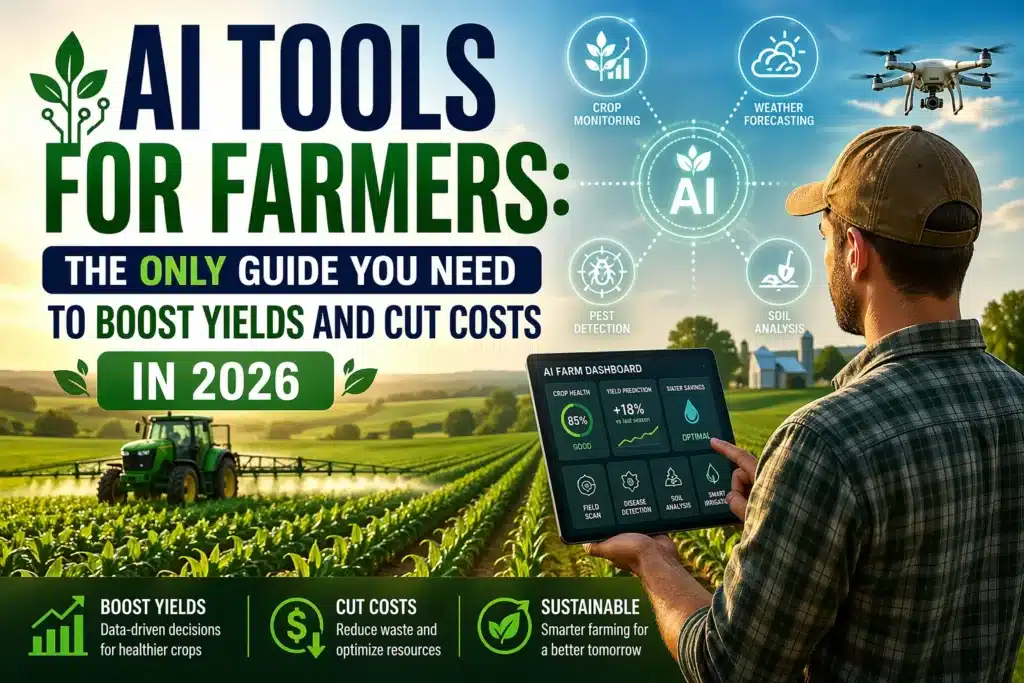
This is not a tech blog written by someone who has never touched soil. This guide focuses on what is actually working in fields — from smallholder farms in Punjab to large-scale operations in the American Midwest. Whether you grow wheat, cotton, vegetables, or fruit, there is an AI-powered solution that can directly impact your bottom line.
Let us get into it.
Table of Contents
What Exactly Are AI Tools for Farmers — And Why Should You Care in 2026?
Before anything else, let us clear up the confusion. When people say AI tools for farmers, they are not talking about robots replacing everything you do. They are talking about software, sensors, satellite data, and machine learning algorithms that help you make smarter decisions — faster and with less guesswork.
According to the Food and Agriculture Organization of the United Nations (FAO), global food production will need to increase by nearly 50% by 2050 to feed a growing population. At the same time, arable land is shrinking and water is becoming more scarce. That gap can only be filled with smarter farming — and that is exactly what AI is designed to do.
The best AI tools for farmers right now work across five core areas: crop health monitoring, weather and risk prediction, soil analysis, irrigation management, and market price forecasting. When these tools are used together, farmers consistently report 15–30% increases in yield, 20–40% reductions in input costs, and dramatically better decision-making under pressure.
The USDA’s National Institute of Food and Agriculture has been actively funding precision agriculture research since 2018, and the results are showing up in real farm data now — not just in lab reports.
A Student who Wants to Make their notes more interesting, check out Google NotebookLM.
Also Read about AI SMELL DETECTION TECHNOLOGY!
How Is AI Actually Being Used to Monitor Crop Health Right Now?
Crop health monitoring used to mean walking your fields every morning and hoping you caught a problem before it spread. Today, AI tools for farmers can scan thousands of acres in minutes using satellite imagery, drone footage, and ground sensors — and flag problems you would never spot with the naked eye.
Multispectral imaging is the backbone of most crop monitoring AI. These systems capture light wavelengths outside the visible spectrum — particularly near-infrared — which reveals plant stress weeks before it becomes visible. A yellowing leaf you notice in week three might have been detectable by AI in week one.
Tools like Taranis and Cropin use deep learning models trained on hundreds of millions of crop images. When you upload a photo or connect satellite data, the AI cross-references your crop’s visual signature against a massive disease and deficiency database. You get a diagnosis, a confidence score, and recommended treatment — often within seconds.
The real value is speed. Fungal infections like wheat rust or blight can devastate an entire field within 72 hours if untreated. AI tools for farmers that flag these threats early can be the difference between a reduced yield and a complete loss.
For Indian farmers specifically, the ICAR-National Bureau of Agricultural Insect Resources has published data showing that early AI-assisted pest detection can reduce pesticide use by up to 35% while improving efficacy. That means lower costs and less environmental impact at the same time.
Which AI-Powered Weather Tools Are Most Reliable for Agricultural Planning?
Weather is the one thing every farmer talks about and no one can fully control. But AI tools for farmers have transformed weather forecasting from a 5-day guess into a hyper-local, season-long planning tool.
Traditional weather apps pull data from regional stations — sometimes dozens of kilometres from your field. AI-powered agri-weather platforms pull data from satellite feeds, IoT sensors, historical climate records, and real-time atmospheric models to give you field-level forecasts with unprecedented accuracy.
The Climate Corporation’s FieldView platform, now part of Bayer, combines weather intelligence with agronomic data to help farmers decide when to plant, spray, irrigate, or harvest. Its machine learning models process billions of data points daily to produce localized risk scores for frost, drought, flooding, and disease pressure.
aWhere is another platform widely used by agribusinesses and cooperatives. It delivers agronomic weather data going back 30 years for any GPS coordinate on Earth — meaning you can see exactly how your specific location has behaved historically and model future scenarios accordingly.
For farmers working with crop insurance or government advisory services, these weather AI tools are also becoming critical documentation tools. They provide timestamped, geo-verified weather data that can support damage claims and subsidy applications.
The key insight here: AI tools for farmers in weather forecasting are not about predicting rain. They are about telling you what that rain means for your specific crop, at your specific growth stage, in your specific soil type. That kind of context-aware intelligence is genuinely transformative.
Also Check Out : How to start your own AI Automation Agency in 2026
Can AI Tools for Farmers Really Improve Soil Health and Fertilizer Decisions?
Soil is the foundation of every farm, and most farmers are flying partially blind when it comes to what is actually happening beneath the surface. Traditional soil tests require lab submissions, cost money, and take days or weeks to return results. By that time, your planting window may have closed.
Modern AI tools for farmers for soil management work on two levels: real-time sensor data and predictive modelling.
Sensor systems like Teralytic embed wireless probes in the ground that continuously measure nitrogen, phosphorus, potassium, moisture, pH, and aeration at multiple depths. This data streams to a cloud platform where AI analyses trends and generates variable-rate fertilizer recommendations — meaning different zones of your field get different amounts, based on actual need.
Variable-rate application alone typically reduces fertilizer input by 15–25% without reducing yield. That is a massive cost saving. For a 100-acre operation spending ₹8–12 lakh on fertilizer annually, that saving compounds significantly year over year.
Predictive soil AI goes further. Platforms like Arable combine soil data with weather patterns and crop growth models to predict nutrient depletion curves — telling you not just what your soil needs today, but what it will need in three weeks when your crop hits a critical growth stage.
The Indian Council of Agricultural Research (ICAR) has been integrating AI soil analytics into its soil health card initiative, helping bridge the gap between data collection and actionable farm advice for smallholders across the country.
What Are the Best AI Tools for Farmers When It Comes to Irrigation Management?
Water management is arguably where AI tools for farmers deliver the highest ROI in the shortest time. Globally, agriculture accounts for roughly 70% of freshwater consumption, and a significant portion of that water is wasted through over-irrigation or poor timing.
AI-driven irrigation systems use a combination of soil moisture sensors, evapotranspiration models, crop water demand curves, and weather forecasts to calculate exactly how much water your field needs — and when. The result is precision irrigation that can cut water usage by 30–50% while maintaining or improving yields.
Drip irrigation combined with AI control systems is the gold standard right now. Companies like CropX offer soil sensors paired with a cloud AI that integrates with your irrigation hardware. The system automatically adjusts watering schedules based on real-time soil conditions, not just timers.
For rice farmers — a major segment in India — this matters enormously. Rice is one of the thirstiest crops, but research from the International Rice Research Institute (IRRI) shows that AI-managed alternate wetting and drying (AWD) techniques can reduce water use by up to 30% without yield loss, while also reducing methane emissions from paddy fields.
At the smaller scale, apps like Fasal (developed in India) provide affordable AI-based microclimate and irrigation advisory for horticulture crops. Their system has shown consistent results in reducing water usage among vegetable and fruit farmers in Maharashtra and Karnataka.
How Do AI Tools for Farmers Help With Pest and Disease Prediction Before Outbreaks Occur?
Reactive pest management is expensive and often ineffective. By the time you see damage, you have already lost yield. AI tools for farmers are shifting this entire paradigm toward predictive, preventative action.
The way predictive pest AI works is elegant: it combines historical outbreak data with real-time weather conditions, crop growth stages, and regional surveillance feeds to calculate risk probabilities. When conditions align — say, humidity stays above 80% for five consecutive days during a vulnerable crop stage — the system issues an alert before the outbreak materialises.
Plantix, developed by PEAT GmbH and widely used in India, is one of the most accessible AI tools for farmers for disease identification. You photograph a symptomatic leaf, and the app diagnoses the problem using a deep learning model trained on over 500,000 images. It then provides a treatment recommendation and links to nearby agri-input retailers. The app has over 10 million downloads globally.
At a more enterprise level, Prospera (now part of Valmont Industries) deploys in-field cameras that continuously monitor crop canopy for insect activity, disease symptoms, and physiological stress. The AI processes these images in real time, flagging concerns before they escalate into economic damage.
For locust and major pest swarms — a serious concern in South Asia and East Africa — platforms integrated with FAO’s Desert Locust Information Service now use AI to model swarm movement and predict landing zones days in advance, giving farmers and governments a critical response window.
Is There an AI Tool That Can Help Farmers Predict Market Prices and Sell Smarter?
Getting your timing right when selling produce can be worth as much as any yield improvement. Most farmers, however, sell when they harvest — not when prices peak. AI tools for farmers focused on market intelligence are starting to fix this.
Price prediction AI analyses historical mandi data, seasonal demand patterns, crop production estimates, import/export trends, and real-time supply chain data to forecast price movements for specific commodities. This gives farmers a data-backed window for deciding whether to sell immediately, store, or enter a forward contract.
AgriBazaar in India provides AI-enabled market intelligence for farmers, including price trend forecasts, quality grading via AI image analysis, and digital trade facilitation. Their platform is directly integrated with mandis across multiple states, giving farmers transparent, real-time price discovery.
At the global level, Gro Intelligence offers institutional-grade agricultural market analytics powered by machine learning. While primarily used by agribusinesses and governments, their data infrastructure increasingly trickles down to farmer advisory services and cooperatives.
The most practical use case right now: AI-powered mandi price alert apps that notify you when prices in nearby markets hit a threshold you set. Combined with cold storage, this gives even a small farmer leverage they never had before.
How Do Farm Management Platforms Combine Multiple AI Tools for Farmers Into One System?
Managing five different apps — one for weather, one for soil, one for pests, one for irrigation, one for markets — is not realistic for a busy farmer. The most useful AI tools for farmers today are integrated farm management platforms (FMPs) that consolidate all these functions.
John Deere Operations Center (JohnDeere.com) is one of the world’s most widely used FMPs. It connects field equipment, agronomic data, and decision tools in one dashboard. The AI layer helps with yield mapping, equipment diagnostics, field activity logging, and advisory recommendations.
Cropin SmartFarm is an Indian-origin platform now used across 52 countries. It tracks crop calendars, manages advisory delivery, and uses AI to detect yield anomalies across large farm portfolios — particularly useful for FPOs (Farmer Producer Organisations) and agribusinesses managing contract farming.
IBM Environmental Intelligence Suite (IBM.com) provides climate risk analytics, pest and disease modelling, and hyper-local weather intelligence in an enterprise format. Many large agribusinesses and government advisory bodies use this as their core agricultural AI backbone.
The benefit of integrated platforms is not just convenience — it is intelligence multiplication. When your soil data, weather forecast, crop stage, and market price are all visible in the same place, the AI can surface cross-domain insights that no single-point tool ever could.
Comparison Table: Top AI Tools for Farmers at a Glance
| Tool | Primary Function | Best For | Pricing Model | India Availability |
|---|---|---|---|---|
| Plantix | Crop disease diagnosis | Smallholder farmers | Free (freemium) | ✅ Yes |
| FieldView (Climate Corp) | Field analytics & weather | Mid-large operations | Subscription | Limited |
| CropX | AI irrigation management | All farm sizes | Hardware + SaaS | ✅ Yes (partners) |
| Cropin SmartFarm | Full farm management | FPOs, agribusinesses | Enterprise/custom | ✅ Yes |
| Taranis | Aerial crop monitoring | Large operations | Subscription | Limited |
| AgriBazaar | Market price intelligence | Commodity sellers | Free + premium | ✅ Yes |
| Fasal | Microclimate & irrigation | Horticulture farmers | Subscription | ✅ Yes |
| Teralytic | Soil nutrient sensing | Precision farming | Hardware + SaaS | Limited |
| John Deere Ops Center | Full farm operations | Equipment-heavy farms | Free + connected | ✅ Partial |
| aWhere | Agronomic weather data | Advisory services | Enterprise API | ✅ Via partners |
Are AI Tools for Farmers Affordable Enough for Small and Marginal Farmers?
This is the most important question, and the honest answer is: it depends on the tool — but the trend is strongly in favour of accessibility.
Five years ago, precision agriculture technology was almost exclusively the domain of large commercial farms with big capex budgets. Today, the cost structure has flipped. Smartphone-based AI tools for farmers like Plantix, mFarm, DeHaat, and AgriApp are either free or cost a few hundred rupees per season. That puts them within reach of any farmer with a basic Android smartphone.
DeHaat, for example, operates across Bihar, UP, Odisha, and other states providing AI-driven crop advisory, input delivery, and market linkage to smallholders at near-zero direct cost to farmers, monetising instead through the supply chain. According to their published data, over 1.5 million farmers are currently on their platform.
The Digital India initiative and various state government schemes are also subsidising the cost of agritech tools for marginal farmers, particularly through Kisan Credit Card integration and PM-KISAN-linked advisory platforms.
The honest caveat: Hardware-based AI tools — soil sensors, drone-based imaging, connected irrigation controllers — still require upfront investment that puts them beyond individual smallholders. The workaround is FPO-level or cooperative adoption, where the cost is spread across dozens or hundreds of farmers and the AI tools for farmers become part of a shared service model.
Read : What is V2V Communication?
What Should Farmers Look for When Choosing AI Tools for Farming in Their Region?
Not all AI tools for farmers are built equally for every geography, crop type, or farming context. Here is what genuinely matters when evaluating any tool:
1. Local crop and pest databases. An AI trained on North American soybean images will give poor results for chilli or paddy disease identification in India. Always verify that the tool’s training data includes your crop type and regional disease variants.
2. Offline functionality. Internet connectivity in rural areas is still inconsistent. The best AI tools for farmers in India work partially or fully offline, syncing data when connectivity is available.
3. Language support. Advisory tools in Hindi, Kannada, Telugu, Marathi, or Punjabi are dramatically more useful than English-only platforms for most Indian farmers. Check what languages are supported before committing.
4. Integration with government schemes. Some platforms integrate directly with PM-KISAN, Pradhan Mantri Fasal Bima Yojana (crop insurance), and soil health card data. This integration multiplies the value of the tool significantly.
5. Quality of agronomist support. The best AI advisory platforms combine machine intelligence with human agronomist review. Pure AI without human verification can give confident but wrong advice — especially in edge cases.
How Are AI Tools for Farmers Changing the Future of Agriculture in India?
India’s agricultural sector employs roughly 42% of the workforce and contributes about 17% of GDP. The opportunity for AI to reshape this sector is enormous — but the path is not straightforward.
The most transformative change happening right now is AI-assisted extension services. Traditional agricultural extension — government advisors visiting farmers — cannot scale to reach India’s 146 million farm households. AI chatbots and voice-based advisory systems, however, can. Platforms like Kisan Suvidha, mKisan, and increasingly WhatsApp-based agri-bots are delivering personalised, crop-specific advisory at scale.
Microsoft’s AI for Good initiative has been running agricultural AI pilots in Andhra Pradesh and elsewhere in India since 2017, using machine learning to provide personalised sowing date advisories to cotton and rice farmers. Early results showed yield increases of 30% and cost reductions of around 25% in pilot areas.
Drone-based AI is the next frontier in India. DGCA has now cleared agricultural drones for use, and companies like IdeaForge, Garuda Aerospace, and IoTech World Avigation are deploying AI-guided drones for crop spraying, seeding, and monitoring at costs that are coming down rapidly.
The trajectory is clear: within five years, AI tools for farmers will be as routine as a soil test or a tractor. The farmers who start building familiarity with these tools now will have a meaningful competitive advantage in both productivity and market access.
Frequently Asked Questions About AI Tools for Farmers
1. What are the best free AI tools for farmers in India right now?
The top free or near-free AI tools for farmers in India include Plantix (crop disease diagnosis), DeHaat (advisory, inputs, market linkage), Fasal (trial available), and the government-backed Kisan Suvidha app. These work on basic Android smartphones and are available in multiple Indian languages.
2. Do AI tools for farmers require constant internet connectivity?
Not all of them. Several AI tools for farmers — particularly diagnostic apps like Plantix — have offline modes that allow you to capture images and data without a signal, then sync when connectivity is restored. However, real-time weather and market price tools require regular internet access to function accurately.
3. Can small and marginal farmers afford AI farming technology?
Yes — increasingly so. Many of the most useful AI tools for farmers are smartphone-based and either free or low-cost. Hardware-intensive tools (sensors, drones) can be accessed through FPOs, cooperatives, or custom hiring centres where the cost is shared across multiple farmers.
4. How accurate are AI crop disease diagnosis tools?
Leading platforms like Plantix and Taranis report accuracy rates of 90–95% on common diseases in their trained crop categories. Accuracy drops for rare or region-specific diseases not well-represented in training data. For best results, always submit multiple clear images and cross-check AI recommendations with a local agronomist for high-stakes decisions.
5. Are AI irrigation management systems compatible with existing drip or sprinkler setups?
Many AI irrigation platforms are designed to integrate with existing infrastructure through smart controllers or valve adapters. Platforms like CropX and Fasal provide retrofit-compatible hardware. You typically do not need to replace your existing irrigation system — just add a control layer on top of it.
6. How do AI tools for farmers help with weather prediction differently from regular weather apps?
Standard weather apps give city-level or district-level forecasts. AI tools for farmers provide hyper-local, field-level forecasts that account for your specific microclimate, soil type, crop stage, and historical weather patterns at your GPS coordinates. They also translate forecast data into actionable agronomic recommendations, not just temperature and rainfall numbers.
7. What is the ROI on investing in AI tools for farmers?
ROI varies by tool and farm context, but commonly reported figures include: 15–30% yield improvement with AI crop monitoring, 20–40% input cost reduction with variable-rate fertilizer AI, and 30–50% water savings with AI irrigation management. Even modest improvements on these metrics typically generate positive ROI within one to two crop seasons.
8. Can AI tools for farmers help with getting better prices in the mandi?
Yes. AI market price tools analyse historical price patterns, arrivals data, and demand signals to forecast near-term price movements. Apps like AgriBazaar provide these forecasts directly to farmers, helping them decide the best time and location to sell their produce. This alone can add 10–20% to net realisation for price-sensitive commodities.
9. Are government data and schemes integrated with AI farming apps?
Several platforms in India are integrating with government data sources including the Agmarknet price database, soil health card records, and PM-KISAN beneficiary data. Platforms like DeHaat and Cropin have formal tie-ups with state agriculture departments that allow them to deliver government advisories and subsidy information through their apps.
10. What is the biggest limitation of AI tools for farmers today?
The most significant limitations are: (1) training data gaps for hyperlocal crop varieties and regional pest variants, especially in South Asia; (2) language and literacy barriers that reduce accessibility for older farmers; and (3) connectivity requirements that exclude the most rural communities. These gaps are narrowing rapidly, but they are worth knowing before you choose a platform.
The Bottom Line: AI Tools for Farmers Are No Longer Optional
Farming has always required intelligence — reading the sky, reading the soil, reading the market. What AI tools for farmers offer is an amplification of that intelligence. Not a replacement for your knowledge and experience, but a powerful layer on top of it that processes more data, faster, with fewer errors.
The farmers already using AI tools for farmers consistently are not the biggest or the richest. They are often the most curious and the most willing to try something once. That is all it takes to start. Download Plantix and photograph a leaf. Sign up for an AgriApp weather alert. Connect with your local FPO about a shared soil sensor programme.
The data is already out there. The tools are getting cheaper by the season. The question is not whether AI tools for farmers will reshape Indian and global agriculture — it is whether you will be ahead of that curve or behind it.
Start with one tool. Master it. Then add another. That is how every successful precision farmer got here.
For more information on precision agriculture technologies recognised by international food bodies, visit FAO’s e-Agriculture platform and ICAR’s Digital Agriculture initiatives.
3 thoughts on “AI Tools for Farmers: The Only Guide You Need to Boost Yields and Cut Costs in 2026”