
Introduction: The Sales Floor Has Changed — Have You?
Walk into any high-performing sales team in 2026, and the first thing you notice isn’t a whiteboard full of cold-call scripts. It’s a quiet hum of intelligent systems doing the heavy lifting — qualifying leads, drafting personalised outreach, predicting which deals will close, and flagging which accounts are about to churn.
AI for sales isn’t a buzzword anymore. It’s a competitive baseline. Teams that haven’t embraced it aren’t just slower — they’re operating with a structural disadvantage that compounds every quarter.
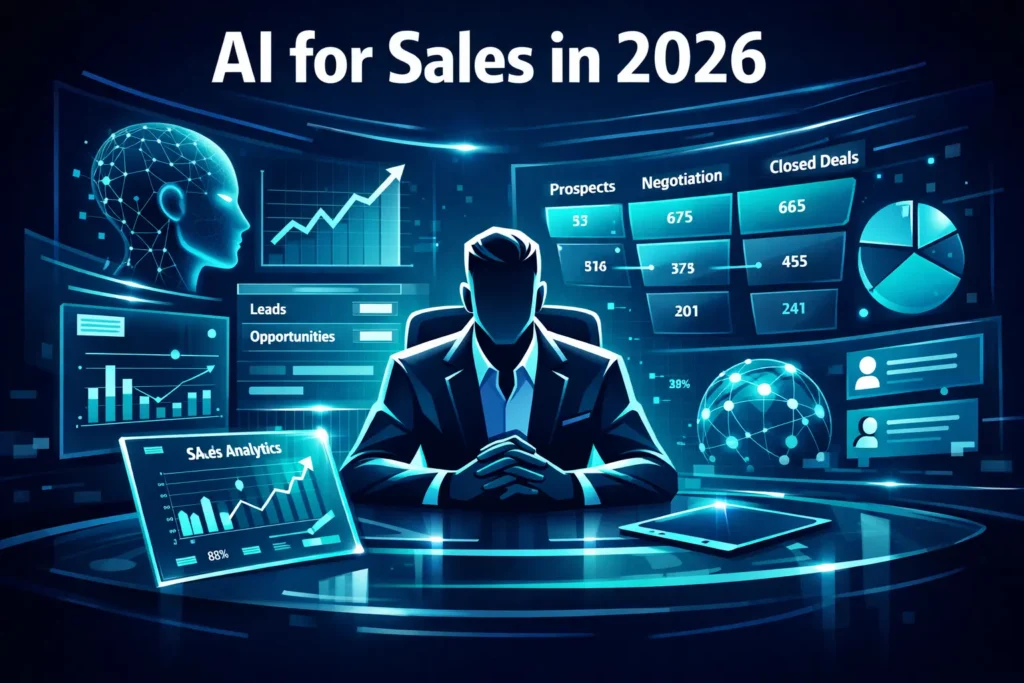
But here’s the thing most guides get wrong: AI for sales doesn’t replace great salespeople. It amplifies them. It hands back the hours burned on admin, data entry, and guesswork — and lets reps do what humans actually do best: build trust, navigate complexity, and close.
This guide is the most practical, current breakdown of how AI for sales works in 2026 — covering the use cases that matter, the tools worth your attention, how to build a strategy around them, and the honest trade-offs you need to know before investing.
Let’s get into it.
Table of Contents
What “AI for Sales” Actually Means in 2026
The phrase AI for sales covers a wide spectrum. At the surface level, it includes anything from auto-generated email sequences to predictive deal scoring. But in 2026, the definition has grown significantly. Here’s how it breaks down:
- Generative AI writes first-draft outreach, follow-up emails, call scripts, and proposals using context pulled from your CRM and the prospect’s digital footprint.
- Predictive AI analyses historical data to score leads, forecast revenue, and surface which accounts are most likely to convert or churn.
- Conversational AI powers live chat, SDR bots, and voice agents that engage inbound leads 24/7 and qualify them before a human ever picks up the phone.
- Analytical AI mines call recordings, email threads, and deal histories to surface coaching insights, objection patterns, and competitive intelligence.
- Autonomous AI agents — the frontier in 2026 — execute multi-step tasks like researching a prospect, personalising a message, and scheduling a meeting with minimal human input.
Together, these layers make AI for sales a full-stack capability, not a single tool.
Why 2026 Is the Inflection Point for AI in Sales
A few years ago, the conversation around AI for sales was dominated by pilot projects and careful experiments. In 2026, the dynamic is different. Three things converged to make this the year where adoption stopped being optional:
1. LLMs matured into reliable, context-aware systems. The hallucination problem that plagued early sales-AI deployments has been dramatically reduced. Models are now much better at staying grounded in CRM data, company context, and industry-specific language.
2. Integrations deepened. Tools like Salesforce Einstein and HubSpot’s AI suite no longer sit on top of your CRM as add-ons — they’re woven into the workflow. A rep doesn’t switch context to use AI; it lives inside the tools they already use daily.
3. Buyers changed. Today’s B2B buyer has done 70–80% of their research before ever talking to a rep. They expect fast, personalised, knowledgeable responses. Manual processes simply can’t meet that bar at scale. AI for sales closes that gap.
Research from McKinsey’s State of AI report consistently shows that companies integrating AI across sales and marketing report higher revenue growth and lower customer acquisition costs than those that don’t.
Also Read : Jeff Bezos Net Worth 2026: Amazon Fortune, Cars, Yacht, Houses & Billionaire Rank
The Core Use Cases: Where AI for Sales Delivers the Most Value
1. AI-Powered Lead Scoring and Prioritisation
One of the oldest problems in sales is knowing where to focus. Traditional lead scoring relied on basic firmographic data and gut feel. AI for sales takes this to a fundamentally different level.
Modern AI scoring engines analyse hundreds of signals — web behaviour, intent data, technographic fit, engagement patterns, job changes, funding rounds — and rank leads by their actual probability of converting. Reps don’t chase cold leads anymore. They work a prioritised list where the top prospects are warm by the time they’re contacted.
Gartner’s research on revenue intelligence has highlighted that AI-assisted lead prioritisation can reduce time-to-contact for high-intent prospects by more than 50%.
2. Personalised Outreach at Scale
Personalisation used to be the bottleneck. You could either send 500 generic emails or spend 45 minutes researching one perfect email. AI for sales removes that trade-off.
Tools now pull context from LinkedIn, news mentions, company earnings calls, job postings, and CRM history — and generate outreach that reads like it was written by someone who spent an hour researching the prospect. The rep reviews, tweaks, and sends. What used to take an afternoon takes fifteen minutes.
This isn’t about blasting more email. It’s about sending the right message to the right person at the right moment, with the right context — every time.
3. Sales Forecasting and Pipeline Intelligence
Ask any VP of Sales what keeps them up at night, and forecast accuracy is always in the top two answers. Traditional forecasting is a combination of rep self-reporting (notoriously optimistic) and manager instinct (unreliable at scale).
AI for sales replaces opinion with pattern recognition. It analyses every deal in your pipeline — the age, the engagement velocity, how similar deals have historically progressed, the communication patterns, the stage-to-stage conversion rates — and generates a probabilistic forecast that’s grounded in actual data.
Platforms like Clari and similar revenue intelligence tools have become standard infrastructure at enterprise sales organisations precisely because this capability translates directly into better resource allocation and fewer missed quarters.
4. Conversation Intelligence and Coaching
Every sales call is a goldmine of information that most teams ignore. With AI for sales, every call, demo, and discovery session is automatically transcribed, analysed, and tagged. The system identifies what was discussed, what objections came up, how the rep handled them, and what next steps were committed to.
Managers get a real coaching agenda without having to listen to recordings. Reps get feedback that’s specific and timely, not generic. And as patterns accumulate, the team builds an institutional knowledge base about what actually works in their market.
5. AI SDRs and Conversational Sales Agents
This is the most visible and controversial use case of AI for sales in 2026. AI SDRs — sometimes called sales development agents — handle inbound lead qualification, follow-up sequences, and meeting scheduling with a level of speed and consistency that human SDRs simply can’t match.
When a prospect fills out a form on your site at 11pm on a Sunday, an AI SDR responds in seconds, qualifies the lead with natural conversation, and books a discovery call with the right human rep — before your competitor even wakes up.
This doesn’t eliminate SDR roles. It shifts them toward higher-complexity prospecting and relationship-building, where human judgment adds clear value.
Check Out : How to Build POWERFUL AI Agents in 2026: The Only Guide You’ll Need (Tools, Frameworks & Roadmap)
AI for Sales: Tool Comparison Table
| Tool | Primary Use Case | Best For | AI Capability Level | Integration Depth |
|---|---|---|---|---|
| Salesforce Einstein | CRM + forecasting + scoring | Enterprise teams | Advanced | Native (Salesforce) |
| HubSpot AI | Outreach + pipeline + content | SMB to Mid-Market | Strong | Native (HubSpot) |
| Gong | Conversation intelligence + coaching | Any size sales team | Advanced | Broad (50+ CRMs) |
| Clari | Revenue forecasting + pipeline mgmt | Mid-Market + Enterprise | Advanced | Strong |
| Outreach AI | Sequences + engagement analytics | SDR-heavy teams | Strong | Broad |
| Apollo.io | Prospecting + lead data + outreach | SMB + B2B | Moderate–Strong | Moderate |
| Clay | Hyper-personalised prospecting | Growth teams | Strong | API-first |
| Lavender | Email personalisation + coaching | Individual reps | Moderate | Gmail/Outlook |
Building an AI for Sales Strategy: The Framework That Works
Having tools is not the same as having a strategy. Most failed AI for sales implementations share a common pattern: technology was purchased before process was defined.
Here’s a framework that avoids that trap.
Step 1: Audit Your Current Sales Workflow
Before adding AI, map every step of your current process — from lead capture to close. Identify where time is being lost, where data quality is weak, and where rep frustration is highest. These are your AI insertion points.
Step 2: Define the Outcome You’re Optimising For
AI for sales can be optimised for speed, volume, conversion rate, or deal size. These are different problems with different tool solutions. A team struggling with pipeline volume has different AI needs than a team with a leaky mid-funnel.
Step 3: Start With One Use Case
The fastest way to kill momentum is trying to deploy five AI capabilities at once. Pick the highest-impact, easiest-to-measure use case — usually lead scoring or outreach personalisation — and prove value within 60 days.
Step 4: Train Your Reps on How to Work With AI
AI for sales tools fail when reps don’t trust them or don’t know how to use them effectively. Invest in training that positions AI as a support system, not a surveillance tool or a replacement. Reps who understand why the AI is scoring a lead the way it is will use the output. Reps who don’t understand it will ignore it.
Step 5: Feed the System Clean Data
Every AI for sales tool is only as smart as the data behind it. A CRM full of stale contacts, missed activity logging, and inconsistent stage definitions will produce bad AI output. Data hygiene is not glamorous, but it’s foundational.
The Real Challenges of AI for Sales (And How to Handle Them)
No honest guide to AI for sales skips this part.
Over-reliance on automation. When everything is automated, nothing feels human. Buyers in 2026 are more sophisticated — they can detect templated AI outreach. The solution is using AI to do the research and the first draft, while humans add the layer of genuine insight and personality.
Data privacy and compliance. Using AI to personalise outreach means processing personal data. GDPR, CCPA, and emerging AI-specific regulations require you to be deliberate about what data feeds your sales AI and how consent is managed.
Model drift and stale logic. An AI model trained on your 2023 deal data will eventually produce outputs that don’t reflect your current market. Regular model retraining and outcome monitoring aren’t optional — they’re part of the operating model.
Internal resistance. Some reps worry that AI for sales is really just a way to track them more closely or eventually eliminate their roles. Transparent communication about how AI outputs are used — and aren’t used — for performance review is essential.
What the Best Sales Teams Are Doing Differently in 2026
The teams winning with AI for sales in 2026 share a handful of observable habits.
They treat AI output as a starting point, not a final answer. Reps add context, adjust tone, and apply judgment — the AI does the research and drafting.
They measure AI-assisted performance metrics separately. Comparing AI-assisted quota attainment versus non-assisted gives them a clear picture of ROI and helps them expand the right capabilities.
They’ve built feedback loops. When AI surfaces a lead that doesn’t convert, or a deal score that turns out to be wrong, that feedback goes back into the system. The AI gets smarter. The process gets tighter.
They’ve also prioritised LinkedIn Sales Navigator integration with their AI tooling — because social signals remain one of the highest-quality intent sources in B2B sales.
The Human Element: Why AI for Sales Makes Great Salespeople More Valuable, Not Less
There’s a version of this conversation that frames AI for sales as an existential threat to sales careers. That framing misunderstands what buyers actually want.
The research is clear: complex, high-value deals still close on the strength of relationships, trust, and the ability to navigate ambiguity. No AI in 2026 can build genuine rapport, read a room, or make a strategic recommendation that accounts for the full nuance of a long-term customer relationship.
What AI for sales does is remove the noise. It eliminates the hours spent on research that should take minutes. It stops great reps from wasting their day on leads that will never convert. It surfaces the right information at the right moment so that when a rep does pick up the phone or walk into a room, they’re prepared to deliver real value.
The best salespeople in 2026 are not the ones fighting AI. They’re the ones who’ve figured out how to be amplified by it. You can explore broader thinking on this shift through Harvard Business Review’s coverage of AI and knowledge work.
Quick-Reference: AI for Sales Metrics Worth Tracking
When measuring the impact of AI for sales in your organisation, focus on these metrics:
- Lead-to-opportunity conversion rate — Does AI scoring improve which leads get worked?
- Outreach reply rate — Is AI-personalised outreach outperforming generic sequences?
- Forecast accuracy — Is your call within 5–10% of actual close?
- Time-to-first-contact — Is AI reducing the lag between lead capture and rep outreach?
- Average deal cycle length — Is intelligence surfacing deal blockers earlier?
- Rep ramp time — Is AI-assisted onboarding getting new reps to quota faster?
Track these before and after any AI for sales deployment. The delta tells you everything.
Also Read : 10 Powerful AI Skills to Learn in 2026 (And Exactly Where to Master Them)
10 Frequently Asked Questions About AI for Sales
Q1. What is AI for sales and how does it work? AI for sales refers to the application of machine learning, natural language processing, and predictive analytics to sales processes. It works by analysing patterns in your CRM data, prospect behaviour, and communication history to automate tasks, prioritise leads, personalise outreach, and forecast revenue. Rather than replacing human judgment, AI for sales gives reps data-backed guidance at every stage of the pipeline.
Q2. Is AI for sales only for enterprise teams? No. While enterprise teams were early adopters, AI for sales tools in 2026 are accessible at every level. Platforms like HubSpot, Apollo.io, and Lavender have pricing and feature sets designed specifically for small and mid-sized sales teams. The barrier to entry has dropped dramatically over the past two years.
Q3. Will AI for sales replace human sales reps? Not in any near-term realistic scenario. AI for sales automates repetitive, low-judgment tasks — research, scheduling, data entry, follow-up sequencing. High-trust, complex selling requires human relationships, strategic thinking, and emotional intelligence that no current AI system can replicate consistently. The likely outcome is smaller, higher-skilled sales teams with significantly higher per-rep productivity.
Q4. How long does it take to see ROI from AI for sales? For point solutions like AI email tools or lead scoring, ROI is typically visible within 30 to 60 days, especially when measured against a clear baseline. For broader deployments — revenue intelligence platforms, AI forecasting — allow 90 to 120 days to accumulate the data needed for meaningful output. The most common mistake is judging AI for sales tools before the models have had time to learn your specific patterns.
Q5. What data does AI for sales need to work effectively? At minimum: CRM records (contacts, accounts, activities, deal history), email engagement data, and call logs. The richer your historical deal data — including lost deals and the reasons for loss — the more accurate your predictive outputs will be. Clean, well-maintained CRM data is the single biggest determinant of AI for sales performance.
Q6. How do I choose the right AI for sales tool for my team? Start with your biggest bottleneck. If you’re losing time on prospecting research, look at Clay or Apollo.io. If forecast accuracy is the problem, look at Clari or Salesforce Einstein. If rep coaching is the priority, Gong is the category leader. Match the tool to the specific outcome you need, not to the broadest feature list.
Q7. Is AI-generated sales outreach compliant with GDPR and CAN-SPAM? Using AI for sales doesn’t change your compliance obligations — it changes the scale at which you operate. You’re still responsible for ensuring that contacts have given appropriate consent, that unsubscribe mechanisms are functional, and that data is processed lawfully. Some AI tools include compliance features like email warm-up, unsubscribe management, and data sourcing transparency. Always verify compliance before scaling any outreach programme.
Q8. Can AI for sales work with my existing CRM? In most cases, yes. The major AI for sales platforms — Gong, Outreach, Clari, and others — offer native integrations with Salesforce, HubSpot, Microsoft Dynamics, and Pipedrive. Before purchasing any tool, verify that it integrates with your existing stack at a depth that makes sense for your workflow, not just a surface-level sync.
Q9. What’s the difference between sales automation and AI for sales? Sales automation refers to rule-based processes — if a lead does X, trigger email Y. It’s powerful but inflexible. AI for sales is dynamic: it learns from outcomes, adapts to new patterns, and improves its recommendations over time. A traditional drip sequence is automation. A system that analyses prospect behaviour and recommends when to call, what to say, and which deal to prioritise based on live data — that’s AI for sales.
Q10. What skills should sales reps develop to work effectively with AI? The most valuable skills in a sales team that uses AI for sales are: the ability to interpret and act on AI-generated insights (data literacy), prompt engineering basics for getting useful output from generative tools, strong communication skills for the human moments AI can’t handle, and a willingness to trust — and occasionally override — AI recommendations with good reasoning. Adaptability is the meta-skill.
Final Word: AI for Sales Is the New Standard
In 2026, AI for sales has moved beyond early adopter advantage. It’s infrastructure. The question is no longer whether your team should use it — it’s whether you’re using it well enough to stay ahead of competitors who are.
The teams winning aren’t the ones with the most tools. They’re the ones that understand where AI for sales genuinely creates leverage, where human judgment is still the differentiator, and how to build a system where both work together cleanly.
The reps winning are the ones who’ve stopped seeing AI for sales as a threat and started treating it the way they treat any great tool — something that makes them more effective at the work they were already built to do.
Start with one use case. Prove it. Build from there. And don’t confuse busyness with progress — let AI for sales give you back the time to do what only you can do.
Want to go deeper? Check out Salesforce’s AI research hub, HubSpot’s sales blog, and McKinsey’s AI insights for ongoing coverage of how AI continues to reshape revenue teams.
3 thoughts on “AI for Sales in 2026: The Complete Playbook to Close More Deals, Faster”