
Introduction: When the Invisible Does the Impossible
There is something almost poetic about the idea that the smallest machines ever created might end up doing the biggest jobs in human history. We are talking about AI-powered nanobots — microscopic robots, often smaller than a single human cell, that are now being deployed in hospitals, labs, water treatment plants, and even deep inside the human bloodstream.
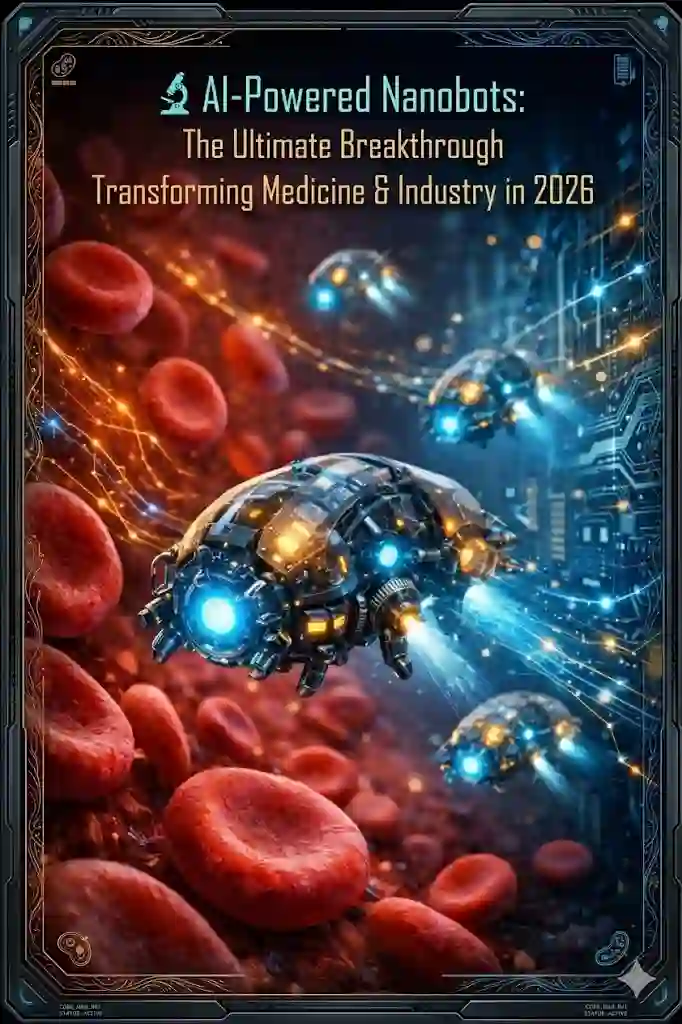
If that sounds like a science fiction plot, it was — until very recently. In 2026, AI-powered nanobots are no longer a theoretical concept. They are a rapidly evolving reality being tested and deployed across some of the world’s most critical sectors. From destroying cancer cells without chemotherapy side effects to cleaning up chemical spills at the molecular level, the work these tiny machines are doing is nothing short of extraordinary.
This post breaks down everything you need to know: what AI-powered nanobots actually are, how artificial intelligence makes them smarter, and which industries are already benefiting from them right now.
Table of Contents
What Are Nanobots? A Clear, No-Jargon Explanation
The term “nanobot” is short for nanorobot — a programmable, autonomous device that operates at the nanometer scale, typically ranging from 1 to 1,000 nanometers in size. To put that in perspective, a single human hair is roughly 80,000 to 100,000 nanometers wide. These are not just small machines. They are machines operating in a realm invisible to the naked eye, interacting directly with molecules, cells, and biological structures.
Nanobots are engineered to perform specific tasks. Depending on their design and programming, they can:
- Navigate through blood vessels and tissues
- Detect and bind to specific cells or biomarkers
- Deliver payloads such as drugs or genetic material
- Perform mechanical actions like cutting, binding, or sealing tissue
- Communicate data back to an external monitoring system
- Work in coordinated swarms to complete large-scale tasks
Now here is where it gets genuinely exciting. On their own, basic nanobots are impressive but limited. Add artificial intelligence to the equation, and you have something that can think, adapt, learn, and make real-time decisions inside environments as complex as the human body. That combination — AI and nanotechnology — is what has turned AI-powered nanobots from a lab curiosity into a transformational technology.
Also Read : How to Use NEO-6M GPS Module with Arduino (Complete BEST 2026 Guide)
How Artificial Intelligence Transforms Nanobots
Traditional nanobots follow fixed, pre-programmed rules. They do what they are told, nothing more. The moment conditions change — say, a tumor shifts its chemical signature, or a contamination level in water rises — a basic nanobot is helpless.
AI-powered nanobots are a different beast entirely. Here is how AI integration changes the game:
1. Real-Time Decision Making
Machine learning algorithms embedded in (or wirelessly connected to) AI-powered nanobots allow them to analyze their environment and make decisions in milliseconds. They can identify whether a cell is cancerous or healthy, whether a water molecule contains a specific toxin, or whether a pipe wall is corroding — and then act accordingly.
2. Navigation and Obstacle Avoidance
The human body is not a clean highway. Blood vessels branch unpredictably, viscosity changes, and immune cells attempt to intercept foreign objects. AI-driven navigation systems allow AI-powered nanobots to map their environment dynamically, adapting their propulsion and path much like a self-driving car handles unexpected road conditions.
3. Swarm Intelligence
One of the most powerful aspects of AI-powered nanobots is their ability to function as a collective. Drawing inspiration from how ants or bees operate, AI enables swarms of AI-powered nanobots to divide tasks, communicate with each other, and complete complex objectives that no single nanobot could accomplish alone. This is called decentralized swarm intelligence, and it is one of the most researched areas in nanorobotics today. You can learn more about swarm intelligence in robotics at Nature Robotics.
4. Adaptive Drug Dosing
In a medical context, AI-powered nanobots can monitor a patient’s cellular response in real time and adjust the amount of medication they release accordingly. This eliminates the trial-and-error approach to dosing that still plagues most drug therapies. Research published in journals tracked by PubMed consistently highlights the accuracy improvements AI brings to nanobot-driven drug delivery.
5. Biomarker Detection and Early Diagnosis
AI algorithms can be trained on enormous datasets of molecular signatures. When AI-powered nanobots encounter a biomarker — say, a protein associated with early-stage pancreatic cancer — the AI can classify it with far greater sensitivity and specificity than traditional diagnostic tools. Studies have shown detection accuracy improvements of nearly 30% over conventional tumor biomarker tests when AI is integrated into nanobot systems.
Sector-by-Sector Breakdown: Where AI-Powered Nanobots Are Working in 2026
🏥 Healthcare and Medicine
This is the most active frontier for AI-powered nanobots, and for good reason. The precision they offer is unmatched.
Cancer Treatment: DNA origami-based AI-powered nanobots are designed to fold into specific three-dimensional shapes that respond to tumor microenvironments — recognizing changes in pH, temperature, and enzyme activity unique to cancerous tissue. Once triggered, they release their therapeutic payload directly inside the tumor. This means zero collateral damage to healthy cells — a dream that chemotherapy has never been able to deliver.
Blood-Brain Barrier Crossing: The blood-brain barrier (BBB) has been one of medicine’s most stubborn obstacles. Most drugs simply cannot get through it. AI-powered nanobots, however, can be engineered to navigate this barrier using magnetic propulsion and AI-guided targeting, opening up new treatment possibilities for Alzheimer’s disease, Parkinson’s disease, multiple sclerosis, and brain tumors. Research on this application is well-documented at ACS Publications.
Hematology: Researchers have developed artificial nanoscale red blood cell mimics — called respirocytes — that are six times smaller than natural red blood cells and can carry oxygen more efficiently. There are also nanorobotic artificial platelets, or “clottocytes,” that can achieve hemostasis (stop bleeding) within a single second using a biodegradable fiber mesh system.
Surgical Precision: AI-powered nanobots can now assist in minimally invasive procedures — clearing arterial blockages, repairing damaged tissue, and even performing operations inside the eye that human hands could never attempt.
Dentistry: DNA-based nanobots are in early-stage trials for painless cavity treatment, enamel repair, and bacterial elimination in root canals — guided by AI sensing the exact bacterial composition of the tooth.
🌿 Agriculture
AI-powered nanobots are quietly reshaping how we grow food. Smart nano-sensors embedded in soil can monitor moisture, pH, nitrogen, and pathogen presence at the root level, feeding data to AI systems that then dispatch AI-powered nanobots to deliver targeted micro-doses of fertilizer or pesticide — only where needed, only when needed.
This precision agriculture model reduces chemical usage by up to 40–60% in experimental settings while increasing crop yield. It is a major step toward sustainable farming. Resources like the Food and Agriculture Organization of the United Nations (FAO) document how nano-enabled agriculture is being piloted globally.
💧 Environmental Science and Water Purification
Less than 1% of Earth’s freshwater is readily accessible. Industrial contamination makes that number worse every year. AI-powered nanobots are being developed to address this crisis directly.
These nanobots use nano-sensors to detect heavy metals, chemical toxins, and organic pollutants in water at the molecular level. AI systems then guide the nanobots to bind with contaminants, neutralize them through catalytic reactions, and separate them from clean water. Early deployments in laboratory settings have demonstrated near-complete removal of lead and arsenic from contaminated water samples.
In addition to water purification, AI-powered nanobots are being tested for oil spill cleanup — deployed in oceanic environments where they detect and break down hydrocarbon chains at a molecular level. Traditional cleanup methods are slow and environmentally damaging; nanobot-assisted cleanup offers speed and precision that simply cannot be matched.
⚡ Electronics and Semiconductor Manufacturing
The semiconductor industry constantly pushes against the physical limits of miniaturization. AI-powered nanobots are being explored for nano-assembly tasks — manipulating individual atoms and molecules to construct components like transistors, logic gates, and quantum dots that are too small for any existing fabrication tool to produce accurately.
They also serve in circuit repair — entering microscopic sections of chips to detect and fix cracks, corrosion, or micro-fractures. This is particularly valuable for aerospace-grade electronics and deep-space hardware that cannot be serviced manually. More information on nanotechnology in semiconductors is available through IEEE Xplore.
🛡️ Military and Defense
Defense agencies in multiple countries are funding research into AI-powered nanobots for surveillance, chemical detection, and biological threat neutralization. Imagine nanoscale sensors deployed across a battlefield that can detect chemical warfare agents at parts-per-billion concentrations and relay that data back within milliseconds.
There is also research into protective gear embedded with AI-powered nanobots that can seal punctures, deliver medicine directly to a wounded soldier, and monitor vital signs — all autonomously. While much of this remains classified or in prototype stages, the defense implications of AI-powered nanobots are profound and heavily funded.
🏭 Manufacturing and Materials Science
In advanced manufacturing, AI-powered nanobots are helping create self-healing materials — surfaces that can detect microfractures and repair them automatically. Aerospace composites, turbine blades, and high-performance structural materials are being developed with embedded nanobot networks that extend product lifespan significantly.
In pharmaceuticals, nanobot-assisted manufacturing allows drug molecules to be assembled with atomic-level precision, producing more stable compounds with fewer impurities than traditional batch synthesis methods.
Also Read: AI-Integrated Anti-Counterfeiting Solutions
Comparison Table: Traditional Technology vs. AI-Powered Nanobots Across Sectors
| Sector | Traditional Approach | AI-Powered Nanobots | Key Advantage |
|---|---|---|---|
| Cancer Treatment | Chemotherapy / Radiation | Targeted payload delivery at tumor site | Zero damage to healthy cells |
| Drug Delivery | Systemic oral / IV medication | Localized AI-controlled micro-dosing | Eliminates trial-and-error dosing |
| Disease Detection | Blood tests / Imaging scans | In-vivo molecular biomarker detection | Up to 95% sensitivity, days earlier |
| Water Purification | Chemical filtration / UV treatment | Nanobot-catalyzed molecular removal | Removes heavy metals at ppb level |
| Agriculture | Blanket pesticide/fertilizer application | Precision nano-delivery at root level | 40–60% reduction in chemical use |
| Electronics Manufacturing | Photolithography / Chemical etching | Atom-level nano-assembly & circuit repair | Smaller, faster, more precise chips |
| Surgery | Invasive procedures / Endoscopy | Nanoscale internal surgery | Reduces recovery time dramatically |
| Environmental Cleanup | Mechanical dredging / Chemical dispersants | Molecular-level hydrocarbon breakdown | Faster, non-toxic, more thorough |
Current Status of AI-Powered Nanobots in 2026: What’s Real, What’s Coming
It is important to be honest here. Not every application described above is in wide clinical or commercial deployment. Here is a realistic breakdown of where things stand:
Active Research & Early Clinical Trials: Cancer-targeted drug delivery, blood-brain barrier crossing, DNA origami nanobots, water purification nanobots, agricultural nano-sensors.
Prototype / Pre-Commercial: AI-swarm coordination systems, nanobot-assisted minimally invasive surgery, self-healing material systems with embedded nanobots.
Concept / Advanced Simulation: Full autonomous body repair, systemic preventive nanomedicine, real-time whole-body monitoring networks.
The pace of progress is genuinely accelerating. Laboratories at institutions like MIT, ETH Zurich, Johns Hopkins, and KAIST are publishing breakthrough research monthly. The National Nanotechnology Initiative (NNI) in the US continues to fund over $1.7 billion annually in nanotech R&D, and a significant portion is now directed toward AI integration.
Check Out : 👉 Waymo vs Zoox: Who Is Dominating the AI Self-Driving Taxi Market in the US in 2026?
The Ethical Dimension: Questions That Cannot Be Ignored
No technology this powerful comes without difficult questions. AI-powered nanobots raise real concerns around privacy (nanobots capable of monitoring biological data could theoretically be weaponized for surveillance), consent (who controls what is deployed in someone’s body?), security (AI-powered systems can be hacked), and long-term biocompatibility (how does the immune system react after years of nanobot presence?).
Regulatory frameworks are still catching up. Organizations like the FDA currently regulate nanobots on a case-by-case basis. International coordination through the WHO and other bodies will be critical to ensuring that AI-powered nanobots are developed safely and equitably.
The Road Ahead for AI-Powered Nanobots
Looking beyond 2026, the convergence of AI-powered nanobots with personalized genomics, wearable tech, and cloud-based health monitoring could usher in a new era of truly preventive medicine — one where disease is caught and corrected at the molecular level before symptoms ever emerge.
The materials science applications alone could reshape entire industries. Imagine bridges that repair their own cracks, airplane wings that self-monitor for fatigue, and water infrastructure that cleans itself autonomously.
AI-powered nanobots are not going to replace doctors, engineers, or environmental scientists. What they will do is give every one of those professionals a tool of extraordinary precision — one that operates at the level where diseases begin, where materials fail first, and where chemical contamination does its worst damage.
That is not just a better tool. That is a fundamentally different way of interacting with the physical world.
Frequently Asked Questions (FAQs) About AI-Powered Nanobots
Q1. What exactly are AI-powered nanobots? AI-powered nanobots are microscopic robotic devices — typically between 1 and 1,000 nanometers in size — integrated with artificial intelligence algorithms that allow them to sense their environment, make real-time decisions, navigate autonomously, and perform specific tasks such as drug delivery, diagnostics, or environmental cleanup.
Q2. Are AI-powered nanobots already being used in humans? Several types of nano-scale drug delivery systems are in clinical trials, and some DNA-based nanobot systems have been tested in animal models with promising results. However, fully autonomous AI-powered nanobots operating inside the human body are still primarily in advanced research and early trial phases as of 2026.
Q3. How do AI-powered nanobots navigate inside the body? They use a combination of external guidance (such as magnetic fields or ultrasound) and onboard AI algorithms trained to recognize biological markers, pressure gradients, and chemical signals. Some systems are guided by cloud-connected AI that processes sensor data in real time.
Q4. Can AI-powered nanobots cure cancer? Not yet as a standalone cure, but they represent one of the most promising delivery mechanisms in oncology. AI-powered nanobots can deliver chemotherapy agents, immunotherapy triggers, or gene-editing tools directly into tumor cells with far greater precision than existing methods, dramatically reducing side effects.
Q5. What powers an AI-powered nanobot? Most AI-powered nanobots draw energy from external sources such as near-infrared (NIR) light, magnetic fields, ultrasound waves, or chemical reactions within the biological environment itself (such as enzyme activity). They cannot carry conventional batteries due to their size.
Q6. Are AI-powered nanobots safe? Current research emphasizes biocompatibility — ensuring materials used are non-toxic and biodegradable. Immune response, long-term accumulation, and potential toxicity remain active areas of study. Regulatory agencies are developing frameworks specifically for nano-scale medical devices.
Q7. What is swarm intelligence in AI-powered nanobots? Swarm intelligence refers to the ability of many individual AI-powered nanobots to work collaboratively, sharing information and dividing tasks — much like a colony of ants. No single nanobot controls the group; instead, collective behavior emerges from AI-driven interactions between individual units.
Q8. Can AI-powered nanobots be used outside the body? Absolutely. Some of the most immediate applications are non-medical — water purification, oil spill remediation, semiconductor manufacturing, agricultural soil management, and self-healing structural materials are all active areas where AI-powered nanobots are being developed.
Q9. What is the difference between a nanobot and a nanoparticle? A nanoparticle is a passive structure — it does not have propulsion, sensing, or decision-making capability. An AI-powered nanobot is an active, programmable device capable of autonomous navigation, sensing, and task execution. Think of the difference between a raft floating downstream and a submarine charting its own course.
Q10. How soon will AI-powered nanobots be mainstream in medicine? Conservative estimates place widespread clinical deployment of AI-powered nanobots in oncology and targeted drug delivery somewhere between 2030 and 2040, depending on regulatory progress, manufacturing scalability, and the outcomes of ongoing clinical trials. However, certain nano-scale drug delivery systems may reach broader approval much sooner.
1 thought on “🔬 AI-Powered Nanobots: The Ultimate Breakthrough Transforming Medicine & Industry in 2026”